


What Are WEEX Trading Fees? A Complete Guide For WEEX Maker, Taker, Funding and VIP Fees
Understanding exactly what you pay to trade is one of the first things any crypto trader should check before choosing an exchange. On WEEX, fees are structured around a maker/taker model for both spot and futures trading, with lower rates unlocked as you climb the WEEX VIP Program tiers. This guide breaks down how each fee works, how it's calculated, and what the current published rates look like — pulled directly from WEEX's official fee schedule.
Fee rates and VIP thresholds can be updated by WEEX at any time. The tables below reflect the schedule published on WEEX's Rate Standards page at the time of writing — always check that page directly for the live, up-to-date numbers before trading.
Maker vs. Taker: The Basics
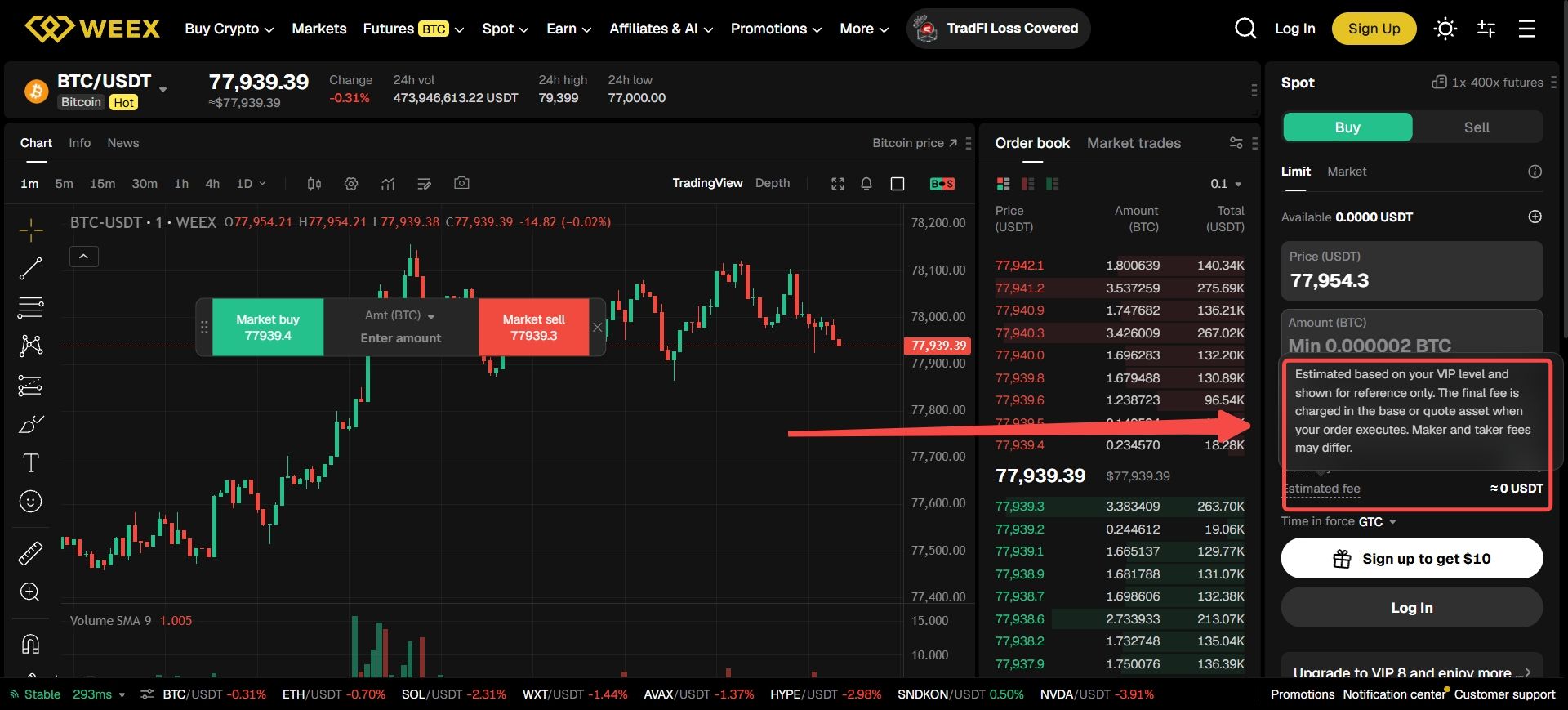
Before looking at specific numbers, it helps to understand the two categories that determine what you pay on almost every centralized exchange, including WEEX.
- Maker orders are orders that are not filled immediately and instead sit on the order book, adding liquidity to the market. A limit order placed away from the current market price is a typical example. If you specifically want your order to only ever be a maker order, WEEX lets you select "Maker Only" when placing it.
- Taker orders are orders that execute immediately against existing orders in the book, removing liquidity. Market orders are always taker orders, and Immediate-or-Cancel (IOC) and Fill-or-Kill (FOK) orders are also classified as taker orders.
Exchanges typically charge lower fees to makers because they help build market depth, while takers pay slightly more because they consume that liquidity.
WEEX Spot Trading Fees by VIP Level
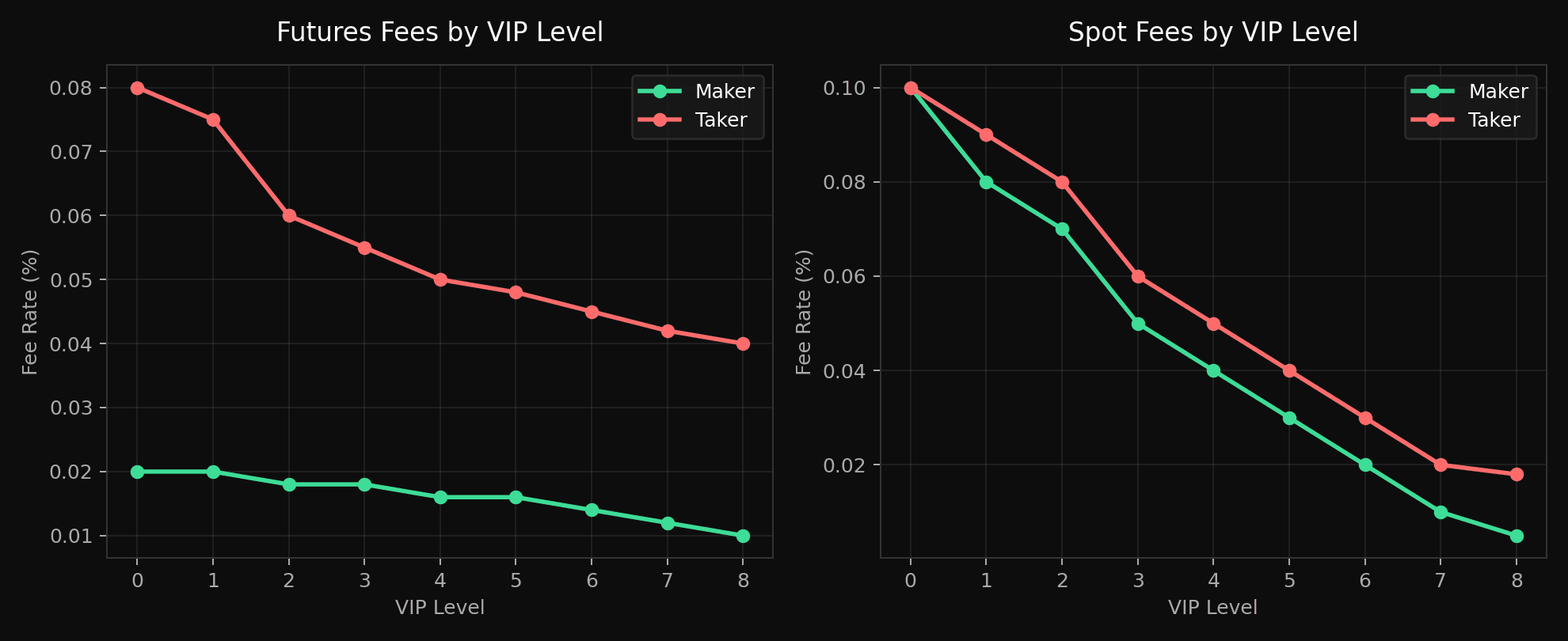
For spot trading, the base rate (VIP 0, no additional requirements) is 0.10% for both makers and takers. As your 30-day spot trading volume, WXT balance, or account asset value increase, you move up VIP tiers and both sides of the fee drop:
| VIP Level | 30d Spot Vol. (USDT) ≥ | 1d WXT Balance ≥ | 5d Asset Value (USDT) ≥ | Maker | Taker |
|---|---|---|---|---|---|
| VIP 0 | 0 | 0 | 0 | 0.100% | 0.100% |
| VIP 1 | 500,000 | 5,000 | 10,000 | 0.080% | 0.090% |
| VIP 2 | 1,000,000 | 50,000 | 30,000 | 0.070% | 0.080% |
| VIP 3 | 2,000,000 | 250,000 | 50,000 | 0.050% | 0.060% |
| VIP 4 | 5,000,000 | 500,000 | 100,000 | 0.040% | 0.050% |
| VIP 5 | 10,000,000 | 1,000,000 | 200,000 | 0.030% | 0.040% |
| VIP 6 | 25,000,000 | 1,500,000 | 300,000 | 0.020% | 0.030% |
| VIP 7 | 50,000,000 | 2,500,000 | 500,000 | 0.010% | 0.020% |
| VIP 8 | 100,000,000 | 3,500,000 | 1,000,000 | 0.005% | 0.018% |
Requirements are "meet any" — you only need to satisfy one of the three criteria (volume, WXT balance, or asset value) to qualify for a given tier. Spot fees are calculated on the value of the executed trade (price × quantity) and are deducted automatically at settlement.
WEEX Futures Trading Fees by VIP Level
Futures fees follow the same tiered logic but start from a lower base. At VIP 0, the standard futures rate is 0.02% for makers and 0.08% for takers, and both figures improve as you move up:
| VIP Level | 30d Futures Vol. (USDT) ≥ | 1d WXT Balance ≥ | 5d Asset Value (USDT) ≥ | Maker | Taker |
|---|---|---|---|---|---|
| VIP 0 | 0 | 0 | 0 | 0.020% | 0.080% |
| VIP 1 | 1,000,000 | 5,000 | 10,000 | 0.020% | 0.075% |
| VIP 2 | 5,000,000 | 50,000 | 30,000 | 0.018% | 0.060% |
| VIP 3 | 10,000,000 | 250,000 | 50,000 | 0.018% | 0.055% |
| VIP 4 | 30,000,000 | 500,000 | 100,000 | 0.016% | 0.050% |
| VIP 5 | 50,000,000 | 1,000,000 | 200,000 | 0.016% | 0.048% |
| VIP 6 | 100,000,000 | 1,500,000 | 300,000 | 0.014% | 0.045% |
| VIP 7 | 300,000,000 | 2,500,000 | 500,000 | 0.012% | 0.042% |
| VIP 8 | 500,000,000 | 3,500,000 | 1,000,000 | 0.010% | 0.040% |
According to WEEX's official fee calculation guide, a few mechanics apply regardless of VIP level:
- Fees are only charged when a position is opened, closed, or reduced. An order that never fills, or is cancelled before execution, does not incur a fee.
- Fees are deducted from your position margin, not billed separately.
- Fees are based on position value, not leverage. The formula is: Transaction fee = entry price × contract (nominal) value × quantity × maker or taker rate Because leverage doesn't factor directly into the fee calculation, a highly leveraged position and a low-leverage position of the same notional size pay the same fee.
As with spot, a GTC (Good-Till-Cancelled) order can end up being executed as either a maker or a taker trade depending on how it fills — placing a limit order doesn't automatically guarantee maker status unless you select "Maker Only."
Funding Rates: Not a Trading Fee, But Still a Cost to Understand
If you trade perpetual futures on WEEX, you'll also come across the funding rate, which is a separate mechanism from the maker/taker fee:
- Funding is settled every 8 hours, at 00:00, 08:00, and 16:00 (UTC+8).
- WEEX does not collect or profit from the funding rate — it is simply a peer-to-peer transfer between long and short position holders, based on the difference between perpetual contract prices and the underlying spot index.
- Depending on market positioning, you may either pay or receive funding. For example, when short positions significantly outweigh long positions, longs typically receive funding while shorts pay it, and vice versa.
- You can review your own funding rate charges under Assets → Contract → Bill → Funds cost in your account.
Because funding is a transfer between traders rather than a platform fee, it's worth monitoring separately from your maker/taker costs, especially if you hold perpetual futures positions across multiple funding intervals.
For more info, check our Q&A about Funding Rate.
Withdrawal Fees
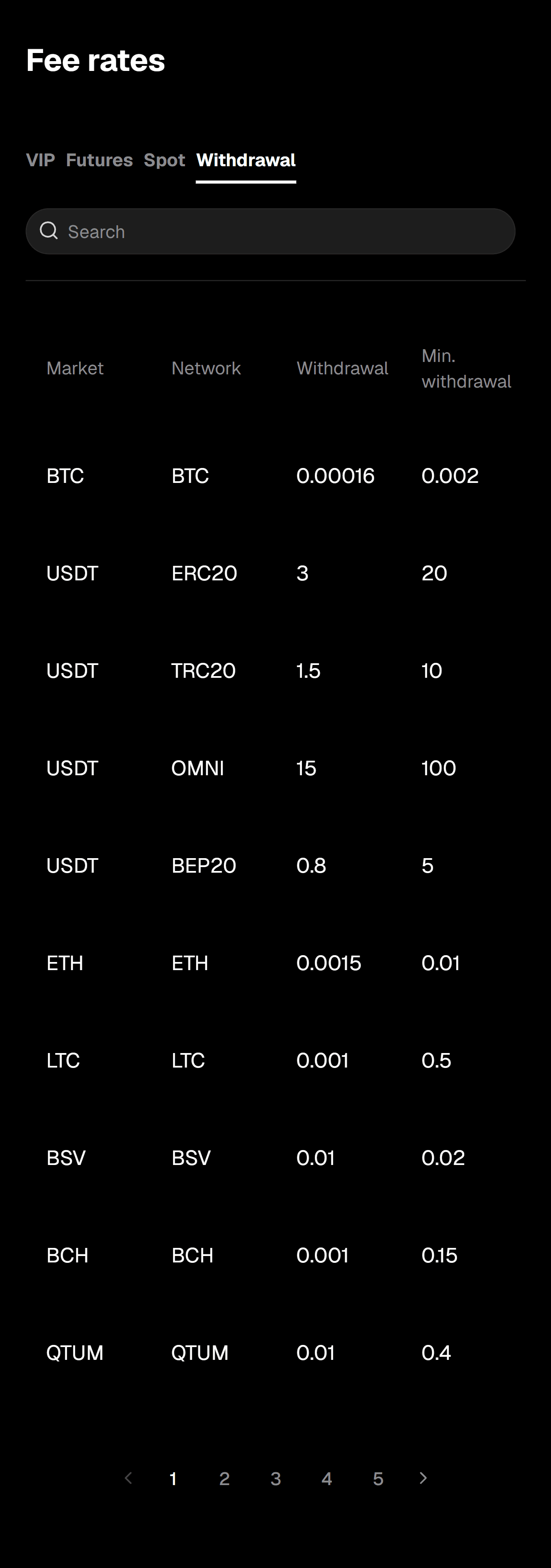
Withdrawal fees on WEEX vary by asset and network, and are separate from trading fees. A few examples from the current published schedule:
| Asset | Network | Withdrawal Fee | Min. Withdrawal |
|---|---|---|---|
| BTC | BTC | 0.00016 | 0.002 |
| USDT | ERC20 | 3 | 20 |
| USDT | TRC20 | 1.5 | 10 |
| USDT | BEP20 | 0.8 | 5 |
| USDT | OMNI | 15 | 100 |
| ETH | ETH | 0.0015 | 0.01 |
| LTC | LTC | 0.001 | 0.5 |
| BCH | BCH | 0.001 | 0.15 |
| BSV | BSV | 0.01 | 0.02 |
| QTUM | QTUM | 0.01 | 0.4 |
This is only a small sample of the full asset list — the complete, current withdrawal schedule covering all supported coins and networks is available on the Rate Standards page(link on the 1st paragraph) referenced above.
How VIP Levels and WXT Work Together
As the tables above show, WEEX's VIP tiers aren't purely volume-based — you can also qualify by holding WXT, the platform's native token, or by maintaining a certain asset value in your account. This means active traders and long-term holders both have a path to lower fees: someone who trades heavily can climb tiers through volume alone, while someone who prefers to hold WXT can reach the same discount level without needing to trade as frequently. Higher VIP tiers also come with additional perks, such as dedicated account support and VIP-only community access, published in full on the VIP Program page.
A Quick Example: Calculating a Futures Fee
Say a VIP 0 user opens a futures position with a notional value of 10,000 USDT using a limit order that fills as a maker order at the 0.02% rate:
Fee = 10,000 × 0.02% = 2 USDT
If the same position were closed with a taker (market) order at 0.08%:
Fee = 10,000 × 0.08% = 8 USDT
Opening and closing a position each triggers its own fee calculation, so a full round-trip trade involves two separate fee charges — one on entry, one on exit — plus any funding paid or received while the position is open. A VIP 6 user with the same trade would pay significantly less, since their maker/taker rates drop to 0.014%/0.045%.
Final Thoughts
WEEX's fee structure follows a familiar maker/taker model, with spot fees generally higher than futures fees, a separate funding-rate mechanism for perpetual futures, and multiple ways to reduce costs through VIP tier progression. Trading digital assets, including spot and futures products, carries significant risk, including the potential loss of your invested capital, and nothing in this article should be read as financial or investment advice — always assess your own risk tolerance and consider independent advice before trading.
For the current, live version of every table on this page — including all supported markets and the full withdrawal fee list — refer to WEEX's official Rate Standards page(link on the 1st paragraph).
To get started, you can sign up on WEEX or log in to an existing account, explore the fee breakdown for your VIP tier, and browse WEEX Learn for more guides on how spot and futures trading work. You can also read more about WEEX and its platform, or follow a step-by-step guide on how to trade if you're new to the exchange.
WEEX does not offer services to users in the United States, its territories, or certain other restricted jurisdictions. Please review the platform's Terms of Use for the current list of excluded jurisdictions and eligibility requirements before creating an account.

Gainers


