


How Does WEEX Copy Trading Work? One Article Explain Everything
Copy trading lets you automatically mirror the trades of another trader on the platform, rather than placing every order yourself. On WEEX, this works through two roles: Elite Traders, whose trading activity is made available for others to follow, and Copy Traders (sometimes called copiers), who choose to replicate that activity in their own account. This guide explains how the two sides of copy trading actually work, how profit sharing is structured, and — just as importantly — what risks are involved before you copy anyone.
Copy trading is not investment advice. Nothing about a trader's Elite status is an endorsement, recommendation, or guarantee from WEEX, and copying another trader's activity carries the same underlying market risk as trading yourself — plus a few risks specific to the copy trading mechanism itself, covered below.
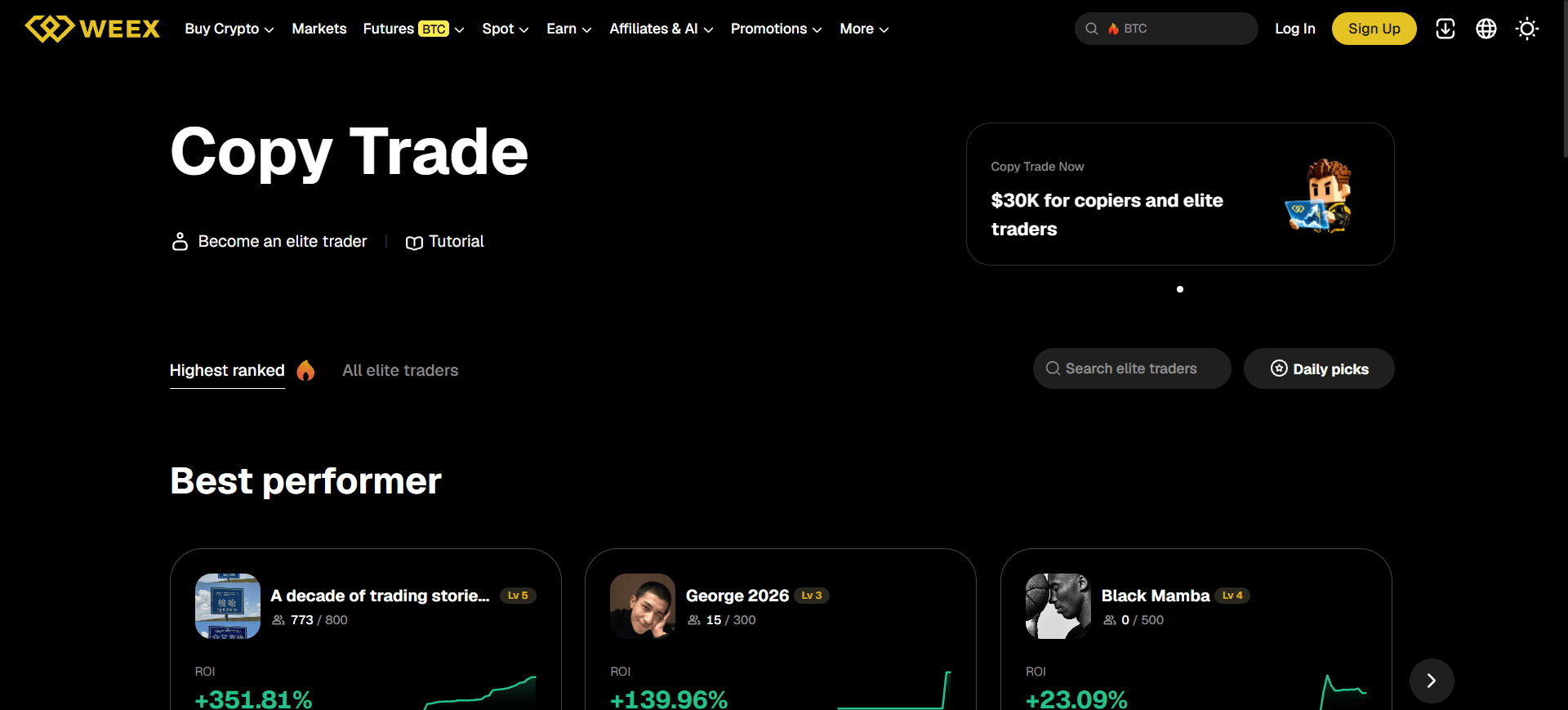
Two Roles: Elite Traders and Copy Traders
Elite Traders are users who, after meeting WEEX's eligibility criteria, make their trading activity available for others to copy. To qualify as an Elite Trader, a user must complete identity verification (KYC) and agree to WEEX's Elite Trader Code of Conduct. Elite Traders act entirely independently — they are not employees, agents, or representatives of WEEX, and WEEX does not vet, endorse, or supervise their individual trading decisions.
Copy Traders are users who select one or more Elite Traders to follow and configure their own copy trading settings. To use copy trading as a copier, you similarly need to complete identity verification and must be at least 18 years old with the legal capacity to enter into WEEX's Copy Trading Terms.
How Trader Selection Works
Selecting who to copy happens through three basic steps:
1. Select the right trader. You can browse traders through WEEX's recommendations, overall rankings, or by manually searching. What you're generally evaluating is a trader's historical performance data, trading style, and risk profile as shown on their public profile — past performance shown on the platform is historical information only and is not a guarantee of future results.
2. Set your parameters. Once you've chosen a trader to follow, you configure the trading pairs you want to copy, your leverage mode, the amount you want to allocate, and your own risk control parameters (such as a maximum position size).
3. Start copying. Once configured, your account mirrors the Elite Trader's activity on the pairs and parameters you've set, in real time.
Margin Modes for Copiers
As a copier, you can run your copy trading positions under either cross margin or isolated margin, the same two modes available in regular futures trading. To switch between the two modes, you'll need to have no open positions, no pending orders, and no trigger orders at the time of the switch — the system then creates new copy trading records under the mode you've selected. You can still close positions using "Total positions," "Flash close," or through "Active copy trades," and trigger orders for closing positions work under either margin mode.
How Profit Sharing Works
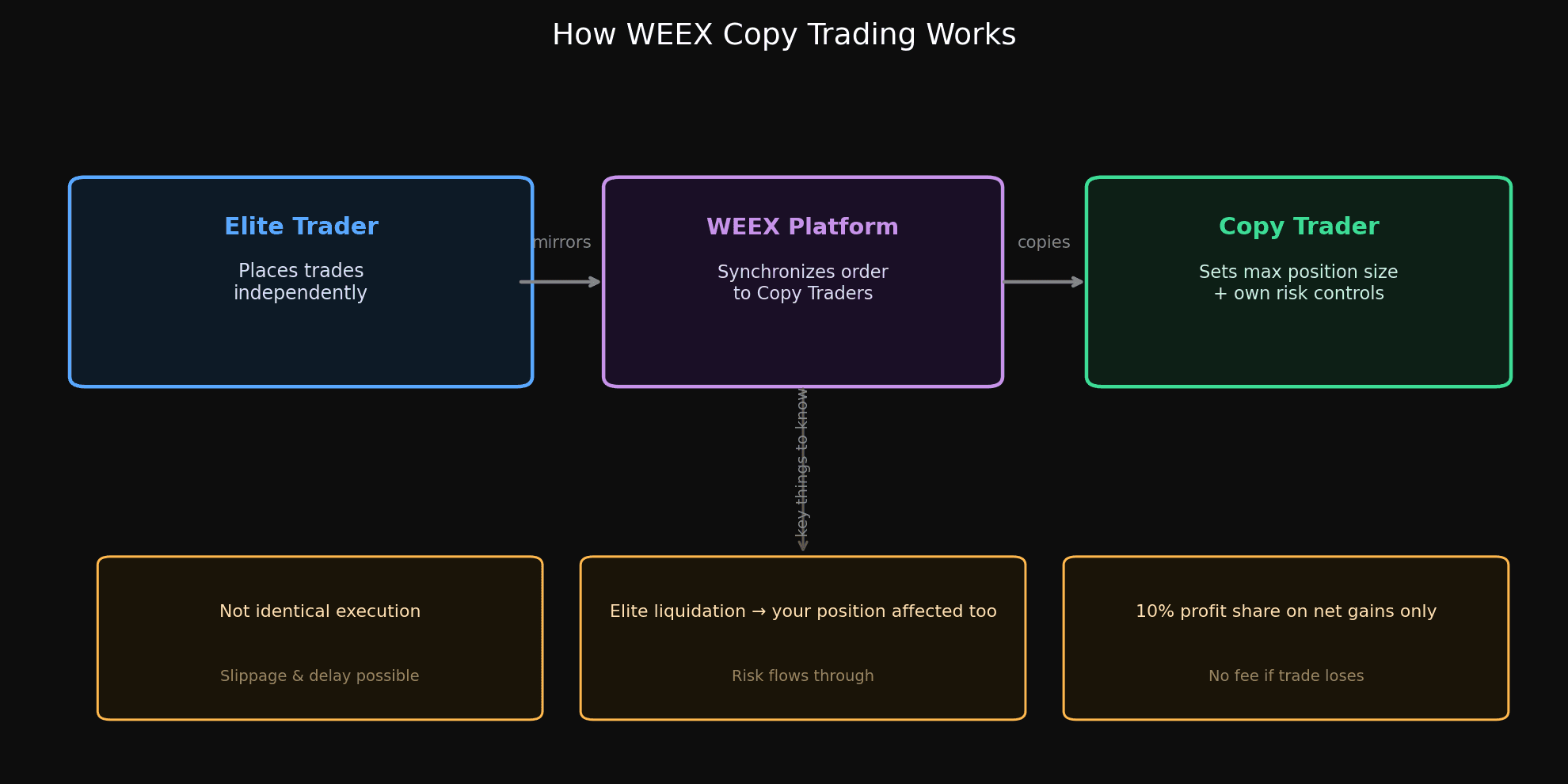
WEEX's copy trading model uses a profit-sharing structure rather than a flat subscription fee. Under WEEX's official Copy Trading Terms and Conditions, Elite Traders receive a share of their copiers' net gains — WEEX's published Elite Trader profit-sharing rate is 10% of a copier's net profit from copied trades. This share is only taken from actual profit generated by the copied trades; it isn't charged on losing trades. As a copier, this cost sits on top of the normal trading fees that apply to the underlying spot or futures trade itself.
Key Risks of Copy Trading
Copy trading carries the same market risk as trading directly, plus several risks that are specific to the copy trading mechanism:
1. Your position can be liquidated even if you didn't place the trade
If an Elite Trader repeatedly opens new positions, a copier's account can be pushed toward liquidation purely by following that activity — the Elite Trader has no visibility into a copier's account size or risk tolerance, so risk control is entirely the copier's own responsibility. WEEX's guidance for this scenario is straightforward: set a maximum position size so that copying automatically stops once that limit is reached, or allocate a deliberately limited amount of capital to the copy trading pair so your exposure is controlled by allocation rather than by reacting after the fact.
2. Copied trades may not match exactly
WEEX does not guarantee that a copied order will execute at the same price, at the same time, or with the same profit/loss outcome as the Elite Trader's original trade. Differences in market depth, price slippage, and system processing delays mean a copier's actual result can differ — sometimes materially — from what the Elite Trader experienced on the same trade.
3. An Elite Trader's liquidation affects your copied position too
If the Elite Trader you're following gets liquidated on a position, your copied position tied to that trade is directly affected as well, since your position mirrors theirs.
4. Elite status is not vetting or endorsement
WEEX does not conduct ongoing due diligence of Elite Traders' strategies, and being listed as an Elite Trader is not a claim about the legality, competence, or accuracy of that trader's approach. Copying a trader based on visible past performance is a decision you make independently — it isn't a recommendation from WEEX.
5. WEEX can suspend or adjust copy trading activity
Under its Copy Trading Terms, WEEX reserves the right to freeze, suspend, or disqualify accounts, exclude specific Elite Traders or portfolios from being copied, or cancel orders for security, legal, or risk-management reasons. This is a normal part of how the service operates and is worth being aware of if your copy trading activity is ever paused or adjusted.
A Practical Risk-Management Checklist for Copiers
- Set a maximum position size before you start copying, rather than reacting after a position grows uncomfortably large.
- Allocate a specific, limited amount to copy trading rather than your full account balance.
- Review an Elite Trader's historical data and risk profile, not just their recent returns, before choosing to follow them.
- Understand that past performance shown on the platform doesn't predict future results.
- Monitor your copied positions periodically rather than assuming the mechanism will manage risk on your behalf.
- Read the full Copy Trading Terms and Conditions before starting, since they set out WEEX's rights and your responsibilities in detail.
Final Thoughts
Copy trading gives you a way to participate in the market by following another trader's activity, but it doesn't remove the underlying risk of trading — it just relocates some of the decision-making. The profit-sharing model means Elite Traders are compensated only when copiers actually profit, but copiers still bear full responsibility for their own risk controls, including position sizing and capital allocation. Before copying anyone, it's worth reading WEEX's official Copy Trading Terms and Conditions in full, along with WEEX's guidance on managing liquidation risk from a copied trader's activity and switching between margin modes as a copier.
Trading digital assets, including through copy trading, carries significant risk and may result in the loss of your invested capital. Nothing in this article is investment advice — assess your own risk tolerance and financial situation, and seek independent advice if you're unsure.
WEEX does not offer services to users in the United States, its territories, or certain other restricted jurisdictions. Please review the Terms of Use for the current list of excluded jurisdictions and eligibility requirements before using copy trading.

Gainers


