
PEP Stock Analysis: Why PEPon Trades Above PepsiCo Shares

 Prefer us on Google


PepsiCo's stock closed near $140.42 in late August 2026, but its tokenized counterpart on WEEX was quoting $145.12 as of 31 August 2026 — a gap of about 3.3%. That is not a mispricing, and it is not a depeg. It is the mechanical result of how Ondo built the instrument. Any PEP stock analysis aimed at traders using crypto venues has to explain both halves: whether PepsiCo is actually cheap at 18.65 times earnings after a bruising year, and what the token wrapper does to the price you see on screen.
The short version: PepsiCo is genuinely cheap relative to its own history and to Coca-Cola, the turnaround is real but slow, and the tokenized route buys you access at the cost of liquidity that is thinner than most buyers assume.
PEP stock analysis: What Q2 2026 actually showed
PepsiCo reported second-quarter results on 9 July 2026. Net revenue rose 6.4% to $24.18 billion, clearing the $23.95 billion consensus. Core EPS came in at $2.20 against a $2.21 estimate — a miss by a single cent, but a miss. Organic revenue grew 2.4%.
The volume detail matters more than the headline. Global food volume rose 3% and beverages 2%, but North American beverage volume fell 4% and North American food was flat. PepsiCo's international business is carrying the company while its home market shrinks in units and holds revenue up through price.
Management affirmed full-year 2026 guidance — organic revenue up 2% to 4%, core constant-currency EPS up 4% to 6% — while signalling the EPS range would likely land at the low end. Roughly $8.9 billion goes back to shareholders this year, $7.9 billion of it in dividends.
Behind this sits Elliott Investment Management's roughly $4 billion stake and the settlement that followed. PepsiCo agreed to cut about 20% of its US product variations by early 2026, introduce lower price points on core brands, commit to core operating margin improvement starting in 2026, and pursue record productivity savings. Elliott did not get a board seat, and PepsiCo did not agree to the more radical asks — outsourcing soda distribution or divesting segments.
What matters most: SKU rationalisation is the one Elliott demand with a clear P&L path, and it is also the slowest to show up. Cutting a fifth of the US assortment depresses reported volume before it lifts margin. The −4% North American beverage number is partly the plan working, which is exactly why the market has trouble pricing it.
The stock reflects that ambivalence. PEP hit a 52-week low of $133.73 on 23 July 2026 against a 52-week high of $171.48 on 12 February, and trades at a market capitalisation near $190.69 billion. The annualised dividend of $5.92 works out to roughly 4.2% at $140.42 — high by PepsiCo's own standards. At 18.65 times earnings versus Coca-Cola's roughly 27, the discount is unmistakable; so is the reason for it, since Coca-Cola's net margin runs near 29% against PepsiCo's expected 11.2% for 2026.
Analyst targets are unusually scattered, and most articles quote whichever number suits their angle. A 22-analyst consensus sits at $156.41, with a high of $183 and a low of $124. Other compilations put the average nearer $169. Citi raised its target to $170 in 2026 with a Buy rating. A $59 spread between the high and low estimate on a consumer staple is the tell: the analyst community does not agree on whether the restructuring works.
Why PEPon trades about 3% above PEP stock
PEPon is Ondo Finance's tokenized PepsiCo share — an ERC-20 token on Ethereum at contract 0x3cE219D498D807317F840f4CB0f03FA27dd65046, backed 1:1 by real PEP shares held through Ondo's brokerage infrastructure. Eligible non-US users can mint and redeem 24 hours a day, five days a week, while the token itself transfers peer-to-peer around the clock.
The critical design choice, and the one almost nobody explains: PEPon tracks total return, not price. Holders receive the economic equivalent of reinvested dividends. The token does not pay you cash — it absorbs the dividend into its own value. That means PEPon and PEP are not supposed to print the same number, and the gap between them should widen every quarter PepsiCo pays out.
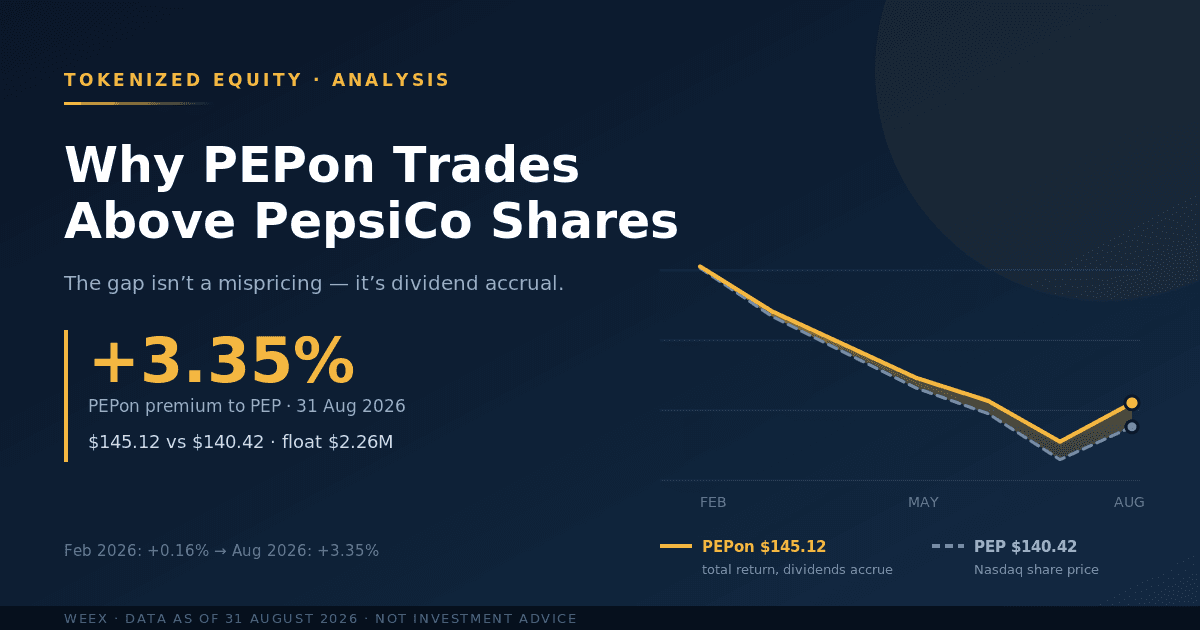
The evidence is in the two series. On 11 February 2026, PEPon set an all-time high of $171.76. PepsiCo's own 52-week high was $171.48 on 12 February. At the peak, the two instruments were 0.16% apart — effectively identical. By 31 August 2026, PEPon at $145.12 sat 3.35% above PEP at $140.42. The spread widened by roughly 3.2 percentage points in about six and a half months.
Where did that come from? PepsiCo pays $1.48 a quarter. Two quarterly dividends across that window is $2.96, or roughly 2 percentage points against a share price in the $140s. So dividend accrual explains most of the drift, and the residual — call it a little over one percentage point — is tracking friction: mint-and-redeem latency, weekend and off-hours pricing when Nasdaq is shut, and the ordinary noise of a very small on-chain market.
The practical consequence is that comparing PEPon's headline return to PEP's headline return is an error. WEEX shows PEPon up 20.71% over one year and up 5.96% over 30 days. Those are total-return figures. PepsiCo's share price is down about 3.1% year-to-date. Both are true. They measure different things, and a trader who treats the token's chart as the stock's chart will systematically overestimate how well PepsiCo has performed.
PEPon liquidity on WEEX: A $2.26M float problem
Here is the number that should shape position sizing more than any valuation ratio. As of 31 August 2026, PEPon's total market capitalisation on WEEX was $2.26 million across 15,585 tokens, on 24-hour volume of $589,490. PepsiCo the company is worth $190.69 billion. The tokenized float is roughly 0.0012% of the underlying equity.
Turnover is actually brisk — nearly 26% of the float changes hands daily — but brisk turnover on a tiny base is not depth. A $50,000 order is about 8.5% of an entire day's volume. On PepsiCo's Nasdaq listing, $50,000 is noise. On PEPon, it is a market-moving trade.
What traders usually miss: the risk in tokenized blue chips is not the blue chip. PepsiCo is a 54-year dividend raiser with $24 billion of quarterly revenue; it is not going to gap 15% overnight. The wrapper can. Thin on-chain books widen sharply when US markets are closed, which is precisely when crypto-native traders are most likely to be active. The instrument's volatility is decoupled from the issuer's fundamentals in the one direction that hurts — downward, on liquidity, at the worst hour.
On the technical picture, WEEX's own indicators as of 31 August 2026 put PEPon's 14-day RSI at 30.74, sitting just above oversold. The token trades above its 50-day simple moving average of $143.25 but below its 200-week SMA of $152.41 — short-term support holding, long-term trend still broken. That is a consolidation reading, not a reversal signal, and on a book this thin the indicators deserve less weight than they would on a liquid pair.
-- Price
Is PEPon a good way to hold PepsiCo exposure?
It depends entirely on whether you have an alternative.
If you can open a conventional brokerage account with Nasdaq access, do that. You get real shareholder status, cash dividends you control, deep liquidity, and no issuer risk sitting between you and the shares.
If you cannot — and for a large share of non-US retail traders that is the actual situation — PEPon is a functional substitute with three costs you should price in explicitly. First, you hold a claim against an issuer rather than the company; there are no voting rights and no direct shareholder standing, and in an issuer or custodian insolvency token holders may rank as unsecured creditors rather than owners of the underlying stock. Second, liquidity is thin enough that execution quality, not the entry price, will likely be your biggest cost. Third, the dividend arrives as accrual rather than cash, which suits compounding but is useless if you were buying PepsiCo for income.
The better reading for most people is that PEPon works as an access tool and a positioning instrument, not as a long-term income holding. Buying a 4.2%-yielding dividend aristocrat through a wrapper that converts the yield into price appreciation defeats the point of the trade for income investors — and income is the most defensible part of the PepsiCo case right now.
How to buy PEPon on WEEX
The route is short if you already hold stablecoins:
- Register and complete identity verification on WEEX. Tokenized equity products carry jurisdictional restrictions, so confirm eligibility for your region before funding.
- Deposit USDT, or buy it directly with card or bank transfer through the platform's fiat channel.
- Open the PEPon/USDT spot pair, which was quoting $144.65 at the time of writing.
- Use a limit order, not a market order. On $589K of daily volume, market orders on any meaningful size will walk the book. Set your price against the live PEPon quote and let it fill.
- Before sizing, check PEP's actual Nasdaq price and subtract the accrual drift — roughly 3.3% as of 31 August 2026 — so you know what you're paying relative to the real equity.
Step five is the one most guides skip, and it is the one that determines whether you bought PepsiCo at a fair price or three percent above it without noticing. WEEX also publishes a PEPon forecast page with model-driven projections, though those extrapolate the token's price series and should be read as scenarios rather than targets.
The verdict
PepsiCo at 18.65 times earnings, yielding about 4.2%, with an activist-backed restructuring underway and international volume still growing, is a reasonable value proposition for patient capital — with the honest caveat that North American beverage volume is falling and the SKU cuts will suppress reported numbers before they help margins. The $59 gap between the highest and lowest analyst target is the market telling you nobody knows how this resolves.
For traders reaching PepsiCo through PEPon, the security selection and the instrument selection are two separate decisions. Get the first one right by reading the fundamentals. Get the second right by understanding that the token's $145.12 quote is not PepsiCo's share price, that its returns include reinvested dividends, and that $2.26 million of float behaves nothing like $190 billion of Nasdaq-listed equity. Check the live PEPon price against PEP on Nasdaq before you size anything.
FAQ
1. Why is PEPon more expensive than PEP stock?
Because PEPon tracks total return rather than price. Ondo's token absorbs PepsiCo's dividends instead of paying them out, so its value drifts above the share price over time. The two were 0.16% apart at February's peak and 3.35% apart on 31 August 2026 — a spread driven mostly by two quarterly dividends of $1.48 each, plus about a percentage point of tracking friction.
2. Does holding PEPon pay me PepsiCo's 4.2% dividend?
Not in cash. You receive the economic equivalent through reinvestment, which shows up as token appreciation. If you are buying PepsiCo specifically for income, that is a meaningful mismatch with the instrument.
3. Is PepsiCo stock a buy at current levels?
Analysts are split, and the spread is unusually wide — a 22-analyst consensus of $156.41 against a high of $183 and a low of $124, with Citi at $170 and a Buy rating. The bull case is a 4.2% yield and 18.65x earnings versus Coca-Cola's 27x. The bear case is a 4% decline in North American beverage volume and a restructuring that has yet to prove out. This is information for your own decision, not a recommendation.
4. Do I get voting rights with PEPon?
No. Tokenized equity gives economic exposure without shareholder status, board participation, or voting. Your legal position is a claim against the issuer, not ownership of the underlying shares.
5. How liquid is PEPon on WEEX?
Thin in absolute terms. As of 31 August 2026, market capitalisation was $2.26 million on 24-hour volume of $589,490. Turnover relative to float is healthy, but a $50,000 order represents roughly 8.5% of a full day's volume — use limit orders and size accordingly.
6. Can I trade PEPon perpetual futures?
WEEX maintains a PEPonUSDT contract page, but as of 31 August 2026 it showed no last price and a 0.000000% funding rate, indicating no active market. Spot PEPon/USDT is the functioning venue.
Risk Warning
Tokenized equities carry the risks of both the underlying stock and the token wrapper, and the wrapper risks are the ones most buyers underestimate. PepsiCo's shares fell from $171.48 in February 2026 to $133.73 in July — a 22% drawdown in a defensive consumer staple — and the value of PEPon can fall to zero in a severe scenario, resulting in partial or total loss.
Specific risks for this instrument: liquidity risk, since $2.26 million of float and $589K of daily volume mean large orders can move the price sharply, with spreads widening most when US markets are closed; counterparty and issuer risk, because you hold a claim against Ondo and its custodian rather than PepsiCo shares, and in an insolvency token holders may be treated as unsecured creditors; smart-contract risk on the Ethereum ERC-20 contract; tracking risk, as the token's price will not match PEP's share price and the gap changes with dividend accrual and market conditions; and regulatory risk, as tokenized-securities rules remain unsettled and access is restricted by jurisdiction. Tokenized stock holders receive no voting rights or direct shareholder protections. Nothing here is investment advice — verify current prices and your own eligibility before trading.
This content is provided for general informational purposes only and doesn't constitute financial, investment, legal, or tax advice. Any events, rewards, online promotions, or related information mentioned herein should not be considered a recommendation, solicitation, or invitation to purchase, sell, trade, or otherwise deal in any crypto assets. Crypto assets are highly volatile and may result in loss. The availability of WEEX services, products, and related events may vary by region. You are responsible for ensuring that your participation is in accordance with applicable local laws and regulations.
You may also like
CRWV Stock Swings From -9.5% to +5.9%: Why CoreWeave Reversed
ETH Staking on WEEX vs On-Chain: Queues, Minimums, and Keys
Crypto Liquidation Price: How to Calculate It From 5x to 50x
PEP Earnings: PepsiCo Beats Q3, Cuts Guidance on North America
How Quant Trading Platforms and Bots Can Build With WEEX Broker
WIF and POPCAT Price Rally: Can the Solana Meme Rotation Hold?
ZEC Futures Trading: Leverage Lessons From Zcash's $1,400 Squeeze
SOL Perpetual Contracts: Mark Price, Index Price and Liquidation
Connecting a Trading Bot to WEEX API: The 12-Point Risk Checklist
How to Test a Trading Strategy on WEEX Demo Before Going Live
Palantir Stock 24/7: How PLTR Perpetual Futures Really Price
Oracle Stock Futures After Earnings: How Leverage Got Liquidated
AVAV Stock Futures: How to Trade AeroVironment With Leverage

Hunter Biden's LAPTOP Memecoin: What TRUMP's Trajectory Suggests Could Happen Next
Cathie Wood Robinhood Stock: What Her 2026 Trades Really Show
Nike S&P 100 Exit: What the Removal Means for NKE Holders

Nike Stock Price Prediction 2026: What the $50 Target Actually Requires to Happen
AAPL Under Ternus: What Apple's CEO Change Means for Traders
NVIDIA Stock: What the $108B Q3 Guide Means for NVDA Next
CRMON After Salesforce's 23% Post-Earnings Surge: The Catch

PKR to USDT Rate: How to Spot a Bad P2P Spread in Pakistan

SOXSB Explained: Why the 3x Chip Bear ETF Resets Without You
Is WMT Stock a Buy After Falling 23% From Its 52-Week High? What the $137 Analyst Target Actually Implies
XRP ETFs Have Pulled Nearly 1 Billion Tokens off the Market: Why the Price Keeps Sliding Anyway
JPMorgan Says Buy the Chip Dip but Morgan Stanley Says Sell: What the SOXL Analyst Disagreement Actually Means
Bitcoin's $2.7 Billion Short Squeeze: What Triggered the Largest Liquidation Event of August 2026

Crypto Exchange API: Permissions, Signing and Rate Limits
QQQB and the Fed: What the FOMC Minutes Mean for Nasdaq-100

SK Hynix Stock Is Down 35% in July: Is the Worst Finally Over?
CRWV Stock Swings From -9.5% to +5.9%: Why CoreWeave Reversed
ETH Staking on WEEX vs On-Chain: Queues, Minimums, and Keys
Crypto Liquidation Price: How to Calculate It From 5x to 50x
PEP Earnings: PepsiCo Beats Q3, Cuts Guidance on North America
How Quant Trading Platforms and Bots Can Build With WEEX Broker
WIF and POPCAT Price Rally: Can the Solana Meme Rotation Hold?
Contents
Popular coins
Latest articles


