
Akash’s Solana plan would end current staking rewards while allowing new AKT issuance

 Prefer us on Google



Akash's proposed Solana migration would end the inflation-funded staking rewards paid on its current chain while its draft economic framework would allow new AKT issuance for provider incentives and the treasury.
Akash is a decentralized cloud-computing marketplace. Its AKT token helps govern and secure its sovereign Cosmos chain. The proposed migration would move the token and marketplace onto Solana in separate steps, with different consequences for balances, staking income and future supply.
Proposal 346 remained in voting when checked on Nov. 2, with a deadline of Nov. 2 at 15:02:58 UTC. A successful vote would authorize the migration and token portal. It would leave the marketplace's cutover date for another proposal.
That distinction matters because a promise to exchange one old AKT for one SPL AKT preserves a balance at conversion. It does not, by itself, preserve the income attached to holding or staking that balance.
Staking income and incentive emissions
The proposal separates approval, token launch, marketplace cutover and the old chain's eventual halt. Old-chain inflation and staking rewards would end at cutover. Validator roles and income would end at halt, 90 days later.
The submitted proposal expects SPL AKT and the one-way portal to launch two to three weeks after passage, once token and portal audits are complete. The marketplace would move only after its audits and migration rehearsals pass and a separate cutover proposal is approved.
The proposal now being voted on describes a portal transaction that starts unbonding, claims rewards and queues migration after 21 days. Earlier descriptions differ: the Oct. 20 technical draft uses seven days to token launch and 14 days for unbonding, while the Oct. 26 blog says two weeks to launch and unbonding for 21 days before using the portal.
Those descriptions do not establish one settled user flow. The current proposal sets the authorization being voted on; final audited instructions would still need to reconcile the older draft and the blog.
In his Oct. 26 explanation, Greg Osuri said new staking mechanisms would be announced before cutover. That establishes a commitment to explain a replacement, rather than a published replacement yield or payout formula.
Who could receive new AKT
Akash's AEP-79 migration design makes a separate provision for replacement emissions: newly issued AKT directed to provider incentives and the community treasury. It describes reduced gross emissions as the intended direction, but leaves the numerical curve for modeling and governance.
Under the proposed design, a holder could lose the present inflation-funded staking income while new tokens continued to be issued for other purposes. Issuance to those accounts would expand the token base without automatically increasing a passive holder's balance.
The unresolved economic modeling covers the gross rate, decay, split between recipients and cumulative hard-cap amount. Those determine both how much new AKT could enter supply and how its distribution would change over time.
The token-migration draft specifies a cumulative incentive-emissions cap separate from the migration budget. Its numerical amount remains unresolved; once set from the ratified model, the cap could not be raised by governance. The schedule would remain adjustable through the DAO and a timelock within that limit, with a guardian able to pause emissions.
The draft also allows a paused start. If the model has not been ratified before the cutover supply snapshot, the token-issuance program would start with zero scheduled emissions and wait for governance activation. That is a contingency in the design, rather than a decision to end issuance permanently.
These are proposed controls over a future program. They supply no final numerical ceiling, emission rate or date on which replacement incentives would begin.
Compute credits and the supply question
Compute payments could also affect how much AKT remains available to trade. Their supply implications depend on the accounting model, and the roadmap and proposed Solana design describe different limits.
Akash's AEP-76 roadmap describes ACT as a nontransferable, dollar-denominated compute credit. Its proposed burn-mint equilibrium (BME) model links funding those credits to AKT removed from liquid circulation.
The roadmap's detailed vault model uses previously removed AKT and remint credits first. If those are insufficient to meet a payout, it describes minting a shortfall. That describes a possible issuance path within the roadmap's model; compute usage alone is not enough to establish a permanent net burn.
The proposed Solana architecture specifies a different limit: AKT supplied for ACT stays in a vault as collateral, and ACT redemption is paid from that vault. It expressly forbids the BME program from minting AKT.
The document also leaves current-chain vault payouts versus fresh minting as an implementation question. The roadmap's shortfall-minting description consequently does not establish a fresh-minting path for the proposed Solana system.
The supply effects need to be separated: tokens represented through migration, new incentive emissions, and AKT moving into and out of compute-credit collateral. A vault balance temporarily removed from trading is not the same thing as tokens permanently destroyed.
The proposed portal would remain open for two years, with migration irreversible. Its 1:1 accounting answers how eligible token balances would be represented on Solana. The future emissions curve and replacement staking terms answer different questions about holders' income and exposure to issuance.
The proposal says the emissions curve must be published before the later cutover proposal. Alongside the promised staking details and resolved compute-credit accounting, it would give holders the information needed to judge the post-migration model.
-- Price
This content is provided for general informational purposes only and doesn't constitute financial, investment, legal, or tax advice. Any events, rewards, online promotions, or related information mentioned herein should not be considered a recommendation, solicitation, or invitation to purchase, sell, trade, or otherwise deal in any crypto assets. Crypto assets are highly volatile and may result in loss. The availability of WEEX services, products, and related events may vary by region. You are responsible for ensuring that your participation is in accordance with applicable local laws and regulations.
You may also like

Strategy's Cash Burn Rate Could Lead to Depletion Within 1.5 Quarters

Dan Bin Reduces Holdings in Storage and Intel, Increases Positions in META, SpaceX, and Amazon

Hut 8 Sells Approximately 3,102 BTC Since Q3, Cashing Out About $250.2 Million to Repurchase Its Own Shares

How to Determine Loss Attribution When DeFi Issues Arise?

SemiAnalysis: Musk Breaks Through Again, How SpaceX Competes for the World's Largest AI Cloud?

Why Did Institutions Bet $40 Million on PhotonPay When Stablecoin Transfers Are Cheap Enough?

TradingBeats Launches New Version, Upgraded to Information Stream Format
The Ghost Behind the Screen: Unveiling the Secret World of North Korean Hackers Lazarus

Where Did the Liquidity Go on the Night Binance Suspended Withdrawals?

WEEX Exclusive:Major Indexes Rise After Election Clarity, Oil Plunges| WEEX Daily Market(November 5, 2026)

Cryptocurrency Exchanges Enter the U.S. Stock Derivatives Market as CFTC Approves Perpetual Futures Amid Wall Street Backlash

Major Indexes Rise After Election Clarity, Oil Plunges| WEEX Daily Market(November 5, 2026)
At the November 4 close, all three major indexes rose. Risk assets rebounded after election clarity, but AI-related stocks broadly declined. Brent and WTI oil both fell more than 9% over 24 hours. Bitcoin briefly rose above $80,000, and the crypto market warmed across the board. TRUMP token plunged. November 5 focus is earnings from Moderna, Sony, ConocoPhillips and others.

AI Infrastructure May Lose Financing Before Losing Customers

3Jane and Settle Reach $100 Million Financing Agreement

Why Banks Still Refuse to Open Accounts for Licensed Crypto Payment Projects
Nvidia stock tokens show price spreads, but slippage crushes the arbitrage

Serenity: AI Industry Chain Stocks Face Indiscriminate Sell-off, Some Storage Stocks Have a P/E Ratio of Only 1.6 Times

Over $133 Million in Suspected Stolen Funds Flow Through Crypto Platforms
The 'Election Effect' of Bitcoin: Political Catalyst or Coinciding with the Halving Cycle?

TeraWulf Signs Credit Support Agreement with Google to Advance $19 Billion Data Center Project

Gold Token 2026: Why Move Gold on Chain?
Copom Expected to Pause Selic Cuts: What Changes for Investors
Democrats Sweep Congress: 12 Key Questions Investors Are Asking

Stablecoins Move Towards Real Payments: Three Technical Advantages of TBC

Is Vitalik Buterin's Digital Minimalism Worth Having?
Suspected North Korean Hackers Transfer Approximately $1.46 Million via Jupiter Lend and Circle
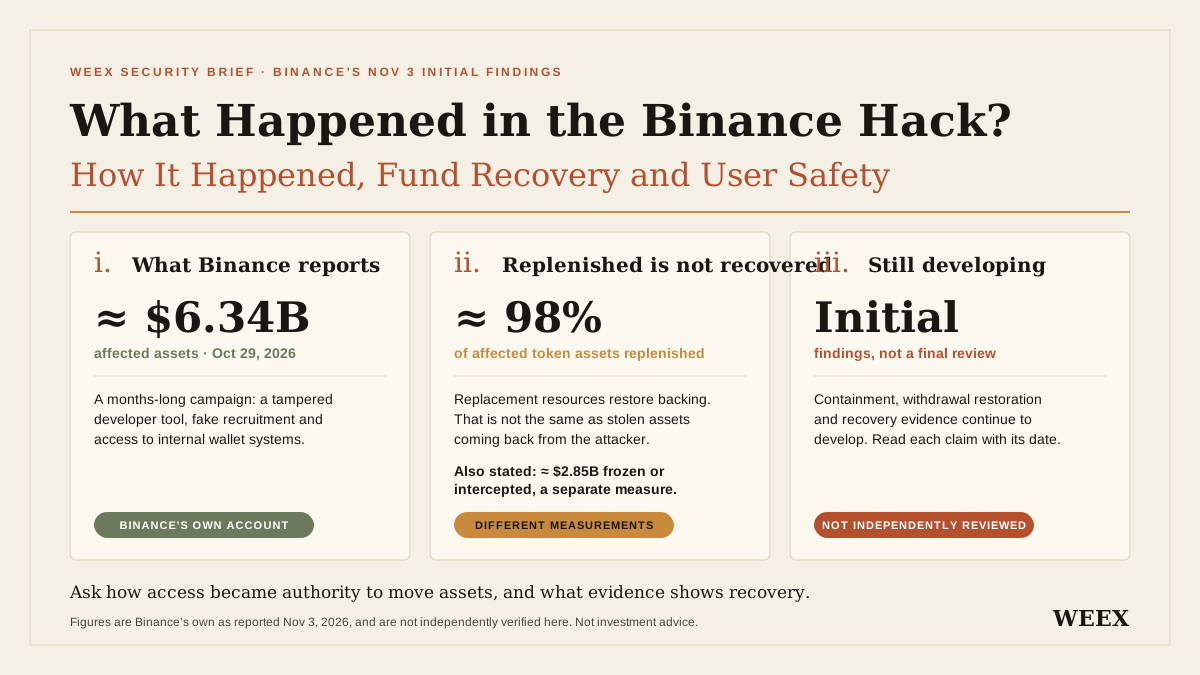
What Happened in the Binance Hack? How It Happened, Fund Recovery and User Safety
What happened in the Binance hack? Review the attack timeline, latest fund replenishment, recovery limits and practical steps to protect your account.
Bitcoin ETF Outflows Hit $398.6M on November 2 as BlackRock Leads Redemptions

Waiting for the Last Dip? Morgan Stanley's Wilson: Regardless of Election Results, It May Be a Good Opportunity to Buy U.S. Stocks
Standard Chartered Launches Continuous Tokenized Deposits in Hong Kong
Strategy's Cash Burn Rate Could Lead to Depletion Within 1.5 Quarters
Dan Bin Reduces Holdings in Storage and Intel, Increases Positions in META, SpaceX, and Amazon
Hut 8 Sells Approximately 3,102 BTC Since Q3, Cashing Out About $250.2 Million to Repurchase Its Own Shares
How to Determine Loss Attribution When DeFi Issues Arise?
SemiAnalysis: Musk Breaks Through Again, How SpaceX Competes for the World's Largest AI Cloud?
Why Did Institutions Bet $40 Million on PhotonPay When Stablecoin Transfers Are Cheap Enough?


