
Circle and ACI Bring USDC Settlement Into Latin American Payment Operations

 Prefer us on Google


TL;DR: ACI Worldwide and Circle announced a collaboration on October 27 to demonstrate how USDC settlement can fit into payment systems that banks already operate. The announcement reinforces an important shift in the stablecoin story: issuance alone is insufficient if enterprises cannot access tokens from the software they already use.
ACI Worldwide and Circle announced a collaboration on October 27 to demonstrate how USDC settlement can fit into payment systems that banks already operate. Their pilot in Colombia uses ACI Connetic, the payments company's cloud-native orchestration platform, alongside Circle's infrastructure. The emphasis is on connecting a dollar stablecoin with established account-to-account and institutional payment processes. The parties described a demonstration and collaboration, not a continent-wide production rollout or a guarantee that all transactions will shift to USDC.
The event and the market response
Payments orchestration software connects instructions, processing routes and settlement services. Adding a stablecoin as one settlement option could help institutions evaluate faster cross-border movement or extended operating hours without replacing every other part of their banking stack. ACI positions Connetic as a platform that can accommodate cards, traditional bank payments and digital assets in one environment. Circle supplies infrastructure for USDC, which aims to maintain a dollar value. The experiment therefore focuses as much on operational integration as on the blockchain transfer itself.
Why the development matters to the crypto market
The announcement reinforces an important shift in the stablecoin story: issuance alone is insufficient if enterprises cannot access tokens from the software they already use. ACI's platform may help USDC move from crypto venues into bank payment operations, but that depends on institutions adopting the workflows and on recipients receiving usable funds. For markets, this is a gradual infrastructure development, not a direct forecast for any cryptocurrency. Track actual corridor usage rather than extrapolating from the size of Latin America's payments industry.
Settlement networks have different strengths, from established bank accounts to cards and digital tokens. A multi-rail approach can be sensible if software chooses the appropriate method for each obligation while preserving controls and consistent reporting. But offering more rails also adds complexity to pricing, liquidity and risk management. Business customers will not adopt a new option merely because it is technically interesting. They need dependable cost, transparent foreign-exchange treatment and accurate delivery times. That is the benchmark for judging payments announcements.
A cross-border payment has at least two meanings of speed: how quickly value moves between institutions, and how quickly the recipient can spend it. Stablecoin settlement can improve the first without necessarily solving the second. Real-world payouts require local networks, liquidity, compliance screening and customer support. The strongest payment partnerships join those pieces rather than attempting to replace everything with one blockchain. Readers should look for end-to-end performance data and distinguish existing network size from transaction volume that actually uses a newly announced digital rail.
What the headline does not establish
A successful pilot must still confront local regulation, the treatment of dollar balances, liquidity provision and how financial institutions reconcile stablecoin settlement with their books. An onchain transfer that completes quickly is only one stage of a bank payment. Currency conversion, compliance checks, beneficiary access and final accounting can still introduce delay or cost. ACI and Circle have not presented comprehensive live-market data proving savings across Latin America. The confirmed development is a practical test of whether old and new rails can work together.
-- Price
What to watch next
Look for pilot performance results, additional bank participants and clarity about which payment corridors move into production. A real-world expansion should be measured by settled transaction value and operational outcomes, not announcement count.
Primary source: Official statement / source documentation.
written by the News Desk and edited by Samuel Rae.
This content is provided for general informational purposes only and doesn't constitute financial, investment, legal, or tax advice. Any events, rewards, online promotions, or related information mentioned herein should not be considered a recommendation, solicitation, or invitation to purchase, sell, trade, or otherwise deal in any crypto assets. Crypto assets are highly volatile and may result in loss. The availability of WEEX services, products, and related events may vary by region. You are responsible for ensuring that your participation is in accordance with applicable local laws and regulations.
You may also like

Gold Token 2026: Why Move Gold on Chain?

Economy: The People's Bank of China Tightens Currency Rules to Calm the Yuan

Trust Wallet user reports losing funds without approving transaction

HashKey Uses Standard Chartered's Digital Deposits for Money Movement

Has Wall Street Broken the Mechanism That Made Bitcoin Soar?
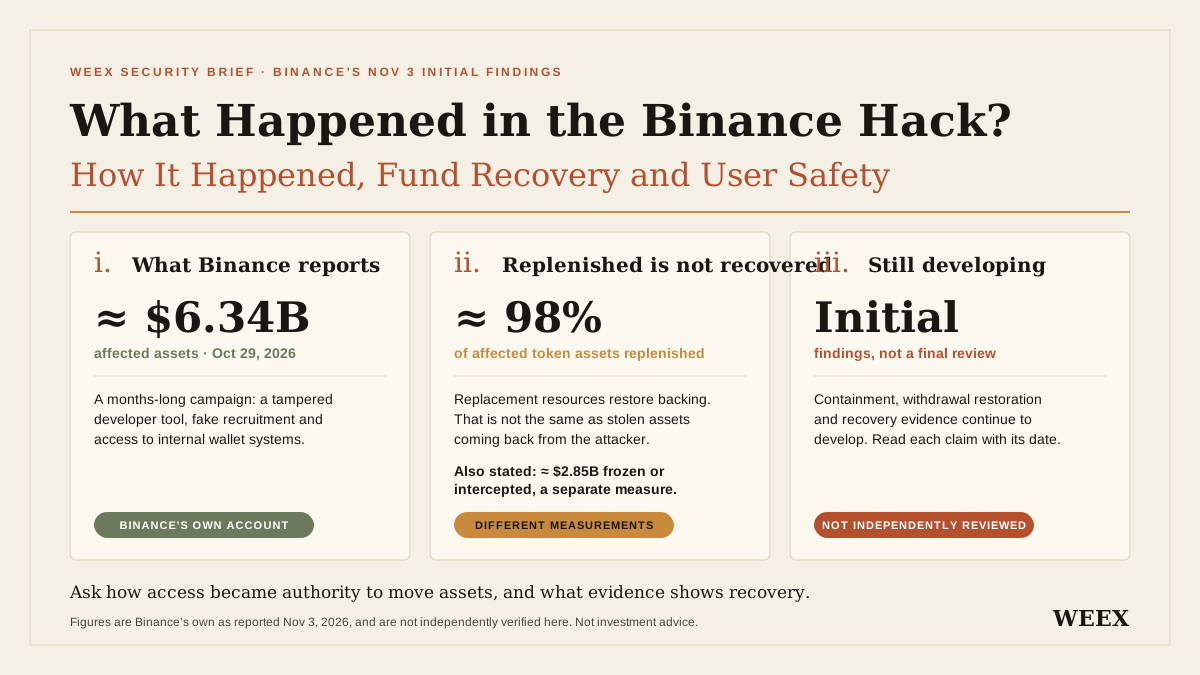
What Happened in the Binance Hack? How It Happened, Fund Recovery and User Safety
What happened in the Binance hack? Review the attack timeline, latest fund replenishment, recovery limits and practical steps to protect your account.
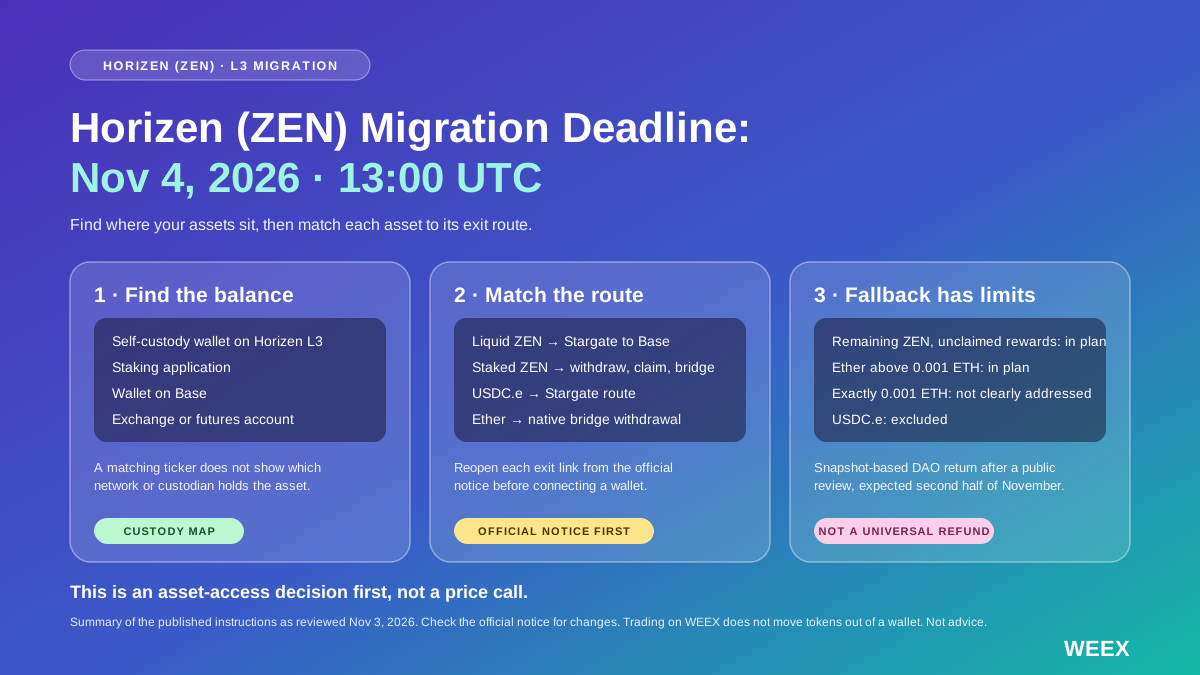
Horizen (ZEN) Migration Deadline: What to Move Before November 4 and What Happens If You Miss It
Horizen (ZEN) migration closes November 4. Check asset-specific bridge routes, wallet requirements, recovery exclusions and what to do if you miss it.

Bitcoin’s year-end liquidity hopes face a projected $150 billion Treasury cash rebuild

DMG Says Client Assets Are Secure and Highlights Layered Transaction Controls
Solana study finds wider spreads outside aggregators at five of six sampled pools

Crypto: Gate Freezes Two Accounts Linked to Binance Hack
BlackRock’s Ethereum fund sheds 580K ETH as monthly exits mount
How T7X Is Building the Infrastructure for a New Era of Capital Markets

The End of the Seasonality Myth. Why September and October Surprised Investors?
Hong Kong plans stablecoin trials for tokenized government debt

Ownership of Bitcoin in the Qian Zhimin Case and Victim Compensation
Polygon expands US banking access to Solana's 15 billion stablecoin market

Sui Puts Enforced Spending Limits at the Center of Its AI-Agent Design

Apple Reclaims Top Market Cap as Silver Nears $50: WEEX TradFi Market Brief
Vitalik's Latest Thoughts: We Need a Digital Minimalism Movement
RLUSD supply fell 29% on XRPL. One XRP trading pool barely changed

Mercado Bitcoin Plans Sui Asset Access in Brazil With Lending and Tokenization Links
Bitcoin Volatility Calendar: Which Events Really Shake the Market?

The decline of gold could signal further tensions, according to Peter Schiff

Bitcoin Turns 18; Will Satoshi's Legacy Stand the Test of Time?

Polygon Completes Coinme Acquisition to Expand Regulated Fiat Payment Rails
The Need for Institutionalization of Market Makers Between Liquidity Provision and Price Manipulation
Chainlink Launches CustodySync With Anchorage to Link Custody and DeFi Loans

CDI was the only refuge in October: what this reveals
Lagarde to leave ECB with Europe’s tokenized-finance blueprint still undecided
Gold Token 2026: Why Move Gold on Chain?
Economy: The People's Bank of China Tightens Currency Rules to Calm the Yuan
Trust Wallet user reports losing funds without approving transaction
HashKey Uses Standard Chartered's Digital Deposits for Money Movement
Has Wall Street Broken the Mechanism That Made Bitcoin Soar?
What Happened in the Binance Hack? How It Happened, Fund Recovery and User Safety
What happened in the Binance hack? Review the attack timeline, latest fund replenishment, recovery limits and practical steps to protect your account.




