
Fixed-Rate Lending Unused? It's the Existing Products That Can't Solve Mismatched Terms

 Prefer us on Google


Fixed rates lock in prices, while early repayment terms determine actual costs.
Written by: Stephen
Fixed rates determine the financing price in the contract, while early repayment terms decide whether this certainty can extend to shorter borrowing periods. If loans only allow repayment at face value or exit at market prices, borrowers cannot automatically obtain an alternative settlement method under the contract, which is to pay interest only for the actual time funds are used and settle the loan.
For borrowers financing LP positions, arbitrage strategies, or short-term market opportunities, the window of potentially profitable strategies may be far shorter than the loan's maturity. Another mismatch occurs when interest rate environments change. Borrowers lock in financing at high rates, and even if cheaper funding opportunities arise during that period, they must first bear the costs of exiting existing financing.
This creates a counterintuitive demand structure for fixed-rate financing. Leverage demand is often strongest when rates are highest, making locking in financing for the entire term least attractive; conversely, when it is suitable to lock in rates, borrowing demand tends to be weaker. The product is most attractive when there is the least demand.
In this structure, the economic consequences of mismatched terms are still borne by the borrower: the term may be too long for the strategy or too long for the interest rate environment.
The Cost of Early Exit Depends on the Repayment Method
When repaying at face value, the amount due does not automatically decrease as the actual borrowing time shortens. Suppose a borrower receives 100,000 USDC and needs to repay 100,600 USDC after 30 days. Ignoring fees and slippage, the financing cost is 600 USDC. If the strategy ends on day 7, the borrower still needs to pay the full 100,600 USDC upon direct repayment. According to the same simple interest calculation, the interest for 7 days is only 140 USDC, and the remaining 460 USDC is the cost of financing for the unused 23 days.
Another way is to buy the corresponding units in the market to offset the debt. Market repurchases can reduce this cost and may even be more cost-effective than paying interest only for the actual borrowing time at the original rate. However, the outcome depends on the price and liquidity at the time of exit, which cannot be determined at the time the loan is initiated.
Under otherwise identical conditions, a decline in market yields will increase the value of the remaining fixed-rate debt, making repurchases more expensive; an increase in yields may have the opposite effect. Borrowers wishing to refinance at lower rates may find the costs of exiting existing financing increasing. The original contract rate remains unchanged; what changes is the exit cost.
More Pools ≠ Aggregated Liquidity
If the market is divided by loan assets, acceptable collateral, risk parameters, and maturity dates, time itself becomes a boundary between markets. Allowing one market to accept multiple collateral assets can reduce some fragmentation.
Standardizing maturity dates can concentrate trading activity, but when borrowers' needs fall outside these dates, they still bear the burden of term differences. Increasing maturity dates expands the optional range but also increases the number of independent debts, each of which requires pricing and executable liquidity.
Multi-market quotes can alleviate some burdens. Shared funding budgets allow the same capital to support multiple quotes without needing to pre-allocate to each market; providing funds at execution can enhance capital efficiency. A rebalancing mechanism can also support atomic extensions between different terms, but extensions still require executable financing conditions on the other end.
These mechanisms are often referred to as “aggregation.” However, each additional market, maturity date, or set of collateral further divides the same supply of funds and order flow into smaller pools, which are then reconnected by the quoting layer.
To measure aggregation, one must see how much existing liquidity a borrowing demand can actually reach. If the market can only match counterparties with identical assets, amounts, and maturity dates, then no matter how many markets participate in quoting, it remains structurally fragmented.
If a market can only match counterparties with “the same asset, the same amount, and the same maturity date,” then regardless of how many different venues quote to this market, it is still structurally fragmented.
This boundary exists because debts inherently carry terms. If there is no longer a requirement for terms to match, allowing loans of any term to serve a shorter-term financing need means that the same pool of funds can reach previously unmatched demands without first slicing liquidity by maturity date.
Liquidity aggregation can reduce the cost of servicing multiple markets but cannot solve the borrower's term mismatch. Matching more existing liquidity and increasing more quoting venues are two different issues.
Cost Ceiling: Making Previously Unquantifiable Demand Measurable
Under floating rates, the cost of funds is essentially a random variable. For strategies with bounded returns, whether arbitrage, basis trading, market making, or financing a known cash flow, it is challenging to pre-calculate financing costs without a clear ceiling. When the strategy itself has a narrow profit margin, the rational outcome may be not to borrow at all.
Without early repayment rights that charge interest based on actual borrowing time, fixed rates only provide known full-term costs. Borrowers still find it difficult to judge in advance whether the strategy's spread can cover the actual costs of ending financing early. The low activity level in the fixed-rate market may not necessarily mean there is no demand; it may also be that product terms exclude some demand.
Clear early repayment rights allow borrowers to settle interest based on actual borrowing time according to pre-agreed rules, while the loan itself still has a fixed rate and a clear maturity date. Thus, the interest cost of funds has a ceiling, at most paying interest at the fixed rate for the actual time used; if cheaper financing is obtained during this period, costs may also decrease. With this ceiling, strategies with bounded returns can be pre-calculated, and borrowers can assess whether financing is appropriate before entering into transactions.
Constant Finance is currently testing its lending design on the testnet, which revolves around this point: fixed terms, early repayment based on actual borrowing time, and built-in refinancing mechanisms. The goal is to clarify the method of interest calculation before borrowers enter positions. As for whether alternative financing can be obtained, it still depends on the available funds and the financing conditions acceptable to the borrower at that time.
-- Price
Core Comparison: Total Financing Cost During Actual Borrowing Period
This flexibility does not come without cost.
Early repayment means lenders lose future interest income while also bearing reinvestment risk, especially when market interest rates have already fallen. Therefore, lenders need to price this early repayment right, which in Constant Finance manifests as higher quoted interest rates.
Whether this flexibility is worth it should ultimately be assessed based on the total financing cost borne by the borrower during the actual use of funds, rather than merely comparing quoted rates.
Thus, the truly meaningful competitive standard is the complete financing outcome, including the initiation of financing, actual use period, and final settlement.
Fixed rates solve an important uncertainty in financing costs. However, under the repayment structure discussed in this article, borrowers still bear the consequences of term mismatches: paying the full face value amount or exiting at market prices.
Infrastructure can become more sophisticated, but it will not eliminate this limitation. When predictable contractual obligations come at the expense of financing terms that match actual demand, for such borrowers, a lending market remains incomplete.
This content is provided for general informational purposes only and doesn't constitute financial, investment, legal, or tax advice. Any events, rewards, online promotions, or related information mentioned herein should not be considered a recommendation, solicitation, or invitation to purchase, sell, trade, or otherwise deal in any crypto assets. Crypto assets are highly volatile and may result in loss. The availability of WEEX services, products, and related events may vary by region. You are responsible for ensuring that your participation is in accordance with applicable local laws and regulations.
You may also like

Pago Móvil Reaches 63% of Transactions in Venezuela, Competing with USDT

Analysts Bullish on MicroStrategy, Target Price Raised to $240

Bank of America Report Shows $39 Billion Inflow into US Stocks in One Week, Strategists Prefer Risk Aversion

MSCI New Rules Implemented, 14 Crypto Companies Enter Potential Impact List

What Do the New Tesla Roadster Specs Mean for Tesla (TSLA) Stock?
Explore the new Tesla Roadster specs, reservation payments and 2028 production plan, plus what the reveal could mean for Tesla stock and future profits.

Quant (QNT) Price Prediction 2026–2030: Can Bank Adoption Drive a Return to $500?

Spout raises $2M to offer 0% interest loans on Solana

RWA Weekly: Ant Group and HSBC Test Agent Tokenized Payments; Robinhood Explores Tokenized Actively Managed ETFs

BlackRock CEO Larry Fink Flags a Different AI Risk, and It Isn’t the Bubble

Shanghai Supports International Data Center Construction to Facilitate Cross-Border Data Flow

Shanghai Advances National Blockchain Network Construction, Strengthens Cross-Chain Service Capabilities

When Will AI Investments Pay Off? JPMorgan Optimistic About Google and Amazon

What is being said at the tables: the BCRA turns on the dollar vacuum and the city counts the bullets in Javier Milei's bazooka

New Developments in the Blue Sky Ge Rui Case: Bitcoin Rises 200 Times, Can Victims Only Be Compensated at Original Price?
Bitcoin inflows to US set to turn positive in 2026, Chainalysis says
iGaming Tokens Need Real Revenue, Not Just Hype
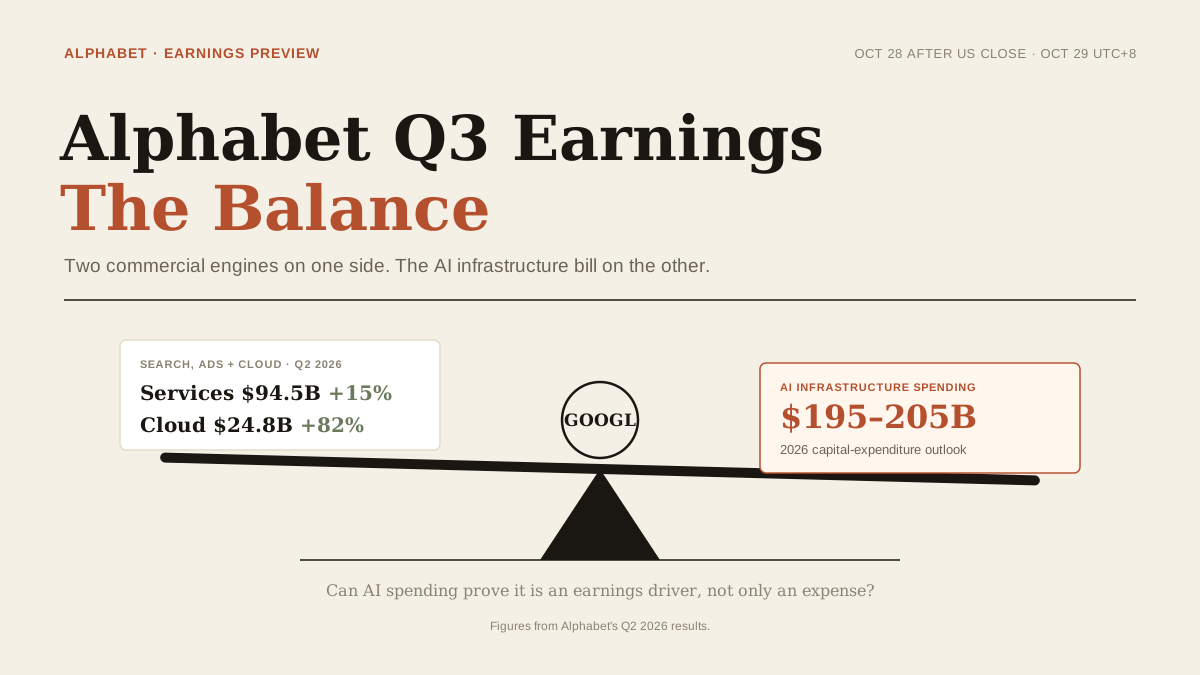
Google Stock Before Alphabet Earnings: Can AI Spending and Search Growth Support GOOGL?
Alphabet reports Q3 2026 results on October 28. See the Search, Google Cloud, AI spending, and guidance signals shaping GOOGL stock.
Fractional Reserve: Reserve Requirement Abolished. Where is the Value?

Anthropic's Revenue Rises to $16.8 Billion Ahead of IPO

‘Is Korea Facing a Second IMF Crisis? The Solution Lies in XRP?’... The Leap of the Crisis Theory by BeInCrypto

ICO, VC Tokens, and Alpha Models: Why They Can't Save the Current Crypto Market?

One Order Book for Dollars and Stablecoins. How It Works

Cyberattack on the ports of Marseille and La Rochelle? Hackers paid 1 dollar in crypto
![[Exclusive] Coinbase Transaction Data Shows 100 Million Trades Misrepresented... Data Analysis Firm Corrects Errors](/public-static/20_9098579959.png?format=avif)
[Exclusive] Coinbase Transaction Data Shows 100 Million Trades Misrepresented... Data Analysis Firm Corrects Errors

Wall Street Morning Report: U.S. Inflation Resurfaces, AI Credit Risks Spread, Chip Stocks Fall for Six Consecutive Days
Arthur Hayes: Focus on Established DeFi Projects with Cash Flow
Anthropic Reports $16.8 Billion Revenue in Q3, IPO Feasibility Strengthened

Hot CPI Lifts Hike Bets; Risk Assets Pull Back | WEEX TradFi Daily(October 15, 2026)
Major indexes closed lower on October 14, with the Nasdaq leading the decline. September unadjusted CPI rose to 3.7% year on year, above forecasts, and core CPI also beat expectations. Traders sharply raised this month’s hike probability to about 43.7% and fully priced two more hikes by the end of January. Chip stocks were sold again. Bitcoin broke below $83,000 and last traded near $81,700, while spot gold and silver fell. Crypto-related stocks were under pressure, but PYTH rose against the tape. October 15 brings PPI, retail sales and key
WEEX Exclusive:Hot CPI Lifts Hike Bets; Risk Assets Pull Back | WEEX TradFi Daily(October 15, 2026)

Sam Price Observes Changes in Bitcoin ETF Net Inflows
Pago Móvil Reaches 63% of Transactions in Venezuela, Competing with USDT
Analysts Bullish on MicroStrategy, Target Price Raised to $240
Bank of America Report Shows $39 Billion Inflow into US Stocks in One Week, Strategists Prefer Risk Aversion
MSCI New Rules Implemented, 14 Crypto Companies Enter Potential Impact List
What Do the New Tesla Roadster Specs Mean for Tesla (TSLA) Stock?
Explore the new Tesla Roadster specs, reservation payments and 2028 production plan, plus what the reveal could mean for Tesla stock and future profits.
Quant (QNT) Price Prediction 2026–2030: Can Bank Adoption Drive a Return to $500?


