
Galaxy’s AI data centers bring $79 million in lease revenue and a small net loss

 Prefer us on Google



Galaxy Digital's first full quarter of AI data-center lease operations generated $69 million in adjusted EBITDA, but its Data Centers segment still posted a $435,000 net loss. The company's Oct. 27 results put a number on both the new earnings stream and the financing burden accompanying its expansion.
For a business still exposed to digital-asset and investment swings, the operating contribution is substantial. Galaxy's much larger group recovery came primarily through Treasury & Corporate.
The quarter ended Sept. 30 was the first with a full period of revenue-generating operations under the Helios I, Phase I lease to CoreWeave. All 133 megawatts of critical IT load had been delivered by the end of Q2. Data-center leasing revenue reached $79 million.
In CryptoSlate's August coverage, approximately $80 million of quarterly lease revenue was still guidance. Q3 supplies the first full-quarter results, alongside the costs determining how much reaches the bottom line.
What reaches Galaxy's bottom line
Adjusted EBITDA strips out financing expenses and several accounting items, making it useful for examining operating performance. It does not measure free cash flow or the final profit available after those costs.
Galaxy's Data Centers reconciliation shows why the distinction matters. Starting with the segment's net loss, the company makes the following adjustments to reach adjusted EBITDA:
| Q3 2026 Data Centers reconciliation | USD |
|---|---|
| Net loss | -435,000 |
| Add equity based compensation and related expense | +785,000 |
| Add notes interest and other expense | +75,439,000 |
| Subtract tax benefit | -24,000 |
| Add depreciation and amortization expense | +17,325,000 |
| Other adjustment | -24,344,000 |
| Adjusted EBITDA | 68,746,000 |
The largest adjustment is the $75 million labeled "notes interest and other expense." That is an accounting adjustment, not a disclosed cash-interest payment. Depreciation and the equity awards themselves are noncash accounting items.
The negative $24 million Other adjustment also matters. Galaxy's footnote groups non-operating income and expenses with discrete items outside ongoing operating performance, without isolating the underlying Data Centers components. The segment loss therefore cannot be explained by subtracting interest alone from the headline EBITDA figure.
Galaxy reported $323 million in consolidated Q3 net income. Treasury & Corporate produced $348 million, while Digital Assets lost $25 million and Data Centers lost $435,000.
The adjusted figures tell a similar story. Treasury & Corporate generated $395 million of the group's $455 million adjusted EBITDA. Data Centers contributed $69 million, and the Digital Assets operating segment recorded negative $9 million.
In Q2, Treasury & Corporate had posted negative $78 million of adjusted EBITDA. Data Centers earned $11 million, and Digital Assets recorded negative $11 million. The comparison places the largest swing in Treasury & Corporate, even as full-quarter leasing materially increased the data-center contribution.
That distinction matters because Treasury & Corporate carries Galaxy's digital-asset and investment exposure. Its positions span spot holdings, derivatives, ETFs, equities and private investments. Net digital assets and investments reached a rounded $1,700 million at Q3's end, against $1,200 million at Q2.
AI income adds a different source of earnings. The scale of the treasury result and the remaining investment exposure show why a strong group quarter cannot yet be read as proof of protection from crypto volatility.
Expansion adds construction and tenant exposure
The operating 133 MW lease sits alongside a much larger construction program. Galaxy reported $757 million of Data Centers capital expenditure in Q3 and said Helios I, Phase II was fully financed and under construction. Initial data-hall deliveries are scheduled for Q2 2027.
The July 23 financing announcement priced $3,507 million of 9.875% senior secured notes through Galaxy Helios Data Centers II LLC, an indirect wholly owned subsidiary. October's results subsequently reported completion of the offering.
The intended proceeds finance part of two buildings containing eight data halls, with 400 MW of utility capacity and 260 MW of critical IT capacity, plus debt-service reserves. Those figures describe later capacity, separate from the 133 MW already delivered.
As CryptoSlate's July financing analysis explained, the debt introduces obligations before the expansion's operating contribution arrives. Cash interest is payable semiannually beginning Feb. 1, 2027. Principal amortization is set at 4% of original principal annually, subject to adjustment, with the first installment at least ten months after project completion. The notes mature Aug. 1, 2031.
Galaxy Helios II LLC, the issuer's direct subsidiary, guarantees the notes. First-priority liens cover substantially all issuer and guarantor assets, subject to exclusions, and all issuer equity held by its direct parent. The pricing disclosure names those project entities as obligors and does not identify Galaxy Digital Inc. as the note guarantor.
Because existing operations and expansion are at different stages, the combined segment result leaves Phase I's standalone economics unresolved.
CoreWeave's growth supports the commercial case for the campus, while its balance sheet remains relevant to the durability of Galaxy's lease income.
The tenant's Q2 results reported $2,575 million in revenue, a $626 million net loss and $640 million of net interest expense. Its June 30 balance sheet also reported $25,170 million of noncurrent recourse debt and $2,385 million of noncurrent non-recourse debt.
CoreWeave reported approximately $104 billion of revenue backlog at June 30. Its definition includes remaining performance obligations and other estimated future revenue under committed contracts, conditional on delivery and service availability.
Its Sept. 17 update reiterated more than $25 billion of net new commitments added early in Q3 and excluded from that June backlog. It also described three-to-six-month compute contracts priced at approximately $40 million per MW, calculated as annualized revenue divided by the power required for the clusters. That is CoreWeave compute pricing, not Galaxy's rental yield.
For Galaxy, the next tests are whether lease income can lift segment net profit after financing costs and whether Phase II begins deliveries on the stated Q2 2027 schedule.
-- Price
This content is provided for general informational purposes only and doesn't constitute financial, investment, legal, or tax advice. Any events, rewards, online promotions, or related information mentioned herein should not be considered a recommendation, solicitation, or invitation to purchase, sell, trade, or otherwise deal in any crypto assets. Crypto assets are highly volatile and may result in loss. The availability of WEEX services, products, and related events may vary by region. You are responsible for ensuring that your participation is in accordance with applicable local laws and regulations.
You may also like

The Ghost Behind the Screen: Unveiling the Secret World of North Korean Hackers Lazarus

Where Did the Liquidity Go on the Night Binance Suspended Withdrawals?

WEEX Exclusive:Major Indexes Rise After Election Clarity, Oil Plunges| WEEX Daily Market(November 5, 2026)

Cryptocurrency Exchanges Enter the U.S. Stock Derivatives Market as CFTC Approves Perpetual Futures Amid Wall Street Backlash

Major Indexes Rise After Election Clarity, Oil Plunges| WEEX Daily Market(November 5, 2026)
At the November 4 close, all three major indexes rose. Risk assets rebounded after election clarity, but AI-related stocks broadly declined. Brent and WTI oil both fell more than 9% over 24 hours. Bitcoin briefly rose above $80,000, and the crypto market warmed across the board. TRUMP token plunged. November 5 focus is earnings from Moderna, Sony, ConocoPhillips and others.

AI Infrastructure May Lose Financing Before Losing Customers

3Jane and Settle Reach $100 Million Financing Agreement

Why Banks Still Refuse to Open Accounts for Licensed Crypto Payment Projects

Nvidia stock tokens show price spreads, but slippage crushes the arbitrage

Serenity: AI Industry Chain Stocks Face Indiscriminate Sell-off, Some Storage Stocks Have a P/E Ratio of Only 1.6 Times

Over $133 Million in Suspected Stolen Funds Flow Through Crypto Platforms

The 'Election Effect' of Bitcoin: Political Catalyst or Coinciding with the Halving Cycle?

TeraWulf Signs Credit Support Agreement with Google to Advance $19 Billion Data Center Project

Gold Token 2026: Why Move Gold on Chain?
Copom Expected to Pause Selic Cuts: What Changes for Investors
Democrats Sweep Congress: 12 Key Questions Investors Are Asking

Stablecoins Move Towards Real Payments: Three Technical Advantages of TBC

Is Vitalik Buterin's Digital Minimalism Worth Having?
Suspected North Korean Hackers Transfer Approximately $1.46 Million via Jupiter Lend and Circle
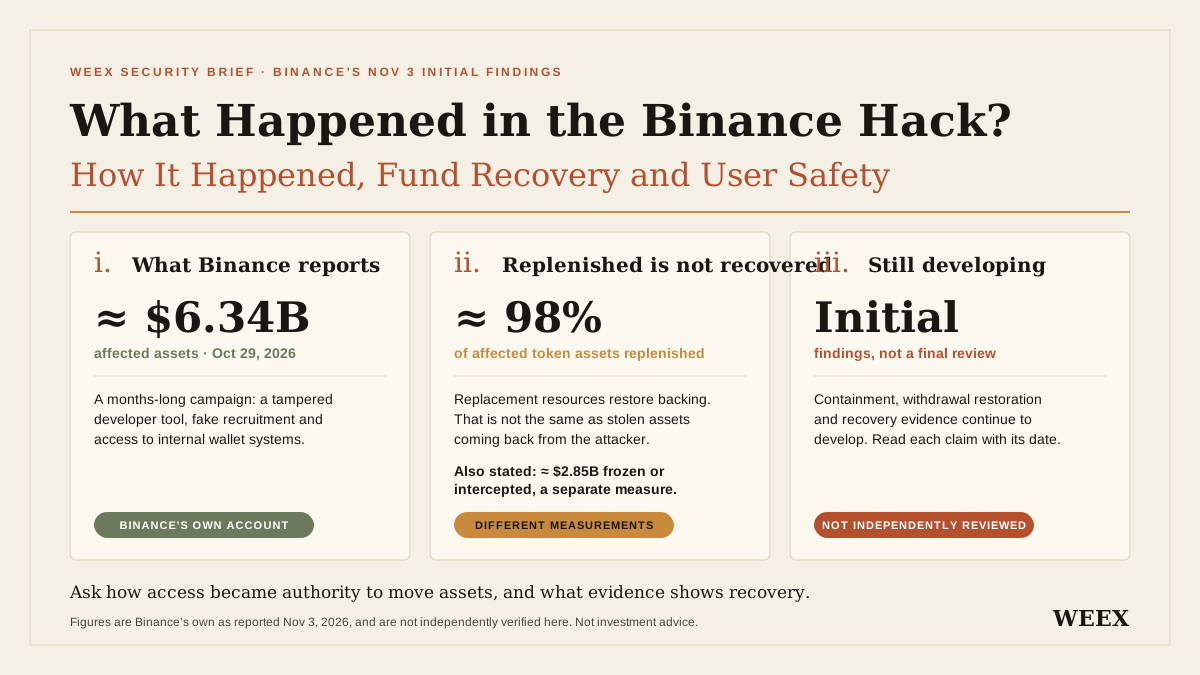
What Happened in the Binance Hack? How It Happened, Fund Recovery and User Safety
What happened in the Binance hack? Review the attack timeline, latest fund replenishment, recovery limits and practical steps to protect your account.

Bitcoin ETF Outflows Hit $398.6M on November 2 as BlackRock Leads Redemptions

Waiting for the Last Dip? Morgan Stanley's Wilson: Regardless of Election Results, It May Be a Good Opportunity to Buy U.S. Stocks
Standard Chartered Launches Continuous Tokenized Deposits in Hong Kong

Judy Shelton and Monetary Policy Point to a Less Dominant Future for the Fed

Bitcoin’s year-end liquidity hopes face a projected $150 billion Treasury cash rebuild

ICE Partners with Hyperliquid, Traditional Exchanges' Moat is Shifting
Dollar stablecoin use stayed elevated after capital controls ended, new research suggests

The "Election Effect" of Bitcoin: Political Catalyst or Coinciding with the Halving Cycle?

CoreWeave's Capital Flywheel Comes to a Halt

Solana study finds wider spreads outside aggregators at five of six sampled pools
The Ghost Behind the Screen: Unveiling the Secret World of North Korean Hackers Lazarus
Where Did the Liquidity Go on the Night Binance Suspended Withdrawals?
WEEX Exclusive:Major Indexes Rise After Election Clarity, Oil Plunges| WEEX Daily Market(November 5, 2026)
Cryptocurrency Exchanges Enter the U.S. Stock Derivatives Market as CFTC Approves Perpetual Futures Amid Wall Street Backlash
Major Indexes Rise After Election Clarity, Oil Plunges| WEEX Daily Market(November 5, 2026)
At the November 4 close, all three major indexes rose. Risk assets rebounded after election clarity, but AI-related stocks broadly declined. Brent and WTI oil both fell more than 9% over 24 hours. Bitcoin briefly rose above $80,000, and the crypto market warmed across the board. TRUMP token plunged. November 5 focus is earnings from Moderna, Sony, ConocoPhillips and others.
AI Infrastructure May Lose Financing Before Losing Customers
Contents
Latest articles





Latest coin listings on WEEX


