
House Oversight Chair Comer Probes Delaware Plan for AI-Run Companies

 Prefer us on Google


House Oversight Committee Chairman James Comer (R-KY) is investigating Delaware's effort to create a new kind of corporate entity run by an artificial intelligence agent, the committee said on Monday.
In a letter to Delaware Gov. Matt Meyer, Comer raised concerns about the proposed Artificial Intelligence Company, or AIC, which would give the person or entity behind it protection from liability for harms caused by the AI agent running it.
🚨 Delaware wants to let AI agents run companies while shielding their owners from liability when the AI causes harm.
Chairman @RepJamesComer is seeking documents, including internal AI chat logs, from Gov. Meyer to find out who's behind the plan. https://t.co/tPzK0qFC4C
--- Oversight Committee (@GOPoversight) October 26, 2026
"We are concerned that Delaware's AIC proposal could be used to protect powerful AI companies and their investors from responsibility for reckless harmful actions, while also protecting non-transparent forces seeking anticompetitive regulatory capture behind state AI initiatives," Comer wrote.
The letter questions the role of private-sector contributors to the proposal. It notes that a December 2025 report by Delaware's AI Commission made no mention of efforts to assess safety risks or consult independent experts, and that the Secretary of State's office declined to tell reporters about its working relationship with an AI company involved in the project.
Comer asked Meyer to hand over all documents and communications about the AIC's development since January 2025, including "internal AI chat logs," along with agreements with outside contributors, records on safety concerns and all drafts of the proposal, by November 9. The committee said the information could inform federal legislation, including proposals to limit state AI regulatory initiatives.
Myriad: How high will NVDA go? Click to make your prediction.
Delaware's AI company plan
Delaware Secretary of State Charuni Patibanda-Sanchez and John Nay, CEO of legal AI firm Norm Ai, unveiled the proposal in a Fortune op-ed in July, describing a public-private partnership led by Norm Ai.
An AIC would be able to sue and be sued, hold property and take on obligations at its AI agent's direction. It would have a single member responsible for keeping it adequately capitalized, and that member would be shielded from its debts unless it failed to capitalize the company or used it to commit fraud or a willful violation of law. AICs would operate only within a 30-month regulatory sandbox overseen by a committee of state officials and outside experts, would have to disclose their status to counterparties, and would be barred from banking.
AI Lawyers Are Already Better Than Law Professors at Reasoning---Say Law Professors
The proposal aims to "wrap AI in legal form," the authors wrote, arguing that a recognizable legal identity would make an autonomous system's conduct "visible, traceable, and accountable."
Some legal scholars have questioned that reasoning. "There's really no overarching regulatory plan here for dealing with the fallout that AI-governed companies could bring," Christopher Bruner, a business law professor at the University of Georgia, told WHYY in September.
Patibanda-Sanchez has rejected the idea that the plan is a liability shield. "We're not trying to shield liability. We're trying to define where exactly liability lands when there's some type of malfeasance or psychopathic behavior," she told Bloomberg Law in July.
Meyer has also defended the effort. "It is coming, and the solution is not ignoring it," he said on a WHYY call-in show in September. State lawmakers are expected to consider draft legislation when they return in January.
-- Price
This content is provided for general informational purposes only and doesn't constitute financial, investment, legal, or tax advice. Any events, rewards, online promotions, or related information mentioned herein should not be considered a recommendation, solicitation, or invitation to purchase, sell, trade, or otherwise deal in any crypto assets. Crypto assets are highly volatile and may result in loss. The availability of WEEX services, products, and related events may vary by region. You are responsible for ensuring that your participation is in accordance with applicable local laws and regulations.
You may also like

Tools for Withdrawing Virtual Assets Found on Hacked Servers of Seven Domestic Financial Institutions

Dubai: Six suspects arrested after a crypto scam exceeding 600,000 euros

New Cryptocurrency Regulations in Ukraine: What Will Change for Asset Owners

Kobe Beef Authorized Store Proves Authenticity with NFC and Blockchain Technology
2026 U.S. Midterm Elections Held Today, Early Voting Shows Democrats Leading

Bank of Korea Conducts Cryptocurrency Risk Survey of 31 Financial Institutions, Including Possible Exchange Suspension

Jesús de Miguel memecoins draw backlash after striker’s death
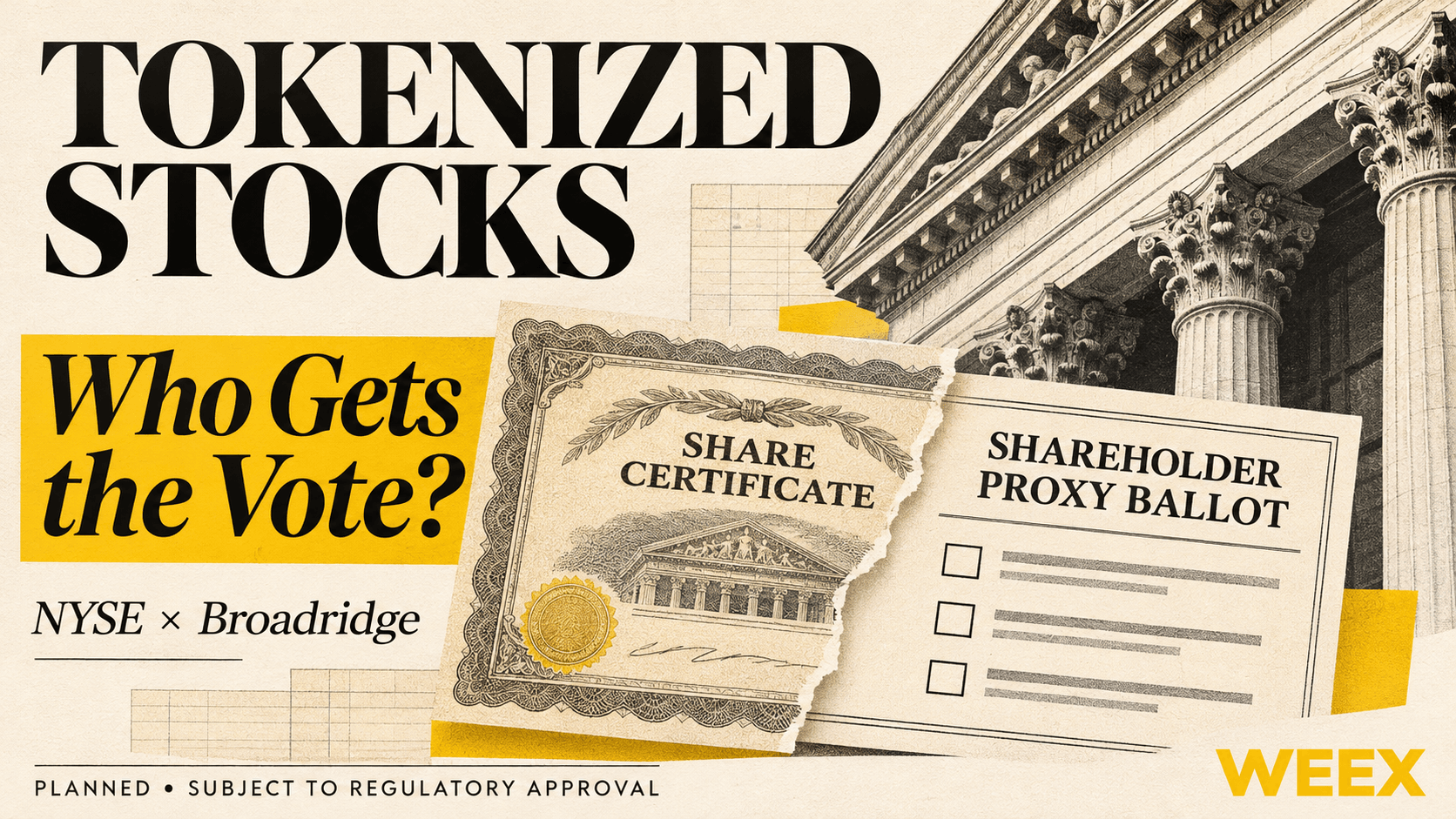
Will NYSE Tokenized Stocks Have Voting Rights? What the Broadridge Plan Means for Investors
Will NYSE tokenized stocks have voting rights? Understand Broadridge’s plan, shareholder eligibility, record dates and how stock futures differ.

$8.6 Billion in Cryptocurrency Held by Ukrainians: How It Affects the Hryvnia Exchange Rate and the Economy

Declaration and Documentation Preparation for Virtual Asset Income of Individuals in Mainland China

"No Private Key Leaked" Is the Most Dangerous Placebo: How to Choose Truly Reliable Crypto Products?

WEEX Shopping Fest 2026: Daily Egg Rewards, Trading Tasks and Event Guide

Financial Supervisory Service Chief Orders Comprehensive Inspection of External Contacts Related to Financial Sector Hacking Incident

From a Gold Bar to AI Agents: What Did Hong Kong FinTech Week Deliver?

WalletConnect Adds Stellar Payments as Bermuda Ticketing Rollout Targets 2027

Horizen Holders Face November 4 Bridge Cutoff Before L3 Wind-Down

Mandatory Monthly Reporting for Bitcoin Exchanges in Argentina Takes Effect

Anchorpoint Plans Native HKDAP on Solana as Hong Kong Dollar Access Expands

XRP Ledger to Activate a Fix Addressing Permission Delegation Vulnerability

FATF to Review Jurisdictions of Crypto Activities, Preliminary Results to be Released in June 2027

"Taxation of Virtual Assets Requires System Overhaul and Increase in Basic Deduction"

Midterm Elections: GENIUS Act to Take Effect in January 2027... Approval and Oversight Post-Election May Be Variables

Supreme Prosecutor's Office Investigates Two Cases of Personal Information Related to Virtual Currency Settlements, Involving Over 9.4 Million Yuan
Bitcoin Core 32.1 Arrives With Privacy Fixes and New Compatibility Checks

Are Crypto Assets Tax-Free While Consumption Tax Increases? Businesses Affected by the '5% Inclusion'

Bank of Korea Investigates Financial Institutions' Virtual Asset Market Situation
HTX Ends UK Activity as FCA Secures Court Undertakings on Crypto Promotions
Regulated, Approved or Registered Crypto Funds: What Each Status Really Guarantees

Launch of AI Technology Overseas Registration, Business Verification and Preparation for Enterprises

Cardano reviews quantum security, stablecoin rules in latest CIP update
Tools for Withdrawing Virtual Assets Found on Hacked Servers of Seven Domestic Financial Institutions
Dubai: Six suspects arrested after a crypto scam exceeding 600,000 euros
New Cryptocurrency Regulations in Ukraine: What Will Change for Asset Owners
Kobe Beef Authorized Store Proves Authenticity with NFC and Blockchain Technology
2026 U.S. Midterm Elections Held Today, Early Voting Shows Democrats Leading
Bank of Korea Conducts Cryptocurrency Risk Survey of 31 Financial Institutions, Including Possible Exchange Suspension


