
Masayoshi Son is borrowing money again, betting billions on OpenAI

 Prefer us on Google


Author: Beating
Masayoshi Son is borrowing money again.
This time it’s $10 billion, plus €1 billion, all to buy OpenAI.
On September 21, Reuters uncovered SoftBank's latest bond issuance documents. Citigroup and JPMorgan are sitting side by side in the underwriting section, aiming to sell this batch of high-risk notes in the public market. SoftBank's main credit rating still sits at BB+, a more respectable term for high-yield bonds, which is essentially junk bonds.
The bond issuance timeline is tight, with the interest rate to be finalized on September 24, funds to be credited on the 29th, and then on October 1, this money must be transferred intact to OpenAI's account. This is the third installment of the agreed investment.
Over a hundred billion dollars will pass through SoftBank's accounts, but can only stay for two days.
A tech visionary who claims to see thirty years into the future is calculating his cash flow by the day.
He used to take his time with big deals. In 1999, he invested $20 million when he met Jack Ma. At that time, everyone thought he was crazy, but he was using his own idle money, and the outcome was his to bear; he could afford to wait a full fifteen years.
Back then, time was his ally.
Now, it’s all reversed. The grand narrative of changing the world remains on the surface, but underneath, he is racing against the calendar before every repayment deadline.
Chips Locked in the Drawer
On February 27, SoftBank signed the final agreement with OpenAI.
A total of $30 billion in additional investment was split into three phases, each exactly $10 billion, due on April 1, July 1, and October 1. Once the final payment is made, SoftBank's total investment in this company will reach $64.6 billion, equating to about 13% equity.
$64.6 billion is double the amount SoftBank spent to acquire Arm in 2016.
In this round, OpenAI's pre-investment valuation soared to $730 billion, far surpassing SoftBank Group's own market value. The phased payments are a result of compromise; OpenAI secured its funding for the next half year, while SoftBank carved out some breathing room for itself.
But the cost is that every three months, SoftBank must raise another $10 billion among financial institutions.
What drove Masayoshi Son to make this decision was a roadshow document addressed to top-tier investors.
The document shows that OpenAI expects revenues of $36 billion in 2026, swelling to $350 billion by 2030, accumulating $840 billion over five years. The massive financing of $122 billion finalized in March pushed its valuation to $852 billion. Its competitor, Anthropic, is planning to go public, and Son is keenly watching the rapidly expanding valuation, convinced he has secured a critical seat in the era of superintelligence.
But behind this document lies an abyss of deficits.
The same document predicts that between 2026 and 2030, OpenAI will accumulate a negative free cash flow of $278 billion. Just the expenses for computing power and data center infrastructure will consume $856 billion, with a single expenditure exceeding the total estimated revenue for the five years.
Every step of technological iteration bleeds billions.
This is why it needs Masayoshi Son. A company with grand ambitions but continuous losses urgently requires a buyer willing to underwrite its debts with the entire conglomerate's credit.
The assets SoftBank receives, however, are currently stagnant.
The agreement clearly states that all subscriptions are for preferred shares, which cannot be converted into freely tradable shares until after the public listing. There are almost no institutions willing to take on hundreds of billions of dollars in off-market transactions. The $64.6 billion holding certificate, before the actual listing, is just a stack of papers locked in a safe.
Masayoshi Son is no stranger to waiting.
In 1995, he bet on Yahoo, with paper profits once exceeding 300 times, briefly placing him on the throne of the world's richest; his $20 million investment in Alibaba lay dormant for over a decade before the ringing of the New York Stock Exchange bell.
These two fame-making battles shaped his faith in major trends, but also made him overlook a premise: back then, whether it was Yahoo or Alibaba, the money at stake was his own.
His idle money can afford to be spent; the worst outcome is merely a loss and exit. As long as he doesn’t leave the table, there’s always a chance for a miracle to happen.
In the official announcement on February 27, he spoke without hesitation:
"AI is changing the world at an unprecedented speed. OpenAI is the clear leader, with world-class technology and an unparalleled global user base, and we are confident in its continued growth."
He articulated why he was optimistic but said nothing about the source of the funds.
The grand vision belongs to the era, but the cost of fulfilling it is written in another contract full of borrowing terms.
$40 Billion Floating Bridge
On March 27, SoftBank signed an unsecured bridge loan totaling $40 billion.
Led by JPMorgan, Goldman Sachs, Mizuho, Sumitomo Mitsui, and Mitsubishi UFJ, a syndicate of over twenty international banks followed. The entire loan was not secured by any physical assets, with a term of only one year, maturing on March 25, 2027.
Wall Street allowed this massive exposure based solely on SoftBank's corporate credit and the Arm asset at the bottom of its balance sheet. In the credit market, bridge loans are temporary tools designed to fill gaps until long-term funding is in place.
But SoftBank withdrew the funds rapidly.
On April 1, it withdrew $10 billion for the first installment, and on July 1, another $10 billion for the second installment. SoftBank also withdrew an additional $10 billion in April as liquidity reserves. In no time, $30 billion of the $40 billion limit was drawn.
More subtly, in September.
On September 9, SoftBank announced it would repay $25.9 billion of the outstanding balance early on September 15. This loan was not fully settled, with about $4.1 billion still on the books; as for the source of the funds to fill this gap of over $20 billion, the official announcement said nothing.
The swap was not a hasty move. As early as the initial investment announcement on February 27, SoftBank had stated that the funds would first be covered by the bridge loan, followed by the use of existing assets and long-term financing for replacement.
At the end of August, the market heard that Mizuho Bank was leading a two-year loan of $10 billion, with a spread of about 275 basis points, directly to take over the bridge loan. CFO Yoshimitsu Goto stated in a conference call that SoftBank had no reason to wait until close to maturity to make arrangements; the replacement would only be advanced.
What SoftBank is doing is replacing one-year short-term debt with public bonds that have terms of three and a half to seven and a half years.
The only goal is to push back the repayment deadline.
Masayoshi Son is subscribing to cutting-edge equity that may take ten years or more to realize, but the funds he has to pay the bills are rigid debts due in a year.
This is his forte, using massive funds to suppress probabilities and create miracles. He once compared his investment style to using a large net for fishing rather than rod and line.
But even a large net can miss.
The Vision Fund's $11 billion investment in WeWork ultimately led to liquidation, and in the 2023 fiscal year, SoftBank lost over $32 billion. Even at a heavy cost, the consumption ultimately comes from its own capital and fund shares, with no creditor pressure from outside.
A Fuse Hanging on Valuation
What truly welds the long-term technological vision with the immediate cash pressure is the loan signed on August 5.
This deal had been in the works behind the scenes since spring. SoftBank's initial goal was to borrow $10 billion, but the investors were very cautious. Pricing equity for a company that is not yet public and whose business model is not yet closed-loop is extremely difficult to assess. Negotiations stalled, and the loan amount was forced down to $6 billion.
It wasn’t until July, when Masayoshi Son personally increased the stake, deciding that SoftBank Group would provide full corporate guarantees, that the syndicate finally relented and pushed the limit back to $10 billion.
The deal was officially signed on August 5. The borrowing entity is SVF II TSUBAKI (DE) LLC, a wholly-owned subsidiary of the Vision Fund II, registered in Delaware, with a two-year term maturing in August 2028. The leading syndicate includes Goldman Sachs, JPMorgan, Mizuho Securities, Apollo, and Sumitomo Mitsui.
The spread reported during the negotiation phase was as high as 425 basis points, which is 150 basis points more expensive than ordinary loans used to take over the bridge loan. This is the risk premium Wall Street charges for illiquid private equity. The contract specifies that the funds are not for direct investment but for general corporate purposes of SoftBank Group and the Vision Fund II, used for daily liquidity turnover.
When external reports on this transaction, most habitually summarize it as SoftBank pledging OpenAI stock to borrow $10 billion.
But the financial reports record a completely different structure. The legal collateral under the agreement has always been just a cash guarantee account in the borrower's name, and OpenAI's shares have never been actually pledged.
That equity locked in the drawer serves as a taut cursor in the entire structure. The contract clearly states that if the fair value of the OpenAI preferred shares referenced in the agreement significantly declines, it will trigger cash guarantee drawdown clauses and mandatory early repayment terms.
The stock has not been handed over to the bank, but the stock's price tag has been set as a target.
As long as the valuation shrinks, creditors have the right to demand SoftBank quickly gather real cash to fill the guarantee account or directly recover the principal and interest of the loan. And at that point, the preferred shares locked at the bottom of the box still have no legal cash-out channel; the stock hasn’t been handed over, but the valuation has become a trigger that the bank can pull at any time.
Extremely dangerous.
When the internet bubble burst in 2000, SoftBank's stock price fell by 90%. After that, Masayoshi Son also borrowed money from banks by pledging SoftBank stock, but he pledged stocks under his personal name, and the losses only affected his personal accounts, not the group.
This time is completely different. No stocks have been pledged out, but SoftBank's stock price is being used by the bank as a measure of whether this loan is secure. In the past, stock price drops were merely numbers shrinking on the balance sheet; now, if the stock price drops too much, it will directly force SoftBank to cough up cash.
This is even clearer when compared to another margin loan using Arm stock. That loan was non-recourse to the group; if the bank lost, it could only seek Arm stock; whereas for this OpenAI loan, SBG is the guarantor, and Goto's words in the conference call were "there is recourse to SBG"; when calculating LTV (loan-to-value ratio), this debt is fully counted as SoftBank Group's debt, with no adjustments.
In other words, borrowing $10 billion this time, the bank wants the entire balance sheet of SoftBank Group as a backstop.
Goto stated in the conference call that he believes the safety cushion is "more than enough." But the contract terms do not follow feelings; if the stock price drops below the agreed level, SoftBank must either add collateral or repay early.
The more troublesome issue is that liquidity will be locked on the spot. When it comes time to add collateral, SoftBank must transfer real cash into the guarantee account, and this money will be instantly frozen, unable to be used for new investments or to pay off other debts.
Waiting Costs Money
If the stock price drops and collateral needs to be added, that’s a problem that arises only when something goes wrong. The more routine cost is interest; as long as this money remains on the books, interest accumulates every quarter.
From April to June 2026, SoftBank Group, along with its financing subsidiaries, had interest expenses reaching ¥281.65 billion, an increase of ¥147.3 billion compared to the same period last year. At an exchange rate of 150, that’s about $1.88 billion.
The $11.5 billion Arm margin loan borrowed in December 2025, the $20 billion bridge loan drawn in April 2026, and the rising balance of corporate bonds, combined with rising global interest rates, have stacked several massive new debts together, causing interest to jump a level.
SoftBank originally hoped that OpenAI would go public soon, allowing equity to be liquidated and this rigid debt to be covered.
But Sam Altman said in September to Fortune that due to concerns about AI safety, now is an "inopportune time" to go public.
The phrase "inopportune time" translates to real cash for SoftBank.
The bridge loan is due in March 2027, while the valuation-linked loan is due in August 2028. Just having the $10 billion debt hang for another year, at an 8% interest rate, translates to $800 million in interest.
What’s more challenging is that OpenAI itself cannot stop.
With a cumulative cash flow deficit of $278 billion over five years, that averages over $55 billion per year. OpenAI's burn rate requires continuous rounds of financing to sustain.
SoftBank is the one putting in the most money; whether it can recoup its investment hinges entirely on whether OpenAI can reach the public listing stage. If OpenAI runs out of funds in the next round, everything SoftBank has invested will be worth zero.
So it has no choice but to help; it must pay interest on the money already borrowed while also organizing the next round of funding to keep its investment alive until the listing.
The Trump Card
With so much debt, why is Wall Street still willing to lend him hundreds of billions?
The answer is Arm.
This chip architecture design company, headquartered in Cambridge, UK, almost monopolizes 99% of the global smartphone processor architecture. In 2016, Masayoshi Son privatized it by raising $32 billion in cash through a massive reduction of his Alibaba shares. By the fall of 2023, when Arm was relisted in the US stock market, it coincided with the fervent demand for AI chips in terms of underlying computing power efficiency, and Arm's stock price surged about 270% within the year, with its market value once exceeding $300 billion.
SoftBank still firmly holds 90% of Arm's shares, and the paper profit from this asset exceeds $220 billion.
The banks are not concerned about how profound the large models are; they only recognize the hard currency SoftBank holds.
SoftBank's management likes to showcase a metric to the market, LTV (net debt divided by equity value), to measure the proportion of borrowing to wealth. From March to June this year, this number dropped from 17% to 13%, seemingly indicating that leverage has contracted.
But this is just a numbers game.
During the same period, SoftBank's net debt actually rose from ¥82 trillion to ¥108 trillion. The borrowed money not only did not decrease but increased by ¥26 trillion; the so-called leverage decline is purely due to Arm's stock price surge, which inflated the denominator in the calculation formula.
However, asset appreciation does not equal cash in hand. SoftBank's cash and cash equivalents on the balance sheet not only did not increase but fell from ¥35 trillion to ¥23 trillion, as money flowed out to pay for OpenAI's investment payments and to repay old debts.
With this passively inflated denominator, SoftBank painted a decent sense of security in its financial reports; the 13% level is still far from the group's internal red line of 25%, and S&P subsequently upgraded its rating outlook from "negative" to "stable."
But this masks the approaching repayment peak.
In the next two years, SoftBank has about ¥1.5 trillion in corporate bonds waiting to be redeemed, equivalent to about $9 billion, with one payment next year and another the year after. Private equity giant Apollo is also in negotiations to try to expand a NAV loan from $5.4 billion to $9 billion for the Vision Fund II.
Wall Street still loves to revolve around SoftBank because at the very bottom of that balance sheet lies Arm, a card that can be liquidated.
Back then, the UK and EU regulators halted the merger between Arm and Nvidia, leaving Masayoshi Son with a breakup fee of $1.25 billion; after a roundabout, this chip company has become the last pillar supporting his entire credit chain today.
On September 24, this $10 billion high-risk bond will finalize its interest rate. This number is the public market's clear price tag for how long Masayoshi Son still has to wait for OpenAI, with a higher price indicating that Wall Street feels this wait is fraught with danger.
The settlement is on September 29, and the funds will be transferred on October 1. Then, the clock continues to tick.
He waits for OpenAI to ring the bell, while creditors wait for him to repay the principal and interest in March 2027.
Time waits for no one.
-- Price
This content is provided for general informational purposes only and doesn't constitute financial, investment, legal, or tax advice. Any events, rewards, online promotions, or related information mentioned herein should not be considered a recommendation, solicitation, or invitation to purchase, sell, trade, or otherwise deal in any crypto assets. Crypto assets are highly volatile and may result in loss. The availability of WEEX services, products, and related events may vary by region. You are responsible for ensuring that your participation is in accordance with applicable local laws and regulations.
You may also like
Analysts Bullish on MicroStrategy, Target Price Raised to $240

Bank of America Report Shows $39 Billion Inflow into US Stocks in One Week, Strategists Prefer Risk Aversion

MSCI New Rules Implemented, 14 Crypto Companies Enter Potential Impact List

What Do the New Tesla Roadster Specs Mean for Tesla (TSLA) Stock?
Explore the new Tesla Roadster specs, reservation payments and 2028 production plan, plus what the reveal could mean for Tesla stock and future profits.

Quant (QNT) Price Prediction 2026–2030: Can Bank Adoption Drive a Return to $500?

Spout raises $2M to offer 0% interest loans on Solana

RWA Weekly: Ant Group and HSBC Test Agent Tokenized Payments; Robinhood Explores Tokenized Actively Managed ETFs

BlackRock CEO Larry Fink Flags a Different AI Risk, and It Isn’t the Bubble
Shanghai Supports International Data Center Construction to Facilitate Cross-Border Data Flow

Shanghai Advances National Blockchain Network Construction, Strengthens Cross-Chain Service Capabilities

When Will AI Investments Pay Off? JPMorgan Optimistic About Google and Amazon

What is being said at the tables: the BCRA turns on the dollar vacuum and the city counts the bullets in Javier Milei's bazooka

New Developments in the Blue Sky Ge Rui Case: Bitcoin Rises 200 Times, Can Victims Only Be Compensated at Original Price?
Bitcoin inflows to US set to turn positive in 2026, Chainalysis says
iGaming Tokens Need Real Revenue, Not Just Hype
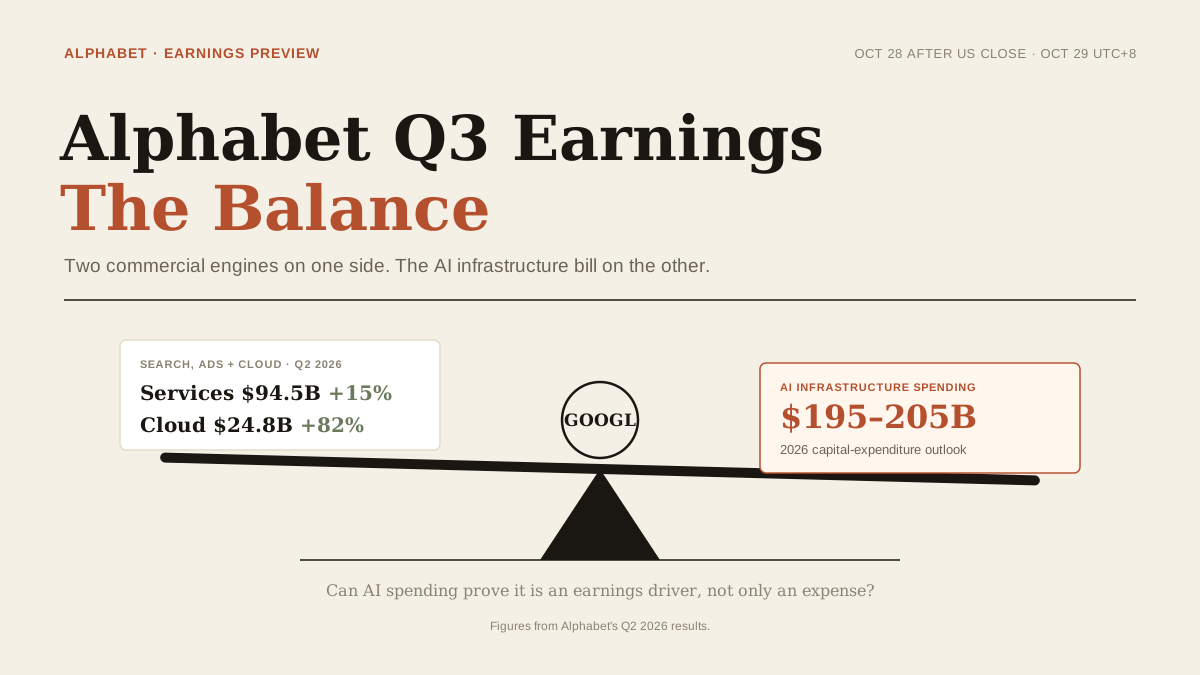
Google Stock Before Alphabet Earnings: Can AI Spending and Search Growth Support GOOGL?
Alphabet reports Q3 2026 results on October 28. See the Search, Google Cloud, AI spending, and guidance signals shaping GOOGL stock.
Fractional Reserve: Reserve Requirement Abolished. Where is the Value?

Anthropic's Revenue Rises to $16.8 Billion Ahead of IPO

‘Is Korea Facing a Second IMF Crisis? The Solution Lies in XRP?’... The Leap of the Crisis Theory by BeInCrypto

ICO, VC Tokens, and Alpha Models: Why They Can't Save the Current Crypto Market?

One Order Book for Dollars and Stablecoins. How It Works

Cyberattack on the ports of Marseille and La Rochelle? Hackers paid 1 dollar in crypto
![[Exclusive] Coinbase Transaction Data Shows 100 Million Trades Misrepresented... Data Analysis Firm Corrects Errors](/public-static/20_9098579959.png?format=avif)
[Exclusive] Coinbase Transaction Data Shows 100 Million Trades Misrepresented... Data Analysis Firm Corrects Errors

Wall Street Morning Report: U.S. Inflation Resurfaces, AI Credit Risks Spread, Chip Stocks Fall for Six Consecutive Days
Arthur Hayes: Focus on Established DeFi Projects with Cash Flow
Anthropic Reports $16.8 Billion Revenue in Q3, IPO Feasibility Strengthened

Hot CPI Lifts Hike Bets; Risk Assets Pull Back | WEEX TradFi Daily(October 15, 2026)
Major indexes closed lower on October 14, with the Nasdaq leading the decline. September unadjusted CPI rose to 3.7% year on year, above forecasts, and core CPI also beat expectations. Traders sharply raised this month’s hike probability to about 43.7% and fully priced two more hikes by the end of January. Chip stocks were sold again. Bitcoin broke below $83,000 and last traded near $81,700, while spot gold and silver fell. Crypto-related stocks were under pressure, but PYTH rose against the tape. October 15 brings PPI, retail sales and key
WEEX Exclusive:Hot CPI Lifts Hike Bets; Risk Assets Pull Back | WEEX TradFi Daily(October 15, 2026)

Sam Price Observes Changes in Bitcoin ETF Net Inflows

G20 warns that stablecoins may lose value even if fully backed
Analysts Bullish on MicroStrategy, Target Price Raised to $240
Bank of America Report Shows $39 Billion Inflow into US Stocks in One Week, Strategists Prefer Risk Aversion
MSCI New Rules Implemented, 14 Crypto Companies Enter Potential Impact List
What Do the New Tesla Roadster Specs Mean for Tesla (TSLA) Stock?
Explore the new Tesla Roadster specs, reservation payments and 2028 production plan, plus what the reveal could mean for Tesla stock and future profits.
Quant (QNT) Price Prediction 2026–2030: Can Bank Adoption Drive a Return to $500?
Spout raises $2M to offer 0% interest loans on Solana


