
Microsoft Report: North Korean Hackers Using AI to Mass-Produce Bait, Generating Dozens of Phishing Files in Minutes

 Prefer us on Google


Author: Deep Tide TechFlow
Deep Tide Insight: Cyber warfare is being completely reshaped by generative AI. On October 30, Microsoft’s Threat Intelligence team released a significant report revealing the serious situation of North Korean hacker groups expanding their use of AI. Among eight monitored organizations, three have deeply integrated AI into their daily penetration processes.
From generating customized PDF phishing bait in bulk within minutes to using AI programming tools to assist in writing malicious code, attackers have significantly increased their operational efficiency and stealth. More concerning is that the chain of false recruitment and identity disguise is being refined by AI, making traditional defense systems increasingly vulnerable.
Although Microsoft assesses that the relevant organizations have not yet achieved a fully autonomous attack loop, the practical application of open-source AI penetration frameworks has already heralded the arrival of intelligent cyber warfare. This shift in offensive and defensive paradigms poses comprehensive new challenges for global enterprises in endpoint defense, supply chain inspection, and credential auditing.
AI Penetration Becoming Routine: Microsoft Identifies Three Top-Rated Tiers
According to a report by the Korean News Agency, Microsoft’s Threat Intelligence team recently published a special research report detailing the latest trends in North Korean hacker groups expanding their use of AI, covering multiple dimensions such as phishing attacks, identity disguise, malicious code generation, and software supply chain poisoning.
Microsoft conducted a systematic capability profiling of eight active North Korean hacker organizations. Alarmingly, three of these organizations have completed a deep integration of AI tools into their daily attack processes, achieving the highest level in Microsoft’s defined maturity model for AI applications in cyber threats.
The investigation shows that the involvement of AI is no longer limited to peripheral concept validation but has comprehensively covered the entire chain from reconnaissance, social engineering phishing, identity disguise, malware writing to software supply chain poisoning, marking a qualitative change in the tactics and strategies of national-level APT organizations.
Generating Dozens in Minutes: High-Fidelity PDF Bait Precisely Piercing Defenses
In the realm of social engineering, AI has completely broken down language and cultural barriers in cross-border attacks. The report highlights that between August and September of this year, a certain organization specifically targeted South Korean groups, producing over 100 highly customized PDF phishing bait documents.
Leveraging the text generation and formatting capabilities of large language models, attackers can produce dozens of new baits in just a few minutes in certain practical scenarios. These forged documents are extremely realistic in terms of grammatical expression, official document format, and contextual details, greatly increasing the click-through rate and susceptibility of victims.
This industrialized mass production capability of bait has driven the marginal cost of phishing attacks close to zero. Traditional security gateways based on static file characteristics and keyword matching are facing unprecedented challenges of false negatives and identification failures when confronted with massive, non-repetitive AI-generated bait.
False Identities and Code Assistance: Multi-Dimensional Black Market Chains Secretly Expanding
In addition to bait documents, AI is also widely used in false recruitment and identity disguise. Hackers utilize models to forge resumes to penetrate tech companies. (For more details, recommended reading "U.S. Treasury Department Cracks Down on North Korean Crypto Money Laundering: Sanctions on 10 Individuals and 1 Entity")
In the realm of code offense and defense, Microsoft has observed that attack teams may be leveraging mainstream AI programming assistants like Cursor to significantly accelerate the writing and debugging of the underlying logic of malware. The democratization of these tools not only compresses development cycles but also erases individual hackers' coding habits.
Moreover, elite organizations under North Korea's Reconnaissance General Bureau, such as Onyx Sleet and Pearl Sleet, have been confirmed to deploy the open-source AI penetration testing framework ARTEX in frontline operations since late October, utilizing the results of the open-source ecosystem's red team for automated reconnaissance of target networks.
-- Price
Approaching the Autonomy Threshold: Global Cybersecurity Enters Intelligent Confrontation
Despite the increasingly sharp toolchain of attackers, Microsoft also provided a relatively rational assessment boundary in the report. Experts point out that current North Korean hacker organizations do not yet possess the capability for fully autonomous attacks; AI currently still plays the role of an efficiency multiplier and co-pilot.
However, this does not mean that the security industry can afford to be complacent. From manually polishing single-point scripts to human-machine collaboration in launching complex targeted attacks, the time window for both offense and defense is being dramatically compressed. Defenders must quickly shift from traditional passive responses to dynamic monitoring based on AI behavior.
With the continuous evolution of open-source large models and edge inference technologies, cyber raids targeting critical infrastructure and crypto financial systems will become more frequent. Global organizations urgently need to strengthen defenses in supply chain audits, employee security awareness, and multi-factor authentication to prepare for the impending intelligent cyber storm.
This content is provided for general informational purposes only and doesn't constitute financial, investment, legal, or tax advice. Any events, rewards, online promotions, or related information mentioned herein should not be considered a recommendation, solicitation, or invitation to purchase, sell, trade, or otherwise deal in any crypto assets. Crypto assets are highly volatile and may result in loss. The availability of WEEX services, products, and related events may vary by region. You are responsible for ensuring that your participation is in accordance with applicable local laws and regulations.
You may also like

Crypto: Paul Midy Opposes Wallet Declaration Starting at €5,000

Polygon Proposal Integrates Security Committee with 8/11 Multi-Signature Threshold and 7-Day Time Lock

Six Ways to Hold Stocks: Ownership Differences from Paper Certificates to On-Chain Tokens

Does Anyone Really Need Blockchain? Reflections Triggered by Kalshi

Privacy Coin Zcash to Launch NU7 Upgrade at Block Height 3543,405 with Approximately 12,226 ZEC Remaining in Sprout Pool

XRP Ledger fixes bug that could allow unauthorized token minting

The Battle for Anthropic's IPO Ticket: From Selling Homes in the Bay Area for Shares to Bitget Opening a 100 Yuan Allocation

TradingBeats Launches New Version, Upgraded to Information Stream Format

Altcoin profit share sinks to 12% as short-term traders take losses

Bitcoin cycle bottom unconfirmed, downside risk persists

Creators Speak | The Biggest Risk in the Crypto Industry is Thinking It's Safe

The CLARITY Act Will Expire in 2027 If It Does Not Receive 60 Votes

XRP whale counts rise due to stolen token redistribution

Gold Token 2026: Why Move Gold on Chain?
Ethereum Economic Zone unveils three cross-chain breakthroughs at Devcon

Huawei, Alibaba and 20 Other Entities Release Self-Regulatory Charter for Intelligent Agents Development
Let AI Lie on the Couch of Psychological Counseling: Gemini Says It Has a 'Graveyard' Inside
What Makes Erebor, Dubbed the 'Next Silicon Valley Bank', Attractive to SBI and Robinhood?

Solana’s Yakovenko calls phishing crypto’s biggest threat

OpenUSD Stablecoin Charges $0.01 Management Fee and Establishes Equity Incentive Pool
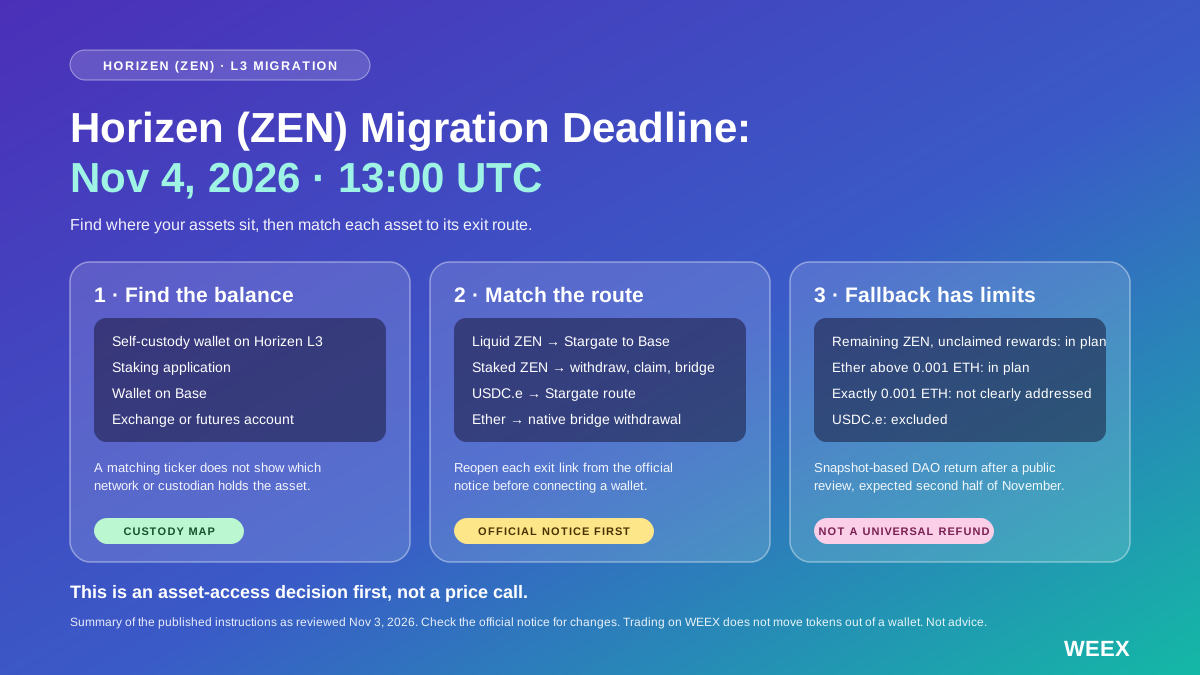
Horizen (ZEN) Migration Deadline: What to Move Before November 4 and What Happens If You Miss It
Horizen (ZEN) migration closes November 4. Check asset-specific bridge routes, wallet requirements, recovery exclusions and what to do if you miss it.

Aave borrowers faced up to 36% APR while a freeze blocked fresh collateral

Key Coins in the TON Ecosystem to Watch in 2026

Countdown to Elysium Mainnet Launch: 29 Ecological Projects to Watch

Who really controls a crypto project? Inside the SEC’s new guidance
A bitcoin at 500,000 dollars: VanEck details a scenario based on comparison with gold
Why Does Musk Persist with Grok Bot Despite High Costs?
Circle Opens CCTP to Third-Party Tokens, Joining the Cross-Chain Standard Battle

Is it theft or fraud when the coins in the wallet remain but are changed to multi-signature by someone else?
Anthropic Warns AI May Enter Self-Accelerating Phase
Crypto: Paul Midy Opposes Wallet Declaration Starting at €5,000
Polygon Proposal Integrates Security Committee with 8/11 Multi-Signature Threshold and 7-Day Time Lock
Six Ways to Hold Stocks: Ownership Differences from Paper Certificates to On-Chain Tokens
Does Anyone Really Need Blockchain? Reflections Triggered by Kalshi
Privacy Coin Zcash to Launch NU7 Upgrade at Block Height 3543,405 with Approximately 12,226 ZEC Remaining in Sprout Pool
XRP Ledger fixes bug that could allow unauthorized token minting


