
OCC Calls on Banks to Enter the Stablecoin Payment Space

 Prefer us on Google



Key Points of This Article
- Recommendation for the development of stablecoin functions based on the Genius Act
- Ongoing discussions on indirect yield provision
OCC Encourages Stablecoin Development
On the 26th, the Office of the Comptroller of the Currency (OCC) called on community banks in the U.S. to develop functions related to payment stablecoins, based on the "National Innovation Guidelines and Establishment Act for U.S. Stablecoins (Genius Act)."
It is recommended that banks or their subsidiaries consider applying to become authorized issuers of payment stablecoins. This is also stated to complement the OCC's "Community Bank Revival" initiative, which reviews the regulation and supervision of community banks.
On the 21st, the OCC announced the final rule regarding the regulation of payment stablecoins under the "Genius Act." This final rule is expected to take effect on January 18, 2027, the same date as the implementation of the Genius Act.
The rule stipulates requirements for stablecoin issuers, issuers of foreign stablecoins, and certain custody operations conducted by entities under OCC supervision.
Removal of Yield-Related Hurdles
The Genius Act prohibits issuers from providing yields or interest on stablecoins themselves. However, organizations such as the American Bankers Association (ABA) have pointed out that stablecoins circulate through intermediaries such as exchanges, which may indirectly provide yields.
In this regard, the OCC stated in the final rule that "payment stablecoins are still in an early market phase, and it is not appropriate to introduce a 'rebuttable presumption' regarding the yield prohibition at this time."
The "rebuttable presumption" is a mechanism that presumes an issuer is in violation of the yield prohibition if it has contracts with affiliates or related third parties to pay interest or yields, and those parties have contracts to pay yields to stablecoin holders solely for holding, using, or maintaining the stablecoins.
Unless the issuer can rebut this presumption, it will be treated as a violation. The OCC removed this item from the final rule, which was included in the proposal stage. However, the OCC maintains its authority to address avoidance behaviors and plans to review related contracts through licensing examinations and supervision.
Rob Nichols, President and CEO of the American Bankers Association (ABA), expressed disagreement with the OCC's removal of the "rebuttable presumption." He is concerned that stablecoin issuers may be able to indirectly provide equivalent yields while circumventing legal prohibitions.
Nichols commented that this could threaten the source of bank lending, which is a driving force of the U.S. economy.
Traditional U.S. banks have long argued that the provision of yields on stablecoins could lead to a flow of funds from bank deposits to stablecoins. Indirect yields have also been a focus of the Clarity Act proposal.
-- Price
This content is provided for general informational purposes only and doesn't constitute financial, investment, legal, or tax advice. Any events, rewards, online promotions, or related information mentioned herein should not be considered a recommendation, solicitation, or invitation to purchase, sell, trade, or otherwise deal in any crypto assets. Crypto assets are highly volatile and may result in loss. The availability of WEEX services, products, and related events may vary by region. You are responsible for ensuring that your participation is in accordance with applicable local laws and regulations.
You may also like

Why Banks Still Refuse to Open Accounts for Licensed Crypto Payment Projects

Nvidia stock tokens show price spreads, but slippage crushes the arbitrage

Serenity: AI Industry Chain Stocks Face Indiscriminate Sell-off, Some Storage Stocks Have a P/E Ratio of Only 1.6 Times

Over $133 Million in Suspected Stolen Funds Flow Through Crypto Platforms
The 'Election Effect' of Bitcoin: Political Catalyst or Coinciding with the Halving Cycle?

TeraWulf Signs Credit Support Agreement with Google to Advance $19 Billion Data Center Project

Gold Token 2026: Why Move Gold on Chain?

Copom Expected to Pause Selic Cuts: What Changes for Investors
Democrats Sweep Congress: 12 Key Questions Investors Are Asking

Stablecoins Move Towards Real Payments: Three Technical Advantages of TBC

Is Vitalik Buterin's Digital Minimalism Worth Having?

Suspected North Korean Hackers Transfer Approximately $1.46 Million via Jupiter Lend and Circle
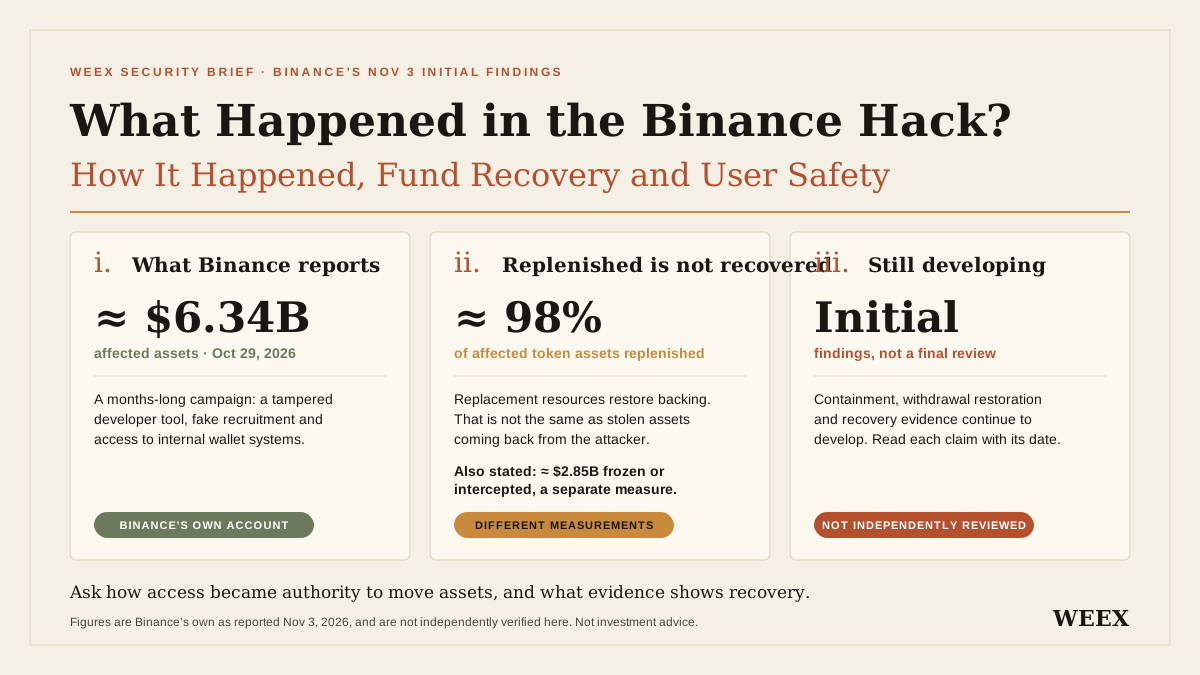
What Happened in the Binance Hack? How It Happened, Fund Recovery and User Safety
What happened in the Binance hack? Review the attack timeline, latest fund replenishment, recovery limits and practical steps to protect your account.

Bitcoin ETF Outflows Hit $398.6M on November 2 as BlackRock Leads Redemptions

Waiting for the Last Dip? Morgan Stanley's Wilson: Regardless of Election Results, It May Be a Good Opportunity to Buy U.S. Stocks
Standard Chartered Launches Continuous Tokenized Deposits in Hong Kong

Judy Shelton and Monetary Policy Point to a Less Dominant Future for the Fed

Bitcoin’s year-end liquidity hopes face a projected $150 billion Treasury cash rebuild

ICE Partners with Hyperliquid, Traditional Exchanges' Moat is Shifting
Dollar stablecoin use stayed elevated after capital controls ended, new research suggests

The "Election Effect" of Bitcoin: Political Catalyst or Coinciding with the Halving Cycle?

CoreWeave's Capital Flywheel Comes to a Halt

Solana study finds wider spreads outside aggregators at five of six sampled pools

Thai Police Obtain Fund Flow Data from Three Exchanges Related to Shuffle, Form 80 Task Forces

唐华斑竹: GOAT Network Addresses Business Security Pain Points
Who Benefits More After Aero's Merger Upgrade: Holders, LPs, or the Platform?
Airtm and BVNK Plan Wallet Payments for Merchants in Emerging Markets

Hashdex Adds Jane Street to Crypto Index ETF Authorized Participants

Tech Stocks Fall 7% on Wall Street Amid AI Concerns

When Software Starts Spending Money: Pantera Partner Explains How AI Agents Are Restructuring SaaS Business Models and Crypto Payments
Why Banks Still Refuse to Open Accounts for Licensed Crypto Payment Projects
Nvidia stock tokens show price spreads, but slippage crushes the arbitrage
Serenity: AI Industry Chain Stocks Face Indiscriminate Sell-off, Some Storage Stocks Have a P/E Ratio of Only 1.6 Times
Over $133 Million in Suspected Stolen Funds Flow Through Crypto Platforms
The 'Election Effect' of Bitcoin: Political Catalyst or Coinciding with the Halving Cycle?
TeraWulf Signs Credit Support Agreement with Google to Advance $19 Billion Data Center Project


