
September CPI in the US: What Inflation Tells the Investor

 Prefer us on Google


September CPI Confirms Persistent Inflationary Pressure in the US
The Consumer Price Index (CPI) in the United States rose by 0.6% in September, according to data released by the Bureau of Labor Statistics on Wednesday (14). This figure was in line with the market's median expectation, which also projected a 0.6% increase for the month.
However, on a year-over-year basis, the CPI accumulated a rise of 3.7%, slightly above the projected 3.6%. This is a tenth of a percentage point that, in isolation, seems irrelevant. But in the context of US monetary policy, every fraction counts in determining the direction of interest rates in the country that anchors the global financial system.
For those investing in Brazil or any emerging market, understanding the US CPI is not an academic exercise. It is a practical matter. The interest rate differential between the US and the rest of the world determines capital flows, the dollar's exchange rate, and risk appetite. As we have discussed in our global finance coverage, US inflation data is one of the most relevant indicators for portfolio allocation.
What the Monthly Figure of 0.6% Really Means
A 0.6% increase in a single month is significant. If annualized directly, this monthly rate equates to an inflation rate close to 7.2% per year, well above the 2% target pursued by the Federal Reserve. It is clear that annualizing a single month is a simplified exercise, but it serves to illustrate the speed at which prices accelerated in September.
Compared to previous months, the September data marks a re-acceleration. Throughout the first half of 2026, the monthly CPI had fluctuated within more moderate ranges, fueling expectations that the Fed would have room to initiate a cycle of cuts. The September figure throws cold water on that narrative.
The composition of the index matters as much as the full number. Historically, components such as housing, energy, and services are the most persistent. When these items pull the index upward, the central bank's job becomes more difficult because they are categories that respond slowly to high interest rates.
Direct Impact on Federal Reserve Policy
The Fed operates with a dual mandate: price stability and full employment. With the US labor market still heated and inflation running above target, the margin for monetary easing decreases. This is the "higher for longer" scenario that markets fear.
With the annual CPI at 3.7%, the real interest rate (nominal rate minus inflation) remains positive, but not as restrictive as some members of the monetary policy committee would like. This reinforces the likelihood that the Fed will maintain interest rates at the current level for longer than the market had priced in at the beginning of the year.
For Brazilian investors, this scenario has direct implications. High interest rates in the US sustain a strong dollar, which pressures currencies of emerging countries. This tends to limit the Brazilian Central Bank's room to reduce the Selic, even if domestic inflation is more controlled. As we analyzed in our monetary policy section, the interdependence between the Fed and Copom is one of the most underestimated factors by individual investors.
-- Price
What Changes for Those Investing in Equities and Crypto
Persistent inflation in the US affects all asset classes. In equities, high interest rates compress multiples of growth companies, especially in the technology sector. Companies that depend on future cash flow are worth less in present value when the discount rate rises.
In the crypto market, the dynamics are similar. Bitcoin and other digital assets have behaved in recent cycles as risk assets, sensitive to global liquidity. When the Fed signals that it will not cut interest rates anytime soon, speculative capital flows tend to migrate to the safety of US treasuries, which offer positive real returns without volatility.
This does not mean that risk assets will necessarily fall. It means that the opportunity cost of holding positions in stocks or cryptocurrencies increases. As we highlighted in previous analyses of the cryptocurrency market, prolonged periods of monetary tightening historically coincide with lateralization or corrections in digital asset markets.
The Extra Tenth in the Annual CPI: Why 3.7% Matters
The market's median projection for the annual CPI was 3.6%. The result came in at 3.7%. The difference of 0.1 percentage points may seem negligible, but it carries symbolic weight. It shows that disinflation, the process of gradually reducing inflation towards the target, is not happening at the expected pace.
Historically, the last percentage points of disinflation are the hardest to achieve. The Fed has already managed to bring down inflation from peaks that exceeded 9% in 2022. However, reducing the index from 3.7% to 2% requires a prolonged maintenance of restrictive financial conditions.
This is the central dilemma: how long can the American economy withstand high interest rates without entering a recession? And if it does enter one, will the Fed be forced to cut rates before inflation converges to the target? These are questions that the market will continue to price in over the coming months.
What to Watch in Upcoming Data
The attentive investor should monitor not only the full CPI but also the core inflation (core CPI), which excludes food and energy. This indicator is the Fed's preferred measure for assessing medium-term inflation trends. If the core also shows acceleration, the likelihood of interest rates remaining elevated for a longer period increases significantly.
Additionally, the PCE (Personal Consumption Expenditures index), which the Fed uses as its official reference, will be released in the coming weeks. A convergence between CPI and PCE above expectations would solidify the cautious monetary scenario.
For investors, the practical lesson is clear: do not bet on interest rate cuts as the base case. Building portfolios that work in both high-interest environments and potential easing is the most prudent strategy at this moment. Geographic diversification, exposure to real assets, and discipline in sizing positions remain fundamental principles.
This content is informative and educational and does not constitute investment advice. Past performance is not indicative of future results.
This content is provided for general informational purposes only and doesn't constitute financial, investment, legal, or tax advice. Any events, rewards, online promotions, or related information mentioned herein should not be considered a recommendation, solicitation, or invitation to purchase, sell, trade, or otherwise deal in any crypto assets. Crypto assets are highly volatile and may result in loss. The availability of WEEX services, products, and related events may vary by region. You are responsible for ensuring that your participation is in accordance with applicable local laws and regulations.
You may also like

Pago Móvil Reaches 63% of Transactions in Venezuela, Competing with USDT

Analysts Bullish on MicroStrategy, Target Price Raised to $240

Bank of America Report Shows $39 Billion Inflow into US Stocks in One Week, Strategists Prefer Risk Aversion

MSCI New Rules Implemented, 14 Crypto Companies Enter Potential Impact List

What Do the New Tesla Roadster Specs Mean for Tesla (TSLA) Stock?
Explore the new Tesla Roadster specs, reservation payments and 2028 production plan, plus what the reveal could mean for Tesla stock and future profits.

Quant (QNT) Price Prediction 2026–2030: Can Bank Adoption Drive a Return to $500?

Spout raises $2M to offer 0% interest loans on Solana

RWA Weekly: Ant Group and HSBC Test Agent Tokenized Payments; Robinhood Explores Tokenized Actively Managed ETFs

BlackRock CEO Larry Fink Flags a Different AI Risk, and It Isn’t the Bubble

Shanghai Supports International Data Center Construction to Facilitate Cross-Border Data Flow

Shanghai Advances National Blockchain Network Construction, Strengthens Cross-Chain Service Capabilities

When Will AI Investments Pay Off? JPMorgan Optimistic About Google and Amazon

What is being said at the tables: the BCRA turns on the dollar vacuum and the city counts the bullets in Javier Milei's bazooka

New Developments in the Blue Sky Ge Rui Case: Bitcoin Rises 200 Times, Can Victims Only Be Compensated at Original Price?
Bitcoin inflows to US set to turn positive in 2026, Chainalysis says
iGaming Tokens Need Real Revenue, Not Just Hype
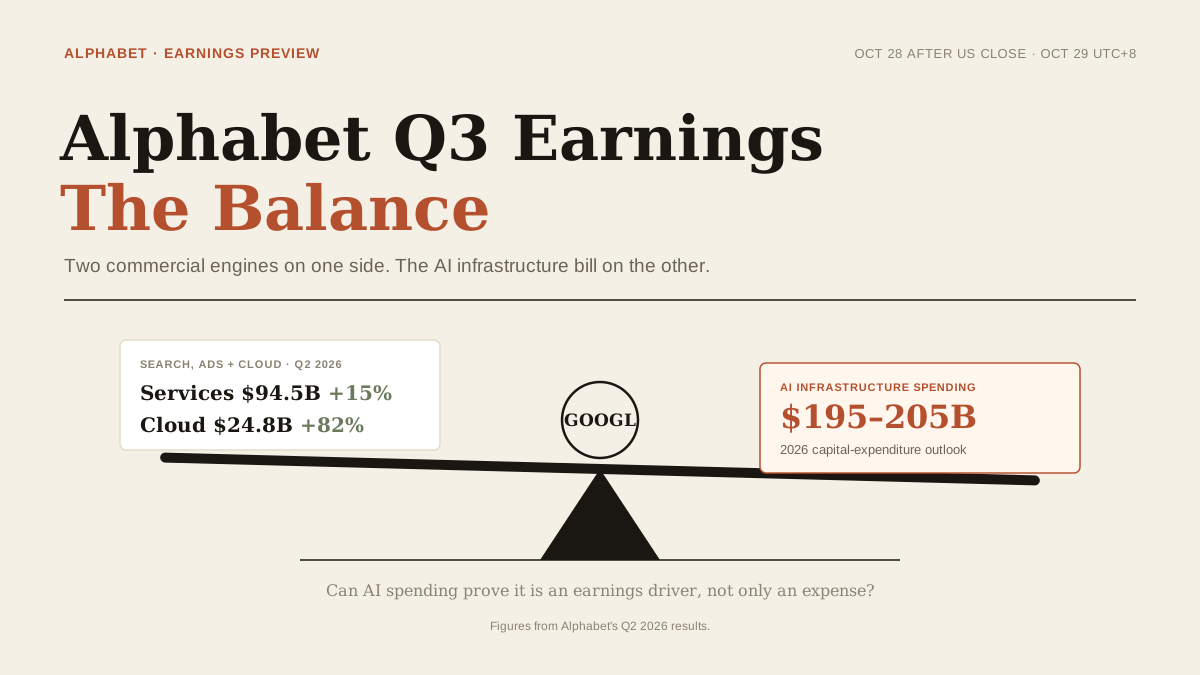
Google Stock Before Alphabet Earnings: Can AI Spending and Search Growth Support GOOGL?
Alphabet reports Q3 2026 results on October 28. See the Search, Google Cloud, AI spending, and guidance signals shaping GOOGL stock.
Fractional Reserve: Reserve Requirement Abolished. Where is the Value?

Anthropic's Revenue Rises to $16.8 Billion Ahead of IPO

‘Is Korea Facing a Second IMF Crisis? The Solution Lies in XRP?’... The Leap of the Crisis Theory by BeInCrypto

ICO, VC Tokens, and Alpha Models: Why They Can't Save the Current Crypto Market?

One Order Book for Dollars and Stablecoins. How It Works

Cyberattack on the ports of Marseille and La Rochelle? Hackers paid 1 dollar in crypto
![[Exclusive] Coinbase Transaction Data Shows 100 Million Trades Misrepresented... Data Analysis Firm Corrects Errors](/public-static/20_9098579959.png?format=avif)
[Exclusive] Coinbase Transaction Data Shows 100 Million Trades Misrepresented... Data Analysis Firm Corrects Errors

Wall Street Morning Report: U.S. Inflation Resurfaces, AI Credit Risks Spread, Chip Stocks Fall for Six Consecutive Days
Arthur Hayes: Focus on Established DeFi Projects with Cash Flow
Anthropic Reports $16.8 Billion Revenue in Q3, IPO Feasibility Strengthened

Hot CPI Lifts Hike Bets; Risk Assets Pull Back | WEEX TradFi Daily(October 15, 2026)
Major indexes closed lower on October 14, with the Nasdaq leading the decline. September unadjusted CPI rose to 3.7% year on year, above forecasts, and core CPI also beat expectations. Traders sharply raised this month’s hike probability to about 43.7% and fully priced two more hikes by the end of January. Chip stocks were sold again. Bitcoin broke below $83,000 and last traded near $81,700, while spot gold and silver fell. Crypto-related stocks were under pressure, but PYTH rose against the tape. October 15 brings PPI, retail sales and key
WEEX Exclusive:Hot CPI Lifts Hike Bets; Risk Assets Pull Back | WEEX TradFi Daily(October 15, 2026)

Sam Price Observes Changes in Bitcoin ETF Net Inflows
Pago Móvil Reaches 63% of Transactions in Venezuela, Competing with USDT
Analysts Bullish on MicroStrategy, Target Price Raised to $240
Bank of America Report Shows $39 Billion Inflow into US Stocks in One Week, Strategists Prefer Risk Aversion
MSCI New Rules Implemented, 14 Crypto Companies Enter Potential Impact List
What Do the New Tesla Roadster Specs Mean for Tesla (TSLA) Stock?
Explore the new Tesla Roadster specs, reservation payments and 2028 production plan, plus what the reveal could mean for Tesla stock and future profits.
Quant (QNT) Price Prediction 2026–2030: Can Bank Adoption Drive a Return to $500?


