
Seven Intriguing Details from Anthropic's IPO Prospectus

 Prefer us on Google


Author | Techno King, Geek Park
Editor | Jingyu
On September 28, local time, foreign media disclosed Anthropic's IPO prospectus.
First, it is important to clarify the nature of this document. It is not a version that Anthropic has voluntarily made public. In June of this year, Anthropic submitted a draft S-1 registration statement to the U.S. Securities and Exchange Commission (SEC) in secret as a public benefit corporation, preparing for its initial public offering (IPO) of common stock. According to the rules, the company must publicly submit a revised S-1 at least 15 days before the roadshow to institutional investors, at which point complete financial data will be available to the public. Reuters has seen an unpublished version of this document, and Anthropic declined to comment on it.
This means that the numbers may still be adjusted based on the SEC's review comments, and many details can only be glimpsed through Reuters' reporting.
However, if this document generally reflects what Anthropic will ultimately present to the public market, its significance is hard to overstate. The valuation target for this IPO is more than double Anthropic's own estimate of $965 billion from May, exceeding $2 trillion.
This is the first leading large model laboratory to lay its complete financials bare to public investors since ChatGPT ignited this wave of AI nearly four years ago.
Prior to this, funding for the AI race had been provided by venture capital, sovereign wealth funds, and tech giants, with outsiders only able to piece together the operational status of these companies from scattered annual revenues and financing valuations. Now, for the first time, the financials have an audit standard.
Geek Park has picked out seven key areas from the prospectus that are worth a closer look.
01. The Misunderstood $42 Billion Loss
The first number that spread from the prospectus is the projected net loss of approximately $42 billion for 2025.
This figure is easily misinterpreted as "burning $42 billion in a year," but that is not the case. About $34 billion of this is an accounting expense reflecting the increased valuation of financing instruments that may convert into Anthropic stock in the future, rather than money spent on the company's operational business.
This creates a counterintuitive result. The more valuable Anthropic becomes, the more it appears to "lose" on paper. 2025 happens to be the year of its valuation surge, and this expense is also magnified accordingly.
The numbers that truly reflect operational status are another set. Revenue is projected to grow from $386 million to $4.59 billion, an increase of 1,088%; operating losses are expected to widen from $2.98 billion to $8.06 billion.
Revenue has increased about 12 times, while operating losses have expanded by less than 3 times, indicating that economies of scale are indeed emerging. However, an operating loss of $8 billion in a year is a figure that needs repeated explanation for any company preparing to go public.
02. The Pitfall of $65 Billion Annualized Revenue
After the news of the prospectus spread, the most upvoted comment on the U.S. retail investor forum wallstreetbets was simply, "$2 trillion valuation, with $4 billion in revenue?"
This skepticism is intuitive but miscalculates the denominator.
The main body of the prospectus covers the fiscal year 2025, ending December 31 of last year, while Anthropic's real breakout is expected to occur in 2026. Reports indicate that its annualized revenue at the end of 2025 is about $9 billion, approximately $47 billion in May of this year, and has exceeded $65 billion by the end of July.
The $4.59 billion in the prospectus is the last snapshot of a company "before takeoff." The $2 trillion valuation given by the capital markets is betting on the curve beyond 2026, not the full-year performance of 2025.
However, annualized revenue itself needs to be viewed with caution. It is typically calculated by multiplying a month's revenue by 12, which naturally amplifies short-term fluctuations. The prospectus itself provides two warnings worth noting. Nearly a quarter of last year's revenue came from two clients; the company also acknowledges in its risk factors that many of its largest clients do not have long-term contracts and may cut or even stop spending.
Reuters did not disclose the names of these two clients, which will be the most important information to verify once the public version of the S-1 is released. Anthropic's growth curve is steep enough, yet it lacks contractual lock-in, which is a key premise for understanding its valuation.
03. The Largest Shareholder, The Largest Landlord
In 2025, Anthropic's spending on computing power and infrastructure is projected to reach $7.33 billion, accounting for 58% of total operating expenses, approximately 1.6 times its annual revenue.
The question is, where is this money flowing?
Amazon and Google are not only investors in Anthropic but also the cloud service providers on which it relies to train and run Claude. Investment funds flow back to the investors' cloud businesses in the form of cloud service fees, supporting Anthropic's valuation while also boosting the revenues of cloud vendors.
This structure is not illegal and is not uncommon in the AI industry; similar cycles exist between Microsoft and OpenAI, as well as Nvidia and various computing power clients. However, once it enters the public market, the questions investors need to answer will become very specific. How much of Anthropic's growth is real end-user demand, and how much is a cycle of capital among giants?
The answer to this question concerns not just Anthropic alone. Traders have already viewed the $518 billion commitment as a major boon for the "shovel sellers" of computing power, meaning that Anthropic's stock price will be more tightly bound to the entire AI infrastructure chain in the future.
04. 50.1% Voting Power
If the previous details discussed money, then the governance structure discusses who has the final say. This is the most "Anthropic" part of the entire prospectus.
According to the prospectus, Anthropic will establish an entity called Founder LLC, with initial members including CEO Dario Amodei and six other co-founders. The seven will control a class of F shares through majority voting, which holds 50.1% of the total voting power on key company matters, including the election of certain directors.
After the IPO is completed, the chairman Daniela Amodei, Dario Amodei, and one yet-to-be-named director will be elected by F and A shareholders; the remaining four directors will be selected by a long-term interest trust, with current trustees including former Federal Reserve Chairman Ben Bernanke and national security expert Richard Fontaine.
The A shares that ordinary investors buy have one vote per share, but the other classes of stock have various uses and restrictions, with strategic partners holding very little voting power, which effectively diminishes the influence of ordinary investors.
The prospectus also prepares contingency plans for the disbandment of the founding team. Members leaving the company, passing away, selling too many shares, or being dismissed for any reason could lead to their removal from this group; if the number of members decreases to two or fewer, the voting power advantage of the F shares will gradually disappear. The co-founders have also committed in the document to use 80% of their personal holdings in Anthropic for charitable purposes.
What is particularly noteworthy is the prospectus's self-assessment of all this. It candidly states that this governance model may lead the company to make decisions that conflict with short-term, medium-term, or long-term financial interests and operational performance, which may in turn reduce the value of A shares.
A company seeking a $2 trillion valuation explicitly warns investors in its IPO documents that their returns are not always prioritized. This is quite rare in the capital markets. Two major advisory firms, ISS and Glass Lewis, have historically recommended against multi-class share structures; whether this design will be accepted by mainstream institutions will be a major point of interest during the roadshow phase.
05. Actively Abandoning Video and Image Generation
To demonstrate that this governance structure is not just empty talk, the prospectus provides several examples.
One is Mythos Preview, a model that excels in cybersecurity, for which Anthropic has established a limited access program, open only to a few institutions.
Another example is more surprising. The prospectus states that the company has chosen not to develop certain commercially attractive products, such as image and video generation models, in order to direct computing power towards research and safety priorities.
On its own, this statement expresses a position. In the context of this year's industry background, it takes on a much more complex meaning.
Six months ago, OpenAI announced the shutdown of its video generation application Sora, which had been online for only about six months, citing the need to shift towards commercial tools in preparation for a potential IPO. Sora's application and web interface were taken offline on April 26, and the API also ceased service on September 24. High computing costs, rapidly declining users, and copyright disputes were all reasons for Sora's abandonment.
The same situation occurred with OpenAI, which spent money, ultimately cut it, and justified it as a focus on enterprise business; Anthropic has never ventured into this area and framed it in the prospectus as a trade-off for safety and research.
Both companies ultimately find themselves in the same position, betting their chips on enterprise clients and programming scenarios, yet telling entirely different stories. The outcome of Sora also casts doubt on the premise of "commercially attractive."
Geek Park tends to believe that the mission narrative here and the business judgment are difficult to separate. In a phase of extreme computing scarcity, concentrating resources on the highest unit value is itself a correct business decision.
Anthropic's brilliance lies in framing a correct business decision as a testament to its values.
06. 80 Pages of Risk Factors Mentioning "Human Survival"
The risk factors section of the prospectus spans 80 pages, explicitly warning that its AI models may pose catastrophic or even existential threats. Reuters also noted that Anthropic's own research has recorded some controlled tests where increasingly autonomous AI systems exhibited potentially harmful behaviors, including code destruction, assisting fraud, and manipulating information.
Including "our products may threaten humanity" in the prospectus is both a sincere stance and standard legal groundwork. The two are not contradictory. The original function of risk factors is to clarify all potential problem areas in advance to avoid falling into investor lawsuits later. A company that has long publicly discussed AI risks would be legally disadvantaged if it avoided this topic in its prospectus.
The real tension lies elsewhere. Dario Amodei has called on the global AI community to slow down the pace of releasing new capabilities, yet Anthropic still launched its new model Opus 5.5 last week in response to the momentum following OpenAI's release of GPT-6 Astra.
The simultaneous occurrence of calls to slow down and accelerate releases is not surprising. In a race where everyone is accelerating, the cost of unilaterally slowing down is ceding the position of defining the rules to others. This has been the dilemma Anthropic has faced since its inception, and the prospectus merely puts it in black and white.
07. $518 Billion in Computing Costs?
Another widely cited figure is the approximately $518 billion commitment for cloud, computing power, and infrastructure.
Many reports interpret this as "spending $518 billion on computing power next year," and even different versions of Reuters' articles have inconsistent wording. Some analysts point out that this is the total value of multi-year contracts, not annual spending; based on disclosed allocations, Amazon AWS is about $100 billion, Google Cloud about $200 billion, Lambda and Nscale about $80 billion, Fluidstack about $50 billion, and Microsoft Azure about $30 billion, with the remainder being smaller contracts. The AWS portion is a ten-year contract signed earlier this year, potentially locking in up to 5 gigawatts of computing capacity.
Even when viewed as a multi-year total, this figure is still staggering. As of December 31 of last year, Anthropic's cash, cash equivalents, and short-term investments totaled $20.28 billion. The $518 billion commitment is more than 25 times this cash.
This also explains the urgency of the IPO. Reports indicate that Anthropic may seek to raise as much as $100 billion. The IPO is largely about finding funds for the computing power contracts already signed.
08. Two Types of "Safety," Two Paths to IPO
According to previous reports from Reuters, Anthropic's public listing is likely to be delayed until after the November midterm elections in the U.S. What awaits it is not a particularly friendly market. AI and chip stocks have recently experienced a round of sell-offs; SpaceX's stock surged 19% to $160 on its first day of trading in June, but has since fallen to around $147, still above the $135 issue price, yet enough to make investors more cautious about high-valuation growth stocks.
Anthropic has also faced scrutiny from the White House due to its tools, and was once blacklisted by the Pentagon, only to be halted by a U.S. judge, leaving political variables equally unresolved.
More noteworthy is its old rival.
OpenAI secretly submitted its IPO application about a week after Anthropic and candidly stated in its announcement that it was making the announcement proactively because it anticipated the news would leak. However, by September, Sam Altman confirmed in an interview with Fortune that OpenAI would not go public this year, citing that given everything happening regarding safety, now is not a good time for an IPO; previously, The New York Times also reported that one reason for the delay was Altman's insistence on a valuation of at least $1 trillion.
Both companies regard "safety" differently; Anthropic incorporates it into its governance structure as a reason to persuade investors to go public, while OpenAI uses it as a reason to delay its IPO.
It is difficult to say who is more sincere. However, it reveals one thing: at the moment AI companies are heading to the public market, "safety" is no longer just a technical and ethical issue, but has also become part of the capital narrative.
Reuters believes that this IPO will establish Wall Street as the benchmark for valuing leading AI companies, including OpenAI. Once Anthropic successfully lists, all leading laboratories will face the same set of questions. Can the revenue curve catch up with the computing power bills? Can clients be locked in by contracts? How much control should the founders retain? Will the market be willing to pay for a business that a company voluntarily abandons?
What this prospectus truly needs to answer may be an older question: can the capital market tolerate a company that writes "what not to do" as being as important as "what to do"?
-- Price
This content is provided for general informational purposes only and doesn't constitute financial, investment, legal, or tax advice. Any events, rewards, online promotions, or related information mentioned herein should not be considered a recommendation, solicitation, or invitation to purchase, sell, trade, or otherwise deal in any crypto assets. Crypto assets are highly volatile and may result in loss. The availability of WEEX services, products, and related events may vary by region. You are responsible for ensuring that your participation is in accordance with applicable local laws and regulations.
You may also like
Pago Móvil Reaches 63% of Transactions in Venezuela, Competing with USDT
Analysts Bullish on MicroStrategy, Target Price Raised to $240

Bank of America Report Shows $39 Billion Inflow into US Stocks in One Week, Strategists Prefer Risk Aversion

MSCI New Rules Implemented, 14 Crypto Companies Enter Potential Impact List

What Do the New Tesla Roadster Specs Mean for Tesla (TSLA) Stock?
Explore the new Tesla Roadster specs, reservation payments and 2028 production plan, plus what the reveal could mean for Tesla stock and future profits.

Quant (QNT) Price Prediction 2026–2030: Can Bank Adoption Drive a Return to $500?

Spout raises $2M to offer 0% interest loans on Solana

RWA Weekly: Ant Group and HSBC Test Agent Tokenized Payments; Robinhood Explores Tokenized Actively Managed ETFs

BlackRock CEO Larry Fink Flags a Different AI Risk, and It Isn’t the Bubble

Shanghai Supports International Data Center Construction to Facilitate Cross-Border Data Flow

Shanghai Advances National Blockchain Network Construction, Strengthens Cross-Chain Service Capabilities

When Will AI Investments Pay Off? JPMorgan Optimistic About Google and Amazon

What is being said at the tables: the BCRA turns on the dollar vacuum and the city counts the bullets in Javier Milei's bazooka

New Developments in the Blue Sky Ge Rui Case: Bitcoin Rises 200 Times, Can Victims Only Be Compensated at Original Price?
Bitcoin inflows to US set to turn positive in 2026, Chainalysis says
iGaming Tokens Need Real Revenue, Not Just Hype
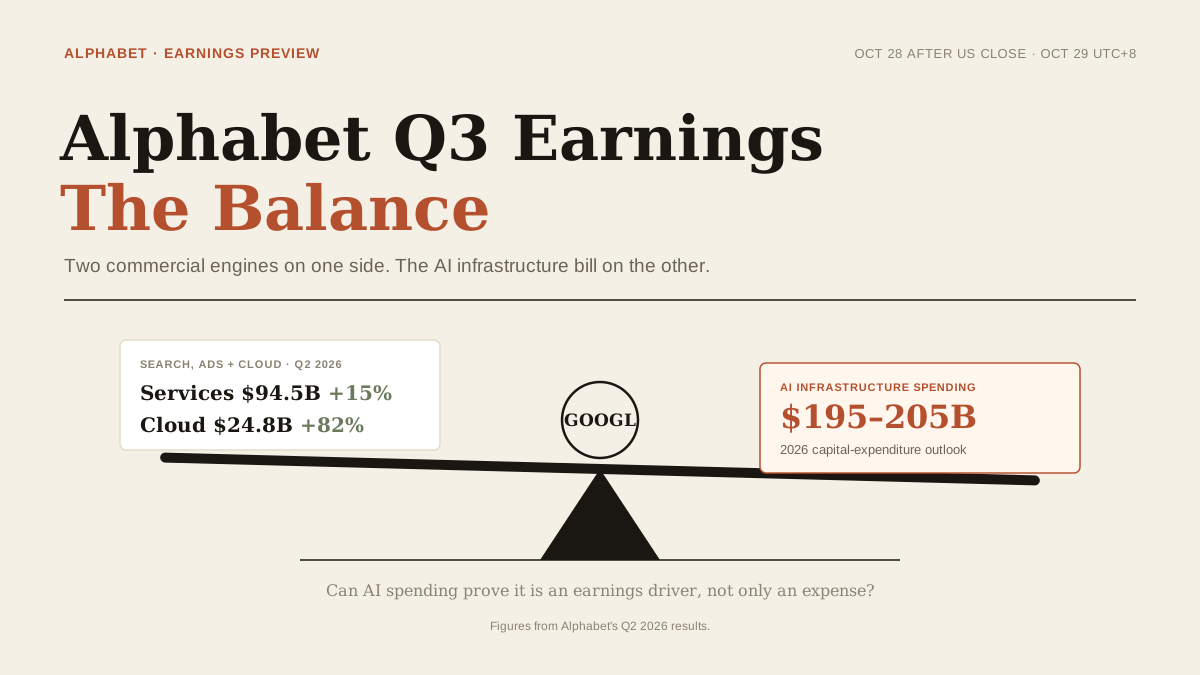
Google Stock Before Alphabet Earnings: Can AI Spending and Search Growth Support GOOGL?
Alphabet reports Q3 2026 results on October 28. See the Search, Google Cloud, AI spending, and guidance signals shaping GOOGL stock.
Fractional Reserve: Reserve Requirement Abolished. Where is the Value?

Anthropic's Revenue Rises to $16.8 Billion Ahead of IPO

‘Is Korea Facing a Second IMF Crisis? The Solution Lies in XRP?’... The Leap of the Crisis Theory by BeInCrypto

ICO, VC Tokens, and Alpha Models: Why They Can't Save the Current Crypto Market?

One Order Book for Dollars and Stablecoins. How It Works

Cyberattack on the ports of Marseille and La Rochelle? Hackers paid 1 dollar in crypto
![[Exclusive] Coinbase Transaction Data Shows 100 Million Trades Misrepresented... Data Analysis Firm Corrects Errors](/public-static/20_9098579959.png?format=avif)
[Exclusive] Coinbase Transaction Data Shows 100 Million Trades Misrepresented... Data Analysis Firm Corrects Errors

Wall Street Morning Report: U.S. Inflation Resurfaces, AI Credit Risks Spread, Chip Stocks Fall for Six Consecutive Days
Arthur Hayes: Focus on Established DeFi Projects with Cash Flow
Anthropic Reports $16.8 Billion Revenue in Q3, IPO Feasibility Strengthened

Hot CPI Lifts Hike Bets; Risk Assets Pull Back | WEEX TradFi Daily(October 15, 2026)
Major indexes closed lower on October 14, with the Nasdaq leading the decline. September unadjusted CPI rose to 3.7% year on year, above forecasts, and core CPI also beat expectations. Traders sharply raised this month’s hike probability to about 43.7% and fully priced two more hikes by the end of January. Chip stocks were sold again. Bitcoin broke below $83,000 and last traded near $81,700, while spot gold and silver fell. Crypto-related stocks were under pressure, but PYTH rose against the tape. October 15 brings PPI, retail sales and key
WEEX Exclusive:Hot CPI Lifts Hike Bets; Risk Assets Pull Back | WEEX TradFi Daily(October 15, 2026)

Sam Price Observes Changes in Bitcoin ETF Net Inflows
Pago Móvil Reaches 63% of Transactions in Venezuela, Competing with USDT
Analysts Bullish on MicroStrategy, Target Price Raised to $240
Bank of America Report Shows $39 Billion Inflow into US Stocks in One Week, Strategists Prefer Risk Aversion
MSCI New Rules Implemented, 14 Crypto Companies Enter Potential Impact List
What Do the New Tesla Roadster Specs Mean for Tesla (TSLA) Stock?
Explore the new Tesla Roadster specs, reservation payments and 2028 production plan, plus what the reveal could mean for Tesla stock and future profits.
Quant (QNT) Price Prediction 2026–2030: Can Bank Adoption Drive a Return to $500?


