
The Battle for Settlement Units Begins as AI Agents Start Spending 'Bank Deposits'

 Prefer us on Google


The battle for settlement units paid by AI Agents has officially begun, with competitors shifting from 'stablecoin vs stablecoin' to 'stablecoin vs bank deposits'.
Written by: EX.IO Research Institute
An AI Agent independently discovered a digital service, invoked it, and completed a payment—less than $2 per transaction, settled in real-time, with each transaction undergoing real-time risk control by the bank.
This sounds like a narrative native to cryptocurrencies. But it is not. It is a technical validation jointly announced by a major bank in Hong Kong and a well-known technology company on October 9, 2026, using 'bank deposits' themselves—tokenized bank deposits—as the settlement unit.
In short: the 'settlement unit battle' of the AI economy has seen the emergence of bank-affiliated competitors, and they aim to define the terms before stablecoin issuers can, embedding this definition into their balance sheets.
A 'Technical Validation' and a Statement of Intent
On October 9, major banks in Hong Kong and a well-known technology company jointly announced the completion of a technical validation test for AI Agent micropayment technology.
The test was built on three components:
- Tokenised Deposit Service (TDS) from major banks in Hong Kong: providing tokenized bank deposits and settlement capabilities, including real-time risk control checks via the MCP interface;
- Anvita Flow network from a well-known technology company: enabling AI Agents to discover services, invoke services, and manage micropayment settlements;
- Jovay Testnet: a Layer-2 blockchain testing environment serving as the underlying transaction layer.
In the test, an AI Agent demonstrated a complete loop of 'discovering and invoking a digital service → initiating a micropayment (typically defined as under $2) → real-time settlement'. The official statement was deliberately restrained: this 'is merely a technical exploration, not a commercial launch, nor a live product aimed at customers'.
However, behind the restrained rhetoric lies a clear statement of intent. The question it seeks to answer is simple: whose 'money' should the funds spent by AI Agents represent?
A Battle for Definition
In the past two years, the narrative that 'AI Agents use stablecoins to purchase computing power, data, and services' has been the hottest topic in the cryptocurrency industry. Multiple asset management and research institutions have echoed the same sentiment— for instance, Citrini Research's report 'Breaking The Wall' in October 2026 posited that AI agents are 'programmatic, 24/7, and cross-application', thus 'money' should ultimately become programmatic, 24/7, and cross-application as well.
The question is: who will be the 'programmatic money'?
The native cryptocurrency answer is stablecoins (USDC, USDT). The banking answer is tokenized deposits—moving real deposits from bank accounts onto the blockchain in a tokenized form.
These two appear similar, yet their legal identities are entirely different:
- Stablecoins: liabilities of the issuer, essentially a 'blockchain dollar IOU', competing on reserves, compliance, and regulatory acceptance;
- Tokenized deposits: liabilities of the banks themselves, a blockchain representation of 'bank deposits', backed by bank credit, and part of a regulated financial system.
The strategic significance of this test by major banks in Hong Kong and a well-known technology company lies precisely in its use of tokenized deposits rather than stablecoins to settle AI Agent micropayments. This is an attempt for 'bank funds' to define the settlement unit for the AI economy ahead of 'stablecoins'.
For banks, this is not a technology showcase; it is a defensive move—if the payment layer of the AI Agent economy is ultimately dominated by stablecoins, banks will lose their intermediary role in 'agent-to-agent' transactions, becoming mere KYC/inflow-outflow conduits. Tokenized deposits are the means for banks to assert 'I am still in the settlement layer' in the AI era.
The Global Race Has Officially Begun
To truly understand the position of this test, it must be placed within a timeline:
- March 2026: Banco Santander in Spain teamed up with Mastercard to complete Europe's first end-to-end real-time payment test initiated by an AI Agent (based on Mastercard Agent Pay);
- May 2026: Swiss digital asset bank Sygnum completed a regulated bank's AI Agent on-chain transaction test (clients must approve each transaction individually);
- July 2026: CaixaBank in Spain partnered with Visa to complete the first credit card transaction initiated by an AI Agent (based on Visa Intelligent Commerce);
- October 2026: Major banks in Hong Kong × a well-known technology company completed AI Agent micropayment technical validation using tokenized deposits.
The previous cases were all about whether 'AI Agents can initiate payments'. The collaboration between major banks in Hong Kong and a well-known technology company has taken a step further: it has replaced the 'settlement unit' itself with tokenized deposits, and it is a combination of 'Globally Systemically Important Banks (G-SIB) + one of Asia's largest fintech groups'.
This means that the participants in this track have upgraded from 'bank + card organization' to a complete stack of 'bank balance sheets + Asian payment/blockchain infrastructure'.
-- Price
What Banks Really Want to Lock In
On the surface, this is a technical integration validation of 'AI + blockchain + regulated banking infrastructure'. Looking deeper, there are three motivations for banks worth unpacking:
- Defending their position as deposit and payment intermediaries. If the AI Agent economy defaults to using stablecoins for settlement, banks will lose the 'flow of funds between agents', reducing them to purely KYC/inflow-outflow conduits. Tokenized deposits are the means for banks to retain the 'essential flow of funds'.
- Turning 'risk control' into a differentiated selling point. Major banks in Hong Kong emphasized in the test that 'real-time risk control checks are provided through the MCP interface'. This signals to the market: the autonomous payments of AI Agents require 'the speed of software + the control of financial institutions', and 'control' is precisely what stablecoin issuers and DeFi protocols cannot provide. Compliance, risk control, and accountability are the hardest assets for banks in the AI payment era.
- Securing the definition of 'regulated settlement units' before regulatory frameworks are established. Global regulations (EU MiCA, US GENIUS Act, Hong Kong stablecoin regulations) are delineating boundaries for stablecoins. Bank-affiliated tokenized deposits naturally fall on the 'regulated funds' side, without needing to reapply for stablecoin licenses. Whoever first establishes 'AI Agent settlement = tokenized deposits' as the industry default will lock in the next generation of institutional settlement layers.
The Long-Term Significance of the Test: From 'Technical Issues' to 'Institutional Issues'
For the industry, the signals released by this test are more important than the actual technical actions completed:
- The battle for settlement units in AI Agent payments has officially begun, with competitors shifting from 'stablecoin vs stablecoin' to 'stablecoin vs bank deposits';
- The way banks participate is evolving: from 'watching/trial' to 'directly defining rails using balance sheets + risk control interfaces';
- 'Regulated, accountable, redeemable' funds are becoming the premium point of the payment layer in the AI economy—this is precisely the structural advantage of tokenized deposits over unbacked stablecoins.
But it is also important to remain calm: this is merely a technical validation, not a commercial launch. There are still a series of unresolved issues between 'AI Agent discovering services and paying $2' and 'the AI Agent economy truly scaling', including identity verification, authorization boundaries, responsibility attribution, cross-border regulation, and anti-money laundering. It opens up 'possibilities', not 'results'.
The EX.IO Research Institute believes that the long-term significance of this test by major banks in Hong Kong and a well-known technology company lies not in whether 'AI Agents can pay', but in how it elevates the battle for settlement units in the AI economy from a 'technical issue' to an 'institutional issue'—who's funds, whose rails, and whose risk control will be the default settlement layer for autonomous transactions by AI agents.
For market participants, the indicators worth continuous observation are: which will first successfully run through 'real payment scenarios at scale for AI Agents', bank-affiliated tokenized deposits or stablecoins, and how major regulatory jurisdictions globally (especially Hong Kong, the EU, and the US) will delineate institutional boundaries between these two 'programmable currencies'.
The data and views in this article are sourced from Citrini Research's 'Breaking The Wall' (October 2026), Santander, Mastercard, Sygnum, CaixaBank, Visa, and related banks and technology companies' public announcements and reports, as of October 12, 2026, based on their original releases.
This content is provided for general informational purposes only and doesn't constitute financial, investment, legal, or tax advice. Any events, rewards, online promotions, or related information mentioned herein should not be considered a recommendation, solicitation, or invitation to purchase, sell, trade, or otherwise deal in any crypto assets. Crypto assets are highly volatile and may result in loss. The availability of WEEX services, products, and related events may vary by region. You are responsible for ensuring that your participation is in accordance with applicable local laws and regulations.
You may also like

Pago Móvil Reaches 63% of Transactions in Venezuela, Competing with USDT

Analysts Bullish on MicroStrategy, Target Price Raised to $240

Bank of America Report Shows $39 Billion Inflow into US Stocks in One Week, Strategists Prefer Risk Aversion

MSCI New Rules Implemented, 14 Crypto Companies Enter Potential Impact List

What Do the New Tesla Roadster Specs Mean for Tesla (TSLA) Stock?
Explore the new Tesla Roadster specs, reservation payments and 2028 production plan, plus what the reveal could mean for Tesla stock and future profits.

Quant (QNT) Price Prediction 2026–2030: Can Bank Adoption Drive a Return to $500?

Spout raises $2M to offer 0% interest loans on Solana

RWA Weekly: Ant Group and HSBC Test Agent Tokenized Payments; Robinhood Explores Tokenized Actively Managed ETFs

BlackRock CEO Larry Fink Flags a Different AI Risk, and It Isn’t the Bubble

Shanghai Supports International Data Center Construction to Facilitate Cross-Border Data Flow

Shanghai Advances National Blockchain Network Construction, Strengthens Cross-Chain Service Capabilities

When Will AI Investments Pay Off? JPMorgan Optimistic About Google and Amazon

What is being said at the tables: the BCRA turns on the dollar vacuum and the city counts the bullets in Javier Milei's bazooka

New Developments in the Blue Sky Ge Rui Case: Bitcoin Rises 200 Times, Can Victims Only Be Compensated at Original Price?
Bitcoin inflows to US set to turn positive in 2026, Chainalysis says
iGaming Tokens Need Real Revenue, Not Just Hype
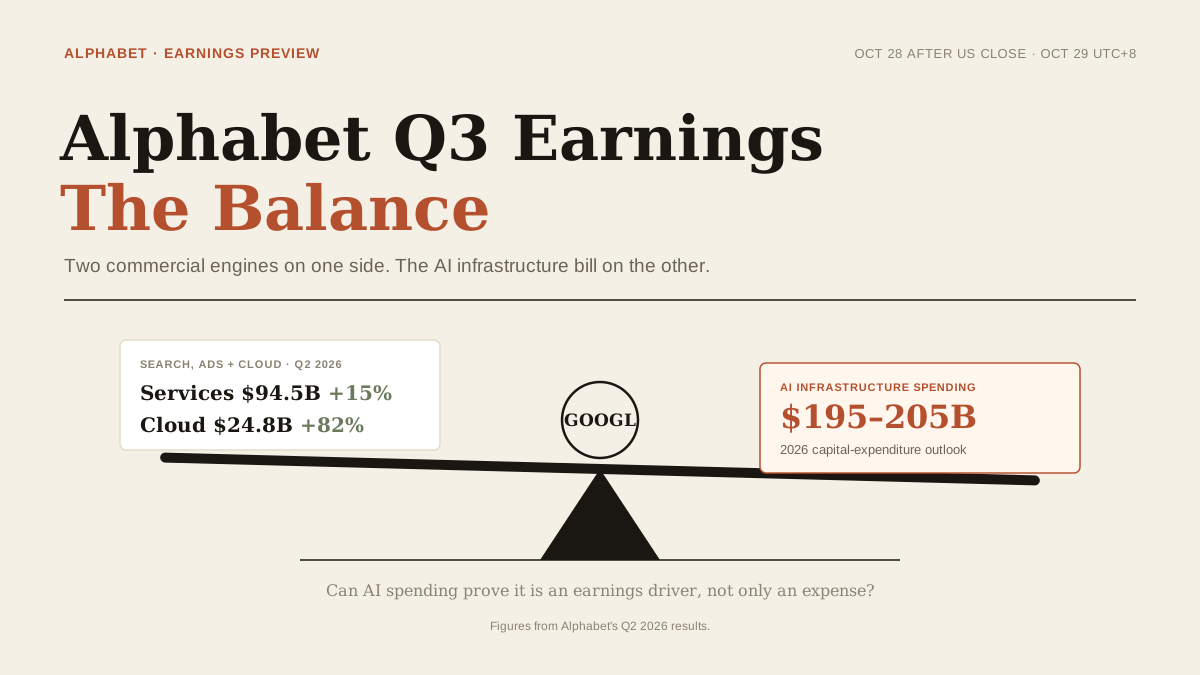
Google Stock Before Alphabet Earnings: Can AI Spending and Search Growth Support GOOGL?
Alphabet reports Q3 2026 results on October 28. See the Search, Google Cloud, AI spending, and guidance signals shaping GOOGL stock.
Fractional Reserve: Reserve Requirement Abolished. Where is the Value?

Anthropic's Revenue Rises to $16.8 Billion Ahead of IPO

‘Is Korea Facing a Second IMF Crisis? The Solution Lies in XRP?’... The Leap of the Crisis Theory by BeInCrypto

ICO, VC Tokens, and Alpha Models: Why They Can't Save the Current Crypto Market?

One Order Book for Dollars and Stablecoins. How It Works

Cyberattack on the ports of Marseille and La Rochelle? Hackers paid 1 dollar in crypto
![[Exclusive] Coinbase Transaction Data Shows 100 Million Trades Misrepresented... Data Analysis Firm Corrects Errors](/public-static/20_9098579959.png?format=avif)
[Exclusive] Coinbase Transaction Data Shows 100 Million Trades Misrepresented... Data Analysis Firm Corrects Errors

Wall Street Morning Report: U.S. Inflation Resurfaces, AI Credit Risks Spread, Chip Stocks Fall for Six Consecutive Days
Arthur Hayes: Focus on Established DeFi Projects with Cash Flow
Anthropic Reports $16.8 Billion Revenue in Q3, IPO Feasibility Strengthened

Hot CPI Lifts Hike Bets; Risk Assets Pull Back | WEEX TradFi Daily(October 15, 2026)
Major indexes closed lower on October 14, with the Nasdaq leading the decline. September unadjusted CPI rose to 3.7% year on year, above forecasts, and core CPI also beat expectations. Traders sharply raised this month’s hike probability to about 43.7% and fully priced two more hikes by the end of January. Chip stocks were sold again. Bitcoin broke below $83,000 and last traded near $81,700, while spot gold and silver fell. Crypto-related stocks were under pressure, but PYTH rose against the tape. October 15 brings PPI, retail sales and key
WEEX Exclusive:Hot CPI Lifts Hike Bets; Risk Assets Pull Back | WEEX TradFi Daily(October 15, 2026)

Sam Price Observes Changes in Bitcoin ETF Net Inflows
Pago Móvil Reaches 63% of Transactions in Venezuela, Competing with USDT
Analysts Bullish on MicroStrategy, Target Price Raised to $240
Bank of America Report Shows $39 Billion Inflow into US Stocks in One Week, Strategists Prefer Risk Aversion
MSCI New Rules Implemented, 14 Crypto Companies Enter Potential Impact List
What Do the New Tesla Roadster Specs Mean for Tesla (TSLA) Stock?
Explore the new Tesla Roadster specs, reservation payments and 2028 production plan, plus what the reveal could mean for Tesla stock and future profits.
Quant (QNT) Price Prediction 2026–2030: Can Bank Adoption Drive a Return to $500?


