
Visa's $2.5 Billion On-Chain Business: Pre-Funding Issuers and Using Smart Contracts for Collections

 Prefer us on Google

Written by: Liam Akiba Wright
Compiled by: Chopper, Foresight News
Every credit card payment creates a timing mismatch for the companies behind it. Credit card issuers often have to pay Visa on a daily settlement basis before the funds from customers arrive, leaving a brief but recurring funding gap.
On September 8, Visa announced the launch of an on-chain lending program aimed at filling this gap. Credit Coop is an on-chain credit protocol that provides a revolving credit line in stablecoins: institutions use it to pre-fund settlement payments, and the cardholders' subsequent repayments automatically flow back to repay the advance.
This design brings traditional accounts receivable financing onto the blockchain. Smart contracts automatically handle withdrawals, fund flows, and repayments; while authorized Visa settlement documents remain the core determinants of "how much can be borrowed and based on what." The result is a hybrid credit market: the execution process is more transparent on-chain, but the decisive commercial data and risk terms remain in the hands of the authorized parties and are not publicly disclosed.
Settlement Gaps as Collateral
In stablecoin-linked credit card projects, regardless of how cardholders repay, they must first pay according to Visa's settlement schedule. This mismatch is particularly challenging for emerging projects: transaction volumes are soaring, but the bank credit they can access or the financing obtained through accounts receivable collateral does not keep pace, widening the gap.
Visa states that this funding demand is growing alongside stablecoin businesses. The company reported that by the second quarter of fiscal year 2026, there were over 160 stablecoin-linked credit card projects, with payment volumes increasing nearly 200% year-on-year; the annualized settlement amount for stablecoins has recently surpassed $20 billion, more than 15 times that of the same period last year.
Each metric measures different aspects of the business. The number of projects reflects network coverage, the growth rate of payment volume indicates card transaction activity, and the settlement operating rate represents the annualized value of recent fund flows. Credit Coop's outstanding loan principal is another independent metric. However, taken together, these indicators point to the same conclusion: an increasing number of projects may need to use settlement receivables as collateral to borrow short-term funds for turnover.
According to Visa, participating institutions will withdraw from the revolving credit line in stablecoins to fulfill their settlement obligations for the day, with funds flowing directly to Visa's settlement address. Subsequently, the money repaid by cardholders will first flow through Credit Coop's Spigot contract—a programmable vault: once the funds arrive, interest is automatically paid, the credit line is replenished, and the remainder enters the borrower's operating account.
Visa describes this model as "secured solely by settlement receivables," which is a fundamental difference from common DeFi structures: in DeFi, borrowers typically need to pledge cryptocurrencies worth more than the loan itself; here, the support for lending comes from the future payment flows generated by cardholders.
On-chain records every withdrawal and repayment, leaving timestamps, token flows, and contract execution histories. Visa states that Credit Coop has processed over 3,000 borrowing events and 9,000 repayment events across its participating credit arrangements.
Visa also has a second layer of evidence mechanism. Visa claims that Credit Coop receives daily authorized settlement documents for each project through secure channels, and then combines these records with on-chain historical records to determine the scale of funds, verify fund disbursements, and repayment statuses. Public transaction data can record the flow of tokens, while Visa's data stream associates these flows with specific settlement obligations and the operational performance of the projects.
This gives Visa a broader role. Its infrastructure bridges the timing gap, while its records help lending institutions determine how much funding is needed to fill this gap.
Performance Records Are Large, Highly Concentrated, and Self-Reported
Visa states that since 2023, the Credit Coop model has provided financing for over $2.5 billion in settlement volume, with zero defaults. The company also noted that increased lender participation has reduced borrowing costs for participants in the program by up to 30%.
Both claims should be viewed with caution. The cumulative financing settlement amount measures the turnover capacity of revolving credit lines. The same funds can be lent, repaid, and reused, so the $2.5 billion figure itself does not indicate any day's outstanding principal or risk capital, nor should it be interpreted as Credit Coop's revenue, total credit card spending, or market share.
The source of the data is also important. Visa's accompanying explanation indicates that the data is provided by Credit Coop, with on-chain event counts as of August 19, 2026, and states that the zero default status should be reconfirmed before publication. As for the claim of reduced borrowing costs, Visa did not provide specific financing rates, sample sizes, or calculation methods.
Payment company Rain is a major member of Visa, accounting for most of the disclosed activities. Visa states that Rain has been using Credit Coop's revolving credit line since August 2023, and as of August 19, the company has completed over 2,000 borrowings and 7,000 repayments, totaling approximately $2 billion in settlement amounts.
The repeated withdrawals and repayments over three years indicate that this is a functioning operational system, but the existing data provides limited insight into the nature of credit risk. Initial credit limits, current risk exposures, lender concentration, and performance during loss cycles are all outside the scope of disclosure.
Karta's experience illustrates how far Visa believes this model can go. Visa states that Karta initially relied on Credit Coop's funds for startup and expansion before switching to larger institutional credit.
Karta itself confirmed this larger funding in a June announcement: a $140 million financing led by Galaxy Ventures and Community Investment Management (CIM). However, this announcement made no mention of Credit Coop—so the claim that "Karta's early growth relied on on-chain financing" currently rests solely with Visa.
This sequence also highlights a potential role for on-chain credit: smaller projects can first use on-chain funds to repeatedly borrow and repay, building an operational record, and then seek traditional institutional financing once they grow larger. Thus, blockchain credit appears more like a stepping stone to private credit rather than a replacement for it.
Programmable Priorities Still Present Loss Issues
Credit Coop's documentation states that a credit arrangement can include multiple lenders and allocate priority repayment rights to them through cash flows controlled by the Spigot contract. The contract enforces pre-set paths for fund flows.
Credit Coop's technical documentation also points out the personnel and software dependencies surrounding this commitment. The protocol grants significant powers to arbitrators and Spigot owners. Its extreme case documentation describes potential changes to income contracts, misappropriation of cash flows, malicious control, and complex situations in execution after defaults. These are design-level risks, with no indication that they have occurred in Visa-associated credit arrangements.
The exclusive legal protections for each credit arrangement remain outside the purview. Public disclosures do not list every lender behind Visa-associated programs, nor do they provide a complete waterfall order for determining loss allocation, and they do not answer the following questions: Do borrowers provide first-loss equity or reserves? Are there guarantees or insurance? And to what extent can lenders' claims extend when controlled receivables are insufficient?
Programmable vaults can enhance lenders' control over incoming value, but when customers default on payments or when receivables are disputed, they cannot create value or route funds that never entered the controlled path. Any resulting losses will depend on the protective measures and contractual rights that Visa and Credit Coop have yet to publicly detail.
Compared to the label "on-chain lending," this boundary more clearly defines the essence of this experiment. A useful product is a priority claim on payment flows, serviced at blockchain speed, and based on Visa's records. Public chains provide execution evidence, while Visa's data and credit contracts determine the extent to which this evidence can indicate credit quality.
For on-chain credit, this is a product with significant market potential, as it addresses the ongoing financing needs generated by credit card settlements. It simultaneously strengthens Visa's position in the market: the network provides channels, critical credit review data, and the background information needed to convert token transfers into credit signals.
-- Price
This content is provided for general informational purposes only and doesn't constitute financial, investment, legal, or tax advice. Any events, rewards, online promotions, or related information mentioned herein should not be considered a recommendation, solicitation, or invitation to purchase, sell, trade, or otherwise deal in any crypto assets. Crypto assets are highly volatile and may result in loss. The availability of WEEX services, products, and related events may vary by region. You are responsible for ensuring that your participation is in accordance with applicable local laws and regulations.
You may also like

Analysts Bullish on MicroStrategy, Target Price Raised to $240

Bank of America Report Shows $39 Billion Inflow into US Stocks in One Week, Strategists Prefer Risk Aversion

MSCI New Rules Implemented, 14 Crypto Companies Enter Potential Impact List

What Do the New Tesla Roadster Specs Mean for Tesla (TSLA) Stock?
Explore the new Tesla Roadster specs, reservation payments and 2028 production plan, plus what the reveal could mean for Tesla stock and future profits.

Quant (QNT) Price Prediction 2026–2030: Can Bank Adoption Drive a Return to $500?

Spout raises $2M to offer 0% interest loans on Solana

RWA Weekly: Ant Group and HSBC Test Agent Tokenized Payments; Robinhood Explores Tokenized Actively Managed ETFs

BlackRock CEO Larry Fink Flags a Different AI Risk, and It Isn’t the Bubble

Shanghai Supports International Data Center Construction to Facilitate Cross-Border Data Flow

Shanghai Advances National Blockchain Network Construction, Strengthens Cross-Chain Service Capabilities

When Will AI Investments Pay Off? JPMorgan Optimistic About Google and Amazon

What is being said at the tables: the BCRA turns on the dollar vacuum and the city counts the bullets in Javier Milei's bazooka

New Developments in the Blue Sky Ge Rui Case: Bitcoin Rises 200 Times, Can Victims Only Be Compensated at Original Price?
Bitcoin inflows to US set to turn positive in 2026, Chainalysis says
iGaming Tokens Need Real Revenue, Not Just Hype
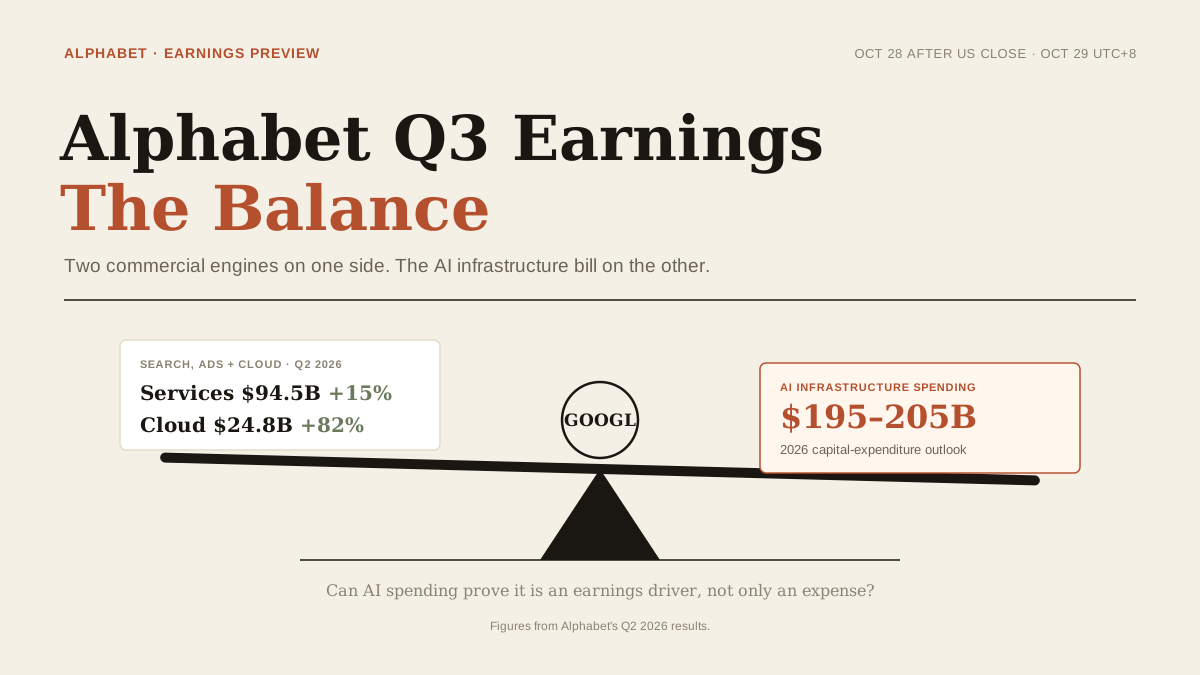
Google Stock Before Alphabet Earnings: Can AI Spending and Search Growth Support GOOGL?
Alphabet reports Q3 2026 results on October 28. See the Search, Google Cloud, AI spending, and guidance signals shaping GOOGL stock.
Fractional Reserve: Reserve Requirement Abolished. Where is the Value?

Anthropic's Revenue Rises to $16.8 Billion Ahead of IPO

‘Is Korea Facing a Second IMF Crisis? The Solution Lies in XRP?’... The Leap of the Crisis Theory by BeInCrypto

ICO, VC Tokens, and Alpha Models: Why They Can't Save the Current Crypto Market?

One Order Book for Dollars and Stablecoins. How It Works

Cyberattack on the ports of Marseille and La Rochelle? Hackers paid 1 dollar in crypto
![[Exclusive] Coinbase Transaction Data Shows 100 Million Trades Misrepresented... Data Analysis Firm Corrects Errors](/public-static/20_9098579959.png?format=avif)
[Exclusive] Coinbase Transaction Data Shows 100 Million Trades Misrepresented... Data Analysis Firm Corrects Errors

Wall Street Morning Report: U.S. Inflation Resurfaces, AI Credit Risks Spread, Chip Stocks Fall for Six Consecutive Days
Arthur Hayes: Focus on Established DeFi Projects with Cash Flow
Anthropic Reports $16.8 Billion Revenue in Q3, IPO Feasibility Strengthened

Hot CPI Lifts Hike Bets; Risk Assets Pull Back | WEEX TradFi Daily(October 15, 2026)
Major indexes closed lower on October 14, with the Nasdaq leading the decline. September unadjusted CPI rose to 3.7% year on year, above forecasts, and core CPI also beat expectations. Traders sharply raised this month’s hike probability to about 43.7% and fully priced two more hikes by the end of January. Chip stocks were sold again. Bitcoin broke below $83,000 and last traded near $81,700, while spot gold and silver fell. Crypto-related stocks were under pressure, but PYTH rose against the tape. October 15 brings PPI, retail sales and key
WEEX Exclusive:Hot CPI Lifts Hike Bets; Risk Assets Pull Back | WEEX TradFi Daily(October 15, 2026)

Sam Price Observes Changes in Bitcoin ETF Net Inflows

G20 warns that stablecoins may lose value even if fully backed
Analysts Bullish on MicroStrategy, Target Price Raised to $240
Bank of America Report Shows $39 Billion Inflow into US Stocks in One Week, Strategists Prefer Risk Aversion
MSCI New Rules Implemented, 14 Crypto Companies Enter Potential Impact List
What Do the New Tesla Roadster Specs Mean for Tesla (TSLA) Stock?
Explore the new Tesla Roadster specs, reservation payments and 2028 production plan, plus what the reveal could mean for Tesla stock and future profits.
Quant (QNT) Price Prediction 2026–2030: Can Bank Adoption Drive a Return to $500?
Spout raises $2M to offer 0% interest loans on Solana


