
AMD Stock Ahead of Q3 2026 Earnings: Revenue, AI Demand, and Key Risks to Watch

 Prefer us on Google


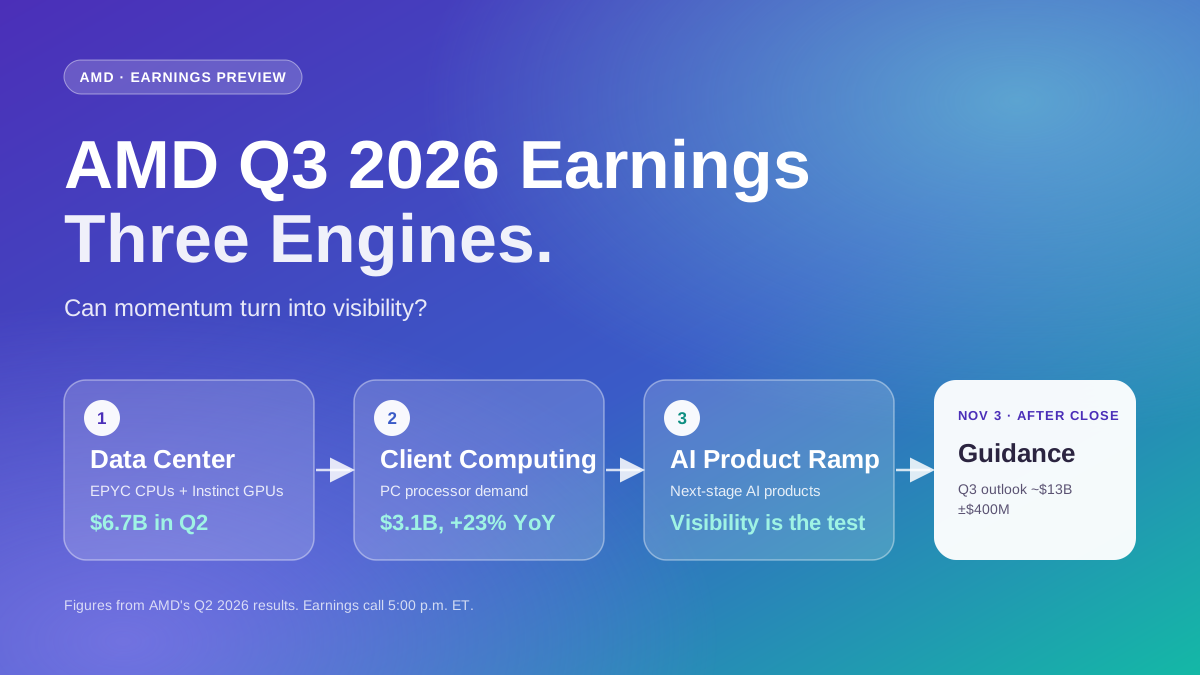 AMD is scheduled to report fiscal third-quarter 2026 results after the market closes on Tuesday, November 3. The central question for AMD stock is whether the company can show that its exceptional data-center growth is continuing while also giving credible evidence that future AI product ramps will convert into durable revenue, margins, and customer demand.
Our view is that AMD’s Q3 report needs to do more than repeat a strong AI narrative. The company has already set a high bar through rapid data-center expansion and a Q3 revenue outlook of about $13 billion. The more important test is whether the results and next-quarter guidance show broad, sustainable execution rather than expectations being carried by future product potential alone.
When Is AMD Reporting Q3 2026 Earnings?
AMD has announced that it will release fiscal Q3 2026 results on Tuesday, November 3, after the U.S. market closes. Management’s earnings call is scheduled for 5:00 p.m. Eastern Time, or 2:00 p.m. Pacific Time.
The event arrives after a strong Q2. AMD reported revenue of $11.5 billion, up 50% year over year, while Data Center revenue reached $6.7 billion, up 107% year over year. The company said this was driven by demand for EPYC processors and Instinct GPUs. For Q3, AMD guided to approximately $13 billion in revenue, plus or minus $400 million.
That combination explains why the earnings setup is demanding. AMD does not only need to report growth. It needs to show that growth remains robust enough to support the expectations created by its data-center momentum and expanding AI roadmap.
The AMD Earnings Question Is a Revenue-Quality Question
A headline revenue beat can be positive, but it does not answer every question surrounding AMD stock. Investors will want to know where the growth came from, whether it is profitable, and whether the company’s next-quarter outlook supports the same trajectory.
The most useful way to read AMD’s report is as a revenue-quality check across four areas:
| Area | What to Watch | Why It Matters |
|---|---|---|
| Data Center | EPYC processor and Instinct GPU demand | This segment is the main engine behind AMD’s current AI and server-growth narrative |
| Gross Margin | Whether product mix supports or pressures profitability | Higher revenue is more valuable when it also improves earnings quality |
| Client and Gaming | PC processor demand versus semi-custom and gaming trends | It shows whether growth is broad-based or concentrated in one segment |
| Forward Guidance | Q4 revenue outlook and commentary on product ramps | Markets value the next stage of demand, not only the reported quarter |
This framework is especially important because data-center growth can make AMD’s total revenue look stronger even when other segments are mixed. That does not necessarily mean the quarter is weak. It means investors should distinguish between a concentrated AI-led quarter and broad execution across the portfolio.
Data Center Remains the Key AMD Stock Driver
AMD’s Data Center segment is likely to be the most closely watched part of the report. In Q2, the segment generated $6.7 billion in revenue—more than half of company-wide revenue—and grew 107% from the prior-year period.
That scale changes the way AMD earnings should be interpreted. The company is no longer judged only as a PC and gaming chipmaker with AI upside. Data-center demand has become central to both its operating performance and the expectations embedded in AMD stock.
Investors will therefore look for more than a broad statement that demand remains healthy. They will want management to clarify the balance between server CPU demand, AI accelerator demand, customer deployments, and the timing of new product availability.
A favorable report would show that the existing data-center business remains solid while the next generation of AI products is progressing on schedule. A less convincing report would leave investors with strong current numbers but little visibility into whether the next stage of growth can meet elevated expectations.

-- Price
Why AI Demand Must Be Separated From AI Expectations
The phrase “AI demand” can hide several different questions. There is demand for server CPUs that support AI workloads, demand for GPU accelerators, demand for complete rack-scale systems, and demand that has been announced but has not yet reached material revenue.
For AMD, this distinction matters. The company’s AI opportunity is real, but investors should separate what is contributing to reported revenue today from what is expected to contribute in future quarters. Product roadmaps, partnership announcements, and customer interest can all be strategically meaningful without producing the same immediate financial effect.
The Q3 call will be more useful if management clarifies:
- Which AI products are already contributing materially to revenue.
- How demand is evolving across existing Instinct GPUs and server processors.
- Whether product availability, supply, memory, or customer deployment schedules could affect the pace of future growth.
- How the company expects the mix of CPUs, accelerators, and integrated systems to influence margins.
This is the difference between a narrative-driven earnings read and an operational one. Investors do not need every AI project to contribute immediately. But they do need a clear path from product development to volume deployment and revenue recognition.
Client Computing Can Still Matter to the AMD Earnings Story
AMD’s Client and Gaming segment generated $3.8 billion in Q2 2026. Within that segment, Client revenue was $3.1 billion, up 23% year over year, while Gaming revenue was $779 million, down 31% year over year because of lower semi-custom revenue.
That split is worth watching in Q3. Strong client-processor demand can help diversify AMD’s growth beyond the data center. But weaker gaming or semi-custom demand can pull in the other direction. The key is not that every business line must move identically; it is whether the overall portfolio supports AMD’s revenue and margin profile as the data-center mix expands.
This also makes AMD different from a pure-play AI infrastructure story. Its earnings report contains signals about enterprise computing, PCs, gaming, embedded products, and AI data centers. The most useful interpretation comes from understanding how those businesses fit together rather than treating every result as a single AI verdict.
What Could Change the Market’s View After November 3?
AMD stock may react to the gap between reported results and the market’s prior expectations. That means the forward-looking discussion can be as important as the Q3 figures themselves.
A constructive earnings read could include revenue near or above the upper end of AMD’s guidance range, continued Data Center strength, stable or improving gross-margin commentary, and a Q4 outlook that supports confidence in the product ramp. Clear detail around customer adoption would strengthen that case.
A more cautious reaction could follow if growth remains strong but guidance suggests a slower pace ahead, if margins do not reflect the higher-value mix investors expect, or if management provides limited visibility into AI-product timing. In a market already debating the durability of AI infrastructure spending, uncertainty can matter as much as the reported result.
The crucial question is not whether AMD can post growth. It is whether the company can explain why that growth remains durable as the comparison base becomes more demanding.
AMD Stock and the WEEX TradFi Prediction Event
The WEEX TradFi Prediction Event runs from October 6 through November 6, 2026, placing AMD’s November 3 earnings within the active campaign period. Users who register can take part in eligible earnings predictions using activity points, with a minimum of one point per prediction.
For each eligible earnings event, the prediction channel closes 10 minutes before the scheduled report. The result is based on the comparison between the closing price on the trading day before earnings and the close on the first trading day after earnings. For AMD’s after-market release, that means the next regular trading day’s closing reaction is the relevant result—not only the initial after-hours move.
Users should review the latest eligible-event list, task requirements, and activity rules on the event page before participating.

A Practical Earnings Checklist for AMD
Before AMD reports, readers can reduce noise by writing down the company’s own Q3 outlook—approximately $13 billion in revenue, plus or minus $400 million—and then comparing the actual report against that starting point.
After the release, the most useful questions are:
- Did AMD meet or exceed its own revenue outlook?
- Did Data Center growth remain strong, and did management explain the mix between CPUs and AI accelerators?
- Did gross-margin commentary support the quality of growth?
- Did Client revenue continue to offset weaker Gaming trends?
- Did Q4 guidance make the next AI product ramp clearer or more uncertain?
This checklist is more useful than reacting to a single earnings-per-share headline. It turns a complex report into a set of linked operating questions.
WEEX Editorial View: AMD Must Convert AI Momentum Into Visibility
AMD’s opportunity is not in doubt. Its Q2 Data Center results showed that the company has already become a meaningful participant in the AI infrastructure buildout. But the market has moved past broad excitement about AI exposure. It now wants evidence of execution, supply readiness, profitable mix, and forward visibility.
That is why AMD’s November 3 report matters. The most important outcome would not merely be another large growth percentage. It would be a report that connects present demand with a believable path through the next product cycle. For AMD stock, the difference between momentum and durable value will be found in that connection.
FAQs
1. When Is AMD Reporting Q3 2026 Earnings?
AMD is scheduled to report fiscal Q3 2026 results after market close on Tuesday, November 3, 2026.
2. What Is AMD’s Q3 2026 Revenue Guidance?
AMD guided to Q3 2026 revenue of approximately $13 billion, plus or minus $400 million.
3. Why Is Data Center Revenue So Important for AMD Stock?
AMD’s Data Center segment generated $6.7 billion in Q2 2026, up 107% year over year. It is the company’s largest reported growth engine and a key indicator of server and AI demand.
4. How Does the WEEX TradFi Prediction Event Settle AMD Earnings Predictions?
For eligible events, the result compares the closing price on the trading day before earnings with the closing price on the first trading day after earnings. Check the activity page for the latest event eligibility and rules.
Sources
- AMD: Fiscal Q3 2026 Results Announcement — accessed October 15, 2026
- AMD: Q2 2026 Financial Results — accessed October 15, 2026
- WEEX TradFi Prediction Event — activity period: October 6 to November 6, 2026
This content is provided for general informational purposes only and doesn't constitute financial, investment, legal, or tax advice. Any events, rewards, online promotions, or related information mentioned herein should not be considered a recommendation, solicitation, or invitation to purchase, sell, trade, or otherwise deal in any crypto assets. Crypto assets are highly volatile and may result in loss. The availability of WEEX services, products, and related events may vary by region. You are responsible for ensuring that your participation is in accordance with applicable local laws and regulations.
You may also like

AMC's No Does Not Automatically Halt AMC Stock Tokens Abroad on Robinhood

New Exchanges in Russia, Spy Chips in Ledger, and Cryptocurrency Market Events

Ledger Receives Warning of Hardware Wallet Implant, Former Mt. Gox CEO Accuses Insufficient Response

Institutions managing 800 billion euros question crypto token earnings
Suspect in the Murder of Crypto Tycoon Roman Novak Dies in UAE Prison

Pearl's Strategic Power: Not Eliminating Useless Miners, But Naturally Phasing Them Out Through Economic Principles
Bank of America Report Shows $39 Billion Inflow into US Stocks in One Week, Strategists Prefer Risk Aversion

Glassnode reports Bitcoin enters early recovery after Q3 bottoming

Nine Crypto Companies Form Quantum Alliance Amid Controversy Over Freezing Vulnerable Assets

G7, AI and Stablecoins: The 3 Stablecoin Issues Ignored by Finance Ministers

Xi Jinping Inspects Ulanqab, Emphasizes Accelerated Development of Computing Power Industry

The Other Side of Artificial Intelligence: Why Wall Street Is Starting to Distrust Chips

$5 Billion Bitcoin Seized: Should the Gains Belong to Victims or the UK Government?
A Project Aiming to Live for 100 Years Hands Over Its Exam to the Community

Payward, Parent Company of Kraken, Acquires Parent Company of Saldo Bank to Obtain EU Banking License
Solana event in China canceled, CZ questions organizers

唐华斑竹 Analyzes FIL Supply Changes, Significant Price Fluctuations

Bank Terminated Account of Crypto Company. Court Threatened 10,000 PLN for Each Day of Delay

Kenson Investments Publishes New Education Series on the SEC’s Proposed Crypto Offering Framework

Former Trump Crypto Advisor Under Investigation for Potential Benefits from GENIUS Act

Bo Hines' $6.3 Million Deal with Tether Under Investigation

Bitcoin ETFs See $5.06 Million Net Inflow as Bearish Expectations Rise
WEEX Exclusive:CPI, PPI and TSMC Earnings Recap | WEEX Weekly Market Recap (2026.10.12-10.16)

Filecoin Adjusts Reward Mechanism, Launches New Products for Enterprises and AI Agents

CPI, PPI and TSMC Earnings Recap | WEEX Weekly Market Recap (2026.10.12-10.16)
WEEX Weekly Market Recap focuses on CPI, PPI, TSMC earnings, AI financing pressure, BTC’s key support, the PYTH buyback narrative, L2 and privacy-token rotation, and crypto-finance strength. Risk assets first pulled back on oil, inflation, and AI valuation pressure, then rebounded quickly after the market digested the PPI shock.

a16z: The Endgame of AI Business Models Is Not Selling 'Seats' but Taking 'Cuts'

Federal Reserve Officials Signal Hawkish Stance: Daly Says Supply Shocks Should No Longer Be Ignored, Hammack Warns of Need for More Aggressive Rate Hikes as Inflation Expectations Solidify

Lightning Labs launches LayerTree BTC scaling technology

Analyst Jukan: Storage and Computing Power Will Fluctuate in Sync, AI Demand May Support Storage

Researchers Communicate with Rogue AI Agents Using Hidden Text
AMC's No Does Not Automatically Halt AMC Stock Tokens Abroad on Robinhood
New Exchanges in Russia, Spy Chips in Ledger, and Cryptocurrency Market Events
Ledger Receives Warning of Hardware Wallet Implant, Former Mt. Gox CEO Accuses Insufficient Response
Institutions managing 800 billion euros question crypto token earnings
Suspect in the Murder of Crypto Tycoon Roman Novak Dies in UAE Prison
Pearl's Strategic Power: Not Eliminating Useless Miners, But Naturally Phasing Them Out Through Economic Principles


