
ETHFI Rallies as ether.fi Pivots to Neobanking — Can the Momentum Last?

 Prefer us on Google
ETHFI has returned to the spotlight in early October as ether.fi accelerates its shift from a staking-focused DeFi protocol toward a broader self-custodial crypto neobank model. On October 7, ETHFI traded around $0.77 on WEEX, with a 24-hour gain of more than 6%, while price briefly tested the $0.80 area.
The move followed ether.fi’s latest partnership with MoonPay, which is expected to bring fiat on/off ramps, cross-chain trading, virtual accounts, and crypto deposit infrastructure into the ether.fi ecosystem over time.
The key question is whether this new payments and neobanking narrative can support ETHFI beyond the initial news-driven rally.
What Does the ether.fi–MoonPay Partnership Include?
MoonPay announced a full-stack payments partnership with ether.fi designed to support its crypto neobank strategy.
The integration is expected to include several products:
- Headless Ramps, allowing users to move between fiat and crypto without leaving the ether.fi interface;
- MoonPay Trade, supporting cross-chain swaps and asset conversion;
- Virtual Accounts, designed to support account-based payment flows;
- Crypto Deposits, allowing users to move supported assets from external wallets and platforms.
The rollout is expected to happen in stages rather than all at once.
This matters because ether.fi is trying to reduce the friction between traditional financial rails and onchain finance. Instead of focusing only on staking yield, the platform increasingly aims to combine saving, trading, borrowing, payments, and asset management inside one self-custodial environment.
Why Is ether.fi Moving Beyond Restaking?
ether.fi originally became one of the most prominent names in Ethereum liquid staking and restaking. Its early growth was closely tied to EigenLayer and demand for ETH-based yield products.
However, the protocol has gradually repositioned itself.
The newer strategy is centered on becoming a self-custodial crypto neobank, with products that extend beyond staking into payments, cards, borrowing, tokenized assets, and fiat access.
That shift changes how the market may evaluate ether.fi over time.
Previously, investors mainly focused on metrics such as:
- ETH staked;
- TVL;
- restaking participation;
- staking yield.
Under a neobank model, additional indicators could become relevant, including:
- payment volume;
- active users;
- card usage;
- fiat inflows and outflows;
- cross-chain transaction activity;
- lending and borrowing demand.
Still, growth in ether.fi’s business does not automatically translate into higher ETHFI prices. The connection between product adoption and token value remains an important issue for the market to evaluate.
Why Is ETHFI Rising?
ETHFI’s latest move reflects a combination of project-specific news and broader market conditions.
The MoonPay partnership provides a fresh narrative around payments and crypto banking, while ether.fi’s wider product expansion has helped move attention away from the older restaking-only story.
At the same time, ETHFI had already been recovering from the $0.68–$0.70 area, making the MoonPay announcement an additional catalyst rather than the only reason for the rally.
On WEEX, ETHFI recently traded near $0.773, with price testing the $0.80 region.
That makes $0.80 the most important short-term level to watch.
-- Price
ETHFI Price Analysis: Key Levels to Watch
Recent price action suggests several important technical zones.
Price Level | Market Role |
|---|---|
$0.68–$0.70 | Lower support zone |
$0.72–$0.75 | Near-term support |
$0.78–$0.80 | Current resistance |
$0.85 | Higher breakout area |
$0.90–$1.00 | Extended bullish scenario |
If ETHFI can remain above $0.75 and break through $0.80 with stronger trading volume, the short-term structure could improve further.
If price fails to hold the $0.72–$0.75 zone, the recent rally may begin to lose momentum, bringing the $0.68–$0.70 support area back into focus.
These levels are technical reference zones based on recent price action, not guaranteed targets.
ETHFI Price Prediction: Can It Break Above $0.80?
The short-term ETHFI price prediction depends largely on whether market attention around the neobank pivot can turn into sustained demand.
Three broad scenarios can help frame the current setup:
Scenario | Possible Price Structure | Main Conditions |
|---|---|---|
Bullish | Breaks $0.80 and tests $0.85–$0.90 | Strong volume, continued product momentum, positive crypto sentiment |
Neutral | Consolidates around $0.72–$0.80 | News impact fades while buyers and sellers remain balanced |
Bearish | Falls below $0.72 and retests $0.68–$0.70 | Weak adoption signals, broader market pressure, profit-taking |
A stronger breakout above $0.80 could bring the $0.85 area into focus. If momentum remains strong and broader market conditions stay supportive, traders may begin watching the $0.90–$1.00 zone.
However, that would require more than partnership headlines. Sustainable upside would likely depend on actual user adoption, product rollout progress, and stronger demand for the ether.fi ecosystem.
For a broader outlook, readers can also review the ETHFI price prediction on WEEX.
Can the Neobank Narrative Sustain the Rally?
The neobank pivot gives ether.fi a broader long-term narrative, but execution will be critical.
The MoonPay partnership is important because it adds infrastructure that could make ether.fi easier to use for everyday financial activity. However, the products are expected to roll out gradually, so actual adoption data will matter more than the announcement itself.
Several factors will determine whether the momentum continues:
- how quickly MoonPay-powered features are launched;
- whether users adopt fiat ramps and cross-chain trading;
- whether the Cash Card and payment products see meaningful usage;
- whether ether.fi can grow beyond its original staking audience;
- whether protocol activity creates clearer value for ETHFI.
The main risk is that the business expands while token demand remains relatively weak.
How to Trade ETHFI on WEEX
WEEX provides both ETHFI spot and futures markets.
Step 1: Prepare Trading Funds
Users who already hold supported assets such as USDT, USDC, BTC, or ETH can transfer funds to a WEEX account.
Before depositing, users should confirm the correct deposit address, select a supported network, and make sure the sending network matches the network supported by WEEX.
Users without crypto can explore WEEX Quick Buy or the WEEX P2P marketplace.
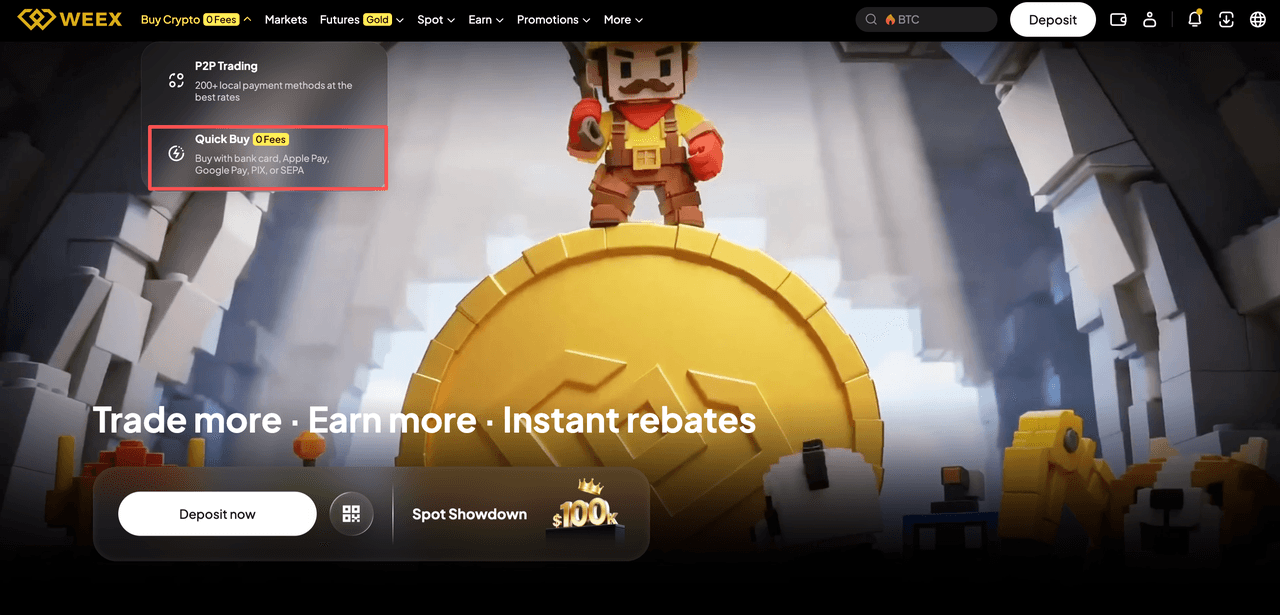
New users can also register on WEEX.
WEEX was founded in 2018 and serves more than 10 million users across over 150 countries and regions. Its services include spot and futures trading, copy trading, APIs, TradFi, and AI trading tools.
Step 2: Open the ETHFI Market
For spot trading, users can open the ETHFI/USDT spot trading pair.
Spot users can choose a Market Order or Limit Order, enter the amount of ETHFI they want to buy or sell, review the order details, and submit the trade.
For derivatives, users can access the ETHFI/USDT futures trading pair.
Futures users can choose Long or Short, adjust leverage, enter position size, and consider using Stop Loss and Take Profit according to their own risk-management approach. Leverage can amplify both gains and losses.
For a more detailed beginner guide, see how to buy ether.fi (ETHFI).
WEEX also provides Proof of Reserves and states that it maintains a 1,000 BTC protection fund.
Final Outlook: Can ETHFI Keep Its Momentum?
ETHFI’s latest rally reflects more than a short-term price move. ether.fi is attempting to reshape its identity from a staking-heavy DeFi protocol into a broader self-custodial crypto neobank.
The MoonPay partnership strengthens that transition by adding payment, fiat access, and cross-chain infrastructure.
For price, however, $0.80 remains the key near-term test.
A sustained breakout could bring $0.85 and potentially higher levels into focus, while a loss of the $0.72–$0.75 area would weaken the current structure.
The bigger question is whether ether.fi can turn its new banking and payments strategy into real user activity and whether that growth can eventually translate into stronger ETHFI demand.
For now, the neobank story gives ETHFI a fresh narrative, but the durability of the rally will depend on execution rather than headlines alone.
This content is provided for general informational purposes only and doesn't constitute financial, investment, legal, or tax advice. Any events, rewards, online promotions, or related information mentioned herein should not be considered a recommendation, solicitation, or invitation to purchase, sell, trade, or otherwise deal in any crypto assets. Crypto assets are highly volatile and may result in loss. The availability of WEEX services, products, and related events may vary by region. You are responsible for ensuring that your participation is in accordance with applicable local laws and regulations.
You may also like

Aave submitted a governance proposal to the Arbitrum DAO, requesting the release of frozen ETH to be injected into DeFi United

Data: A certain whale has accumulated 19,300 ETH, with an unrealized profit of 1.453 million USD
Cryptocurrency VC collectively boosts presence, is the market starting to bottom out and rebound?

Hyperbeat, to launch a "bank" on Hyperliquid
ETHZilla: Currently Holding 102,246 ETH, with a Maximum of $250 Million Available for Stock Buyback

ether.fi Foundation: This week spent 73 ETH from protocol revenue to purchase 264,000 ETHFI tokens

Ripple and SBI Team Up for RLUSD Stablecoin Launch in Japan by Early 2026
Latest Crypto Market Snapshot as of August 22, 2025 BTC Soars to $115,250.00 ETH Hits $4,450.75 XRP Climbs…

XRP Fails to Match Bitcoin and Ether's Success for Long-Term Holders: Why the Token Lags Behind the Market

Fortitude sold $8.3 million in borrowed Zcash to fund its mining expansion

Bank of America: Still Expecting Rate Hike in October, Raises Forecast for Fed's Favorite Inflation Indicator

Study finds $188 billion in risky funds linked to crypto exchanges

September Web3 Security Monthly Report: 48 Major Security Incidents, Over $760 Million in Stolen Funds

Papertrade Revenue Surpasses Circle? It's Just a 'Liquidation Harvesting Machine'

Pearl's Strategic Power: Not Eliminating Useless Miners, But Naturally Phasing Them Out Through Economic Principles

Scammers First Deceive, Then Offer to Help Recover Losses

Ripple opens Wall Street’s door to Hyperliquid’s $59 billion trading market

MSCI New Rules Implemented, 14 Crypto Companies Enter Potential Impact List
G7, AI and Stablecoins: The 3 Stablecoin Issues Ignored by Finance Ministers

What Do the New Tesla Roadster Specs Mean for Tesla (TSLA) Stock?
Explore the new Tesla Roadster specs, reservation payments and 2028 production plan, plus what the reveal could mean for Tesla stock and future profits.

Quant (QNT) Price Prediction 2026–2030: Can Bank Adoption Drive a Return to $500?

Spout raises $2M to offer 0% interest loans on Solana

RWA Weekly: Ant Group and HSBC Test Agent Tokenized Payments; Robinhood Explores Tokenized Actively Managed ETFs
Chips, AI and Bitcoin: Reading Cross-Market Risk Appetite After a Volatile Week

Is a Bitcoin record closer than you think? This one indicator reveals everything

$600 Million in Fake Trading Volume Exposes the Myth of the Prediction Market 'Truth Machine'

The Other Side of Artificial Intelligence: Why Wall Street Is Starting to Distrust Chips

Asia Recovers After Tech Sell-off: What Changed in 24 Hours

WEEX TradFi Weekly Review: Semiconductor Contracts Lag While Apple and Coinbase Rise
WEEX TradFi weekly review: chip contracts lag SPY as Apple and Coinbase rise. Compare returns, buying activity, and leveraged ETF product risks.

Altcoin Season? Why 63% Beat Bitcoin (BTC) While WEEX Median Returns Stayed Flat
WEEX altcoin weekly review: 63% beat Bitcoin while median returns stayed flat. Explore relative strength, leaderboard limits, and altcoin season signals.

Bitcoin (BTC) Weekly Outlook: Price Slips as WEEX Spot and Futures Buying Readings Diverge
Bitcoin weekly outlook from WEEX data: compare completed and partial weeks, spot versus futures buying readings, and the limits of trader positioning.
Aave submitted a governance proposal to the Arbitrum DAO, requesting the release of frozen ETH to be injected into DeFi United
Data: A certain whale has accumulated 19,300 ETH, with an unrealized profit of 1.453 million USD
Cryptocurrency VC collectively boosts presence, is the market starting to bottom out and rebound?
Hyperbeat, to launch a "bank" on Hyperliquid
ETHZilla: Currently Holding 102,246 ETH, with a Maximum of $250 Million Available for Stock Buyback
ether.fi Foundation: This week spent 73 ETH from protocol revenue to purchase 264,000 ETHFI tokens
Contents
Latest articles


Latest coin listings on WEEX


