
Kraken's New Leader, After Acquiring European Bank, Aims to Disrupt the Crypto Market?

 Prefer us on Google


Author: Zen, PANews
On October 14, Kraken's parent company Payward announced that it has signed a final agreement to acquire Lithuania's Saldo Bank. The transaction actually involves the latter's Finnish parent company, Saldo Finance Oy, with the acquisition price yet to be disclosed. The deal is expected to be completed by 2027, pending relevant regulatory approvals.
Although this bank is not large, it possesses a key resource that Payward has long sought: an EU banking license. Saldo Bank currently operates in Lithuania, Finland, Sweden, and Germany, and has the necessary qualifications to enter the Dutch market. Its existing services include retail fixed deposits, consumer loans, SME credit, credit cards, and embedded financial services.
According to Payward's plans, after the acquisition is completed, the group will further integrate banking deposits and loans, payment, credit cards, and digital asset services, allowing customers to manage cash, cryptocurrencies, tokenized stocks, and credit products within the same financial system.
Payward's acquisition of Saldo Bank marks the first instance of a digital asset company acquiring a bank in Europe. One of the key figures driving this expansion is Arjun Sethi, co-CEO of Kraken and Payward. Sethi's career transition also reflects a pathway of crypto capital extending into the traditional financial system.
From Game Developer to Silicon Valley Investor
At 43 years old, Arjun Sethi's career start was far from the financial industry.
Sethi grew up in Silicon Valley, where he was exposed to software development at an early age before entering the internet startup scene. In the late 2000s, the rapid rise of the social network Facebook made games and applications developed on social platforms a hot startup direction.
Sethi was one of them. Around 2007, he founded the social gaming company Roflplay. In 2009, the company was acquired by another social application developer, Lolapps, and Sethi subsequently joined Lolapps' management team.
LOLapps also primarily focused on developing social games and applications around Facebook. As the company entered a phase of rapid growth, the challenges of management arose, leading the then-CEO of Lolapps to propose that Sethi take over the company's operations.
At that time, Sethi lacked experience in corporate restructuring and operational management, so he diligently read "Who Says Elephants Can't Dance?" by former IBM CEO Lou Gerstner, learning how this legendary manager successfully transformed and revitalized IBM. He even wrote valuable insights from the book on index cards, attempting to apply these management methods to the company's operations.
In March 2010, Sethi officially became CEO of Lolapps. In the social gaming industry at that time, developers needed to continuously purchase traffic, analyze user retention, and adjust products based on data. It was during this phase that he began to form a management approach that would run through his career: understanding user behavior through data analysis and driving growth with faster product iterations and marketing decisions.
During this period, LOLapps launched many entertaining interactive products familiar to Facebook users, such as the once-popular "Sex and the City" character personality test. The monthly active users of LOLapps' products once reached 100 million, and the company was eventually sold for $240 million.
Subsequently, Sethi entered the mobile instant messaging market. In 2013, he co-launched MessageMe, attempting to compete for users during the rapid growth of instant messaging applications like WhatsApp. MessageMe experienced rapid initial growth, surpassing 5 million users about two and a half months after its launch, and received support from investment firms such as a16z, Greylock Partners, and Google Ventures.
In October 2014, Yahoo acquired MessageMe. As a core founder, Sethi was then absorbed by Yahoo, responsible for growth, data science, and emerging products.
These two entrepreneurial experiences allowed Sethi to go through the complete process from rapid growth to company integration, gradually shifting his interest towards helping more startups discover growth opportunities. During his entrepreneurial period, he had already begun to rely on personal connections for angel investments. As his investment experience accumulated, he gradually realized that investment firms also needed a systematic method to assess a company's growth potential.
Around 2016, Sethi joined the venture capital firm Social Capital, founded by former Facebook executive and well-known investor Chamath Palihapitiya, as a partner. In 2018, Sethi co-founded Tribe Capital with Social Capital co-founder Ted Maidenberg and partner Jonathan Hsu, officially transitioning from an internet entrepreneur to a professional venture capitalist.
From left to right: Arjun Sethi, Jonathan Hsu, and Ted Maidenberg
Unlike many VCs who rely on founders' backgrounds, market size, and industry experience for judgment, Tribe Capital places greater emphasis on actual operational data of companies. Its investment approach includes analyzing user retention, revenue growth, changes in customer demographics, and product-market fit to identify companies with sustainable growth potential. For Sethi, this method is also the one he is most familiar with.
Tribe Capital's venture capital business gradually extended from internet software to fintech, cryptocurrencies, and artificial intelligence. Its investment portfolio includes companies like Carta, Docker, and xAI. Sethi had also previously participated in investments in tech companies like Gusto, Lyft, and Opendoor.
Beyond capital investment, Sethi increasingly entered the crypto industry. He had brushed past this technology during the early development of Bitcoin. Sethi once stated that during his early days running an internet company, a developer had given him a computer containing mined Bitcoin, but he later discarded the computer. According to his estimates, if those Bitcoins had been kept until now, they could be worth between $300 million and $400 million.
From discarding it to deeply entering the cryptocurrency industry, the real turning point for Sethi came with Tribe Capital's investment in Kraken. In 2021, he officially joined Kraken's board of directors, beginning to participate in the development of this crypto exchange from the perspective of an investor and board member.
In the following years, he experienced the crypto industry's transition from a bull market to a deep adjustment after the FTX collapse, gradually establishing closer collaborative relationships with Kraken's founder Jesse Powell and Thanh Luu. In October 2024, Kraken announced Sethi as co-CEO, leading the company alongside Dave Ripley.
Since taking the helm at Kraken, Sethi's home, not far from Stanford University, has become an important workplace for Kraken. This residence in Menlo Park, California, has a rarely used black Cybertruck parked in the driveway, with electronic equipment in the open garage and personnel coming and going. The interior of the house is almost devoid of decoration, with a German shepherd moving around in the backyard.
Ahmed, CEO of Dubai Multi Commodities Centre (DMCC), visits Sethi's residence.
According to Kraken founder Jesse Powell, since Sethi joined the board in 2021, he has helped Kraken through several difficult periods, thus earning the trust of the management.
For Sethi, who started from internet entrepreneurship and transitioned to investing, data has always been an important basis for decision-making in product operations, capital investment, and company management. This style has also been brought into Kraken. Sethi stated that Powell hopes he will bring the quantitative management methods he used in past business operations into Kraken to help the company further develop its business beyond the exchange.
Shortly after taking office, Sethi initiated organizational restructuring. Kraken announced a reduction in management levels, simplification of internal organization, and layoffs. Sethi also adopted a "flat" management approach, which is rare in large companies, allowing many business leaders to report directly to him.
In early 2025, Sethi revealed in an interview that he has about 50 to 70 direct reports and has developed six or seven automated tools to handle the vast amount of information generated from channels like GitHub, email, and Slack.
This highly centralized management approach has sparked mixed reviews internally. A September 2025 investigative report by Fortune cited former executives saying that Sethi places more emphasis on data and execution efficiency, with relatively limited attention to employee morale and the existing management system. Other former executives believe that this management adjustment helps Kraken improve efficiency and prepare for a future IPO.
Dual Identity: At the Core of Both Kraken and Tribe Capital
While managing Kraken, Sethi retains his position as chairman of Tribe Capital. This means he occupies a core position in both the management of the crypto exchange and the venture capital firm.
This overlapping identity was further reflected in capital transactions. In September 2025, Kraken completed a $500 million financing round, achieving a valuation of $15 billion, with investors including Tribe Capital and Sethi personally.
Two months later, Kraken announced it had secured a total of $800 million in financing commitments, bringing in institutional investors like Citadel Securities at a $20 billion valuation.
Notably, according to Kraken's official announcement, Tribe Capital participated significantly in this round of financing, with Sethi's family office also making a large investment commitment. As the company's valuation rises, the relationship between Sethi and Kraken has now involved multiple layers of capital and governance relationships, including management positions, existing board relationships, and personal and institutional capital investments.
A former executive interviewed by Fortune expressed concerns that Sethi's continued role as chairman of Tribe Capital could create conflicts of interest between investment decisions and company management. A Kraken spokesperson responded that Sethi does not handle the daily operations of Tribe Capital, and his dual identity has been approved by both Kraken's board and Tribe Capital's limited partner advisory committee.
This capital connection continues to extend. In January 2026, a special purpose acquisition company (SPAC) named KRAKacquisition Corp went public on NASDAQ, raising $345 million.
According to the SEC's disclosed prospectus, the company's sponsors, NCTK Sponsor LLC, are jointly composed of Kraken, Tribe Capital, and Natural Capital.
The three parties have equal member rights in the sponsor entity and each appoint a representative to participate in the sponsor management committee, jointly managing the securities and related investment decisions they hold. KRAKacquisition plans to focus on potential acquisition targets at the intersection of traditional finance, fintech, cryptocurrency, and decentralized finance.
From investing in Kraken, joining the board, serving as co-CEO, to participating in financing through Tribe Capital and his family office, and finally jointly launching a SPAC with both institutions, Sethi's connections with Kraken have formed a multi-layered capital and governance relationship.
Continuous Acquisitions: Kraken's Next Financial Chess Game
After Sethi joined Kraken's management, the company's acquisition pace significantly accelerated.
In March 2025, Kraken announced it would spend $1.5 billion to acquire the U.S. futures trading platform NinjaTrader.
This transaction brought Kraken mature futures trading software, a trader customer base, and related infrastructure in the traditional derivatives market.
At the time, NinjaTrader had about 2 million customers, allowing Kraken to directly enter the U.S. traditional futures market beyond its existing cryptocurrency trading users. In the same year, Kraken also acquired Small Exchange, Breakout, and Capitalise.ai, enhancing its capabilities in U.S. derivatives trading, trader services, and automated trading.
In the tokenized asset space, Kraken launched xStocks and further acquired its underlying tokenized stock issuer, Backed Finance, integrating the issuance and trading of tokenized stocks into the same group system.
Entering 2026, acquisitions continued to advance.
In February, Payward acquired the token management platform Magna, expanding its token distribution, ownership management, and related infrastructure services.
In May, Payward completed the acquisition of the U.S. derivatives platform Bitnomial for a maximum price of $550 million. This acquisition granted it qualifications as a futures broker, contract market, and derivatives clearing organization under the U.S. Commodity Futures Trading Commission regulatory framework.
In July, Payward completed the acquisition of the stablecoin payment and issuance infrastructure company Reap, with a previously announced maximum price of $600 million.
Both the Bitnomial and Reap acquisition transactions used a combination of cash and equity for payment, with the relevant agreements valuing Payward's equity at $20 billion.
Looking at these acquisitions together reveals the underlying business logic: NinjaTrader expanded the traditional financial trading user base; Bitnomial supplemented U.S. compliant derivatives trading and clearing capabilities; Backed Finance and xStocks improved the tokenized stock business; and Reap integrated payment, issuance, and cross-border capital flow into the group's service scope.
Now, Saldo Bank further supplements traditional banking deposits, loans, and payment infrastructure. Payward hopes to establish a financial service system encompassing trading, custody, payment, financing, and asset management, providing services to retail traders, institutional clients, and fintech companies through its various brands.
In the acquisition announcement on October 14, Sethi clearly stated that Payward Banking has been under construction for many years, and the group is gradually completing financial infrastructure market by market, license by license. He believes that institutions that master core financial relationships with customers can further provide trading, wealth management, and capital management products around services such as deposits, loans, and payments.
Continuous acquisitions also place higher demands on the group's operations. For Sethi, this expansion brings new operational challenges. In the past, he could diversify risks through investment portfolios, assessing which companies have long-term growth potential. Now, as co-CEO of Payward, he needs to directly assume responsibilities for business integration, organizational management, capital allocation, and regulatory compliance.
Payward has obtained more financial licenses and business capabilities through acquisitions, and the next key task is to integrate the businesses scattered across different markets and regulatory systems into a financially sustainable group.
For this exchange leader who has come from the venture capital world, acquiring a European bank is just a new starting point. The real test for Arjun Sethi will be how to integrate the acquired businesses into a financially sustainable system.
-- Price
This content is provided for general informational purposes only and doesn't constitute financial, investment, legal, or tax advice. Any events, rewards, online promotions, or related information mentioned herein should not be considered a recommendation, solicitation, or invitation to purchase, sell, trade, or otherwise deal in any crypto assets. Crypto assets are highly volatile and may result in loss. The availability of WEEX services, products, and related events may vary by region. You are responsible for ensuring that your participation is in accordance with applicable local laws and regulations.
You may also like

Bank of America’s Hartnett: Sell Signal Ends, Tech Stocks Return to Focus on Semiconductor Prices

Mr&强 Discusses the Interconnection of Five Major Assets in the Global Financial Market

唐华斑竹 Analyzes Market Trends, BTC Futures Open Interest Remains High
BitTorrent Brand Upgrade and BTT First Phase Buyback and Burn Launch Together, Dual Core Drives a New Era of Web3 Infrastructure

Arthur Hayes Reveals Altcoin Selection Logic, Emphasizes Accumulating Bitcoin
Vitalik, Tom Lee, Arthur Hayes and Others Share Views on Cryptocurrency and AI

Multiple Theft Incidents Fund Flow into ZEC, Attackers Use It to Transfer Stolen Funds
![[CoreWeave, AI Crisis Trigger ③] Lessons from the 2008 Financial Crisis](/public-static/057_09c54b942f.png?format=avif)
[CoreWeave, AI Crisis Trigger ③] Lessons from the 2008 Financial Crisis
Pago Móvil Reaches 63% of Transactions in Venezuela, Competing with USDT
Analysts Bullish on MicroStrategy, Target Price Raised to $240

Bank of America Report Shows $39 Billion Inflow into US Stocks in One Week, Strategists Prefer Risk Aversion
MSCI New Rules Implemented, 14 Crypto Companies Enter Potential Impact List

What Do the New Tesla Roadster Specs Mean for Tesla (TSLA) Stock?
Explore the new Tesla Roadster specs, reservation payments and 2028 production plan, plus what the reveal could mean for Tesla stock and future profits.

Quant (QNT) Price Prediction 2026–2030: Can Bank Adoption Drive a Return to $500?

Spout raises $2M to offer 0% interest loans on Solana

RWA Weekly: Ant Group and HSBC Test Agent Tokenized Payments; Robinhood Explores Tokenized Actively Managed ETFs

BlackRock CEO Larry Fink Flags a Different AI Risk, and It Isn’t the Bubble
Shanghai Supports International Data Center Construction to Facilitate Cross-Border Data Flow

Shanghai Advances National Blockchain Network Construction, Strengthens Cross-Chain Service Capabilities

When Will AI Investments Pay Off? JPMorgan Optimistic About Google and Amazon
What is being said at the tables: the BCRA turns on the dollar vacuum and the city counts the bullets in Javier Milei's bazooka

New Developments in the Blue Sky Ge Rui Case: Bitcoin Rises 200 Times, Can Victims Only Be Compensated at Original Price?
Bitcoin inflows to US set to turn positive in 2026, Chainalysis says
iGaming Tokens Need Real Revenue, Not Just Hype
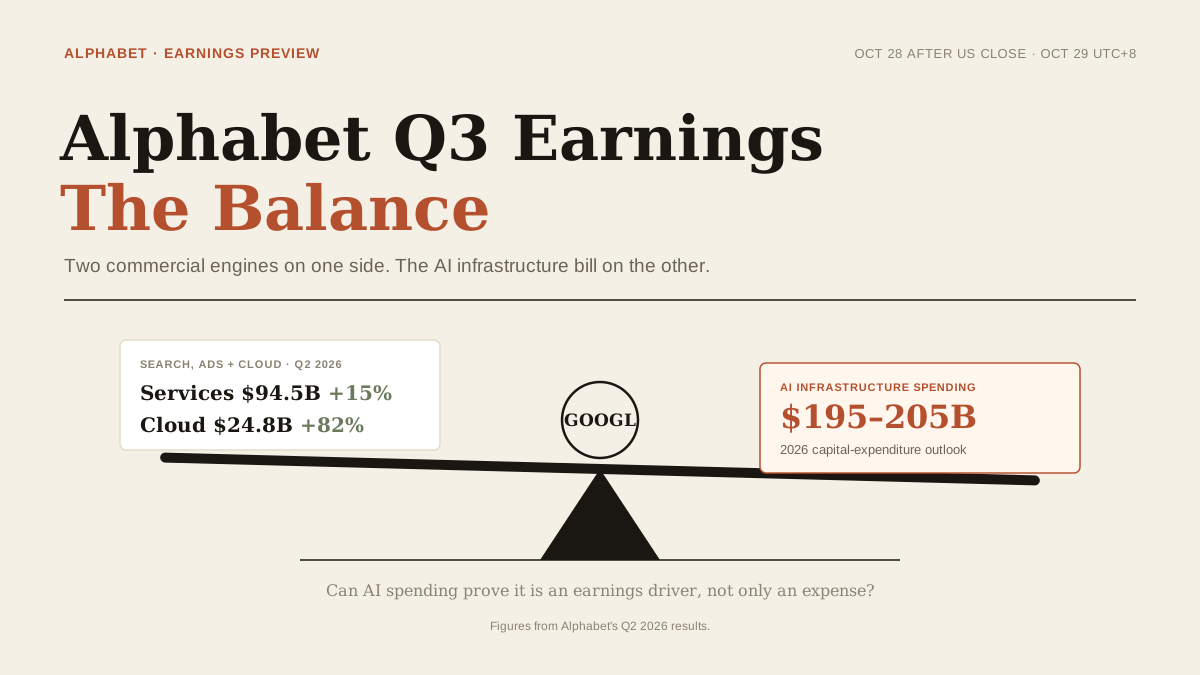
Google Stock Before Alphabet Earnings: Can AI Spending and Search Growth Support GOOGL?
Alphabet reports Q3 2026 results on October 28. See the Search, Google Cloud, AI spending, and guidance signals shaping GOOGL stock.
Fractional Reserve: Reserve Requirement Abolished. Where is the Value?

Anthropic's Revenue Rises to $16.8 Billion Ahead of IPO

‘Is Korea Facing a Second IMF Crisis? The Solution Lies in XRP?’... The Leap of the Crisis Theory by BeInCrypto

ICO, VC Tokens, and Alpha Models: Why They Can't Save the Current Crypto Market?

One Order Book for Dollars and Stablecoins. How It Works
Bank of America’s Hartnett: Sell Signal Ends, Tech Stocks Return to Focus on Semiconductor Prices
Mr&强 Discusses the Interconnection of Five Major Assets in the Global Financial Market
唐华斑竹 Analyzes Market Trends, BTC Futures Open Interest Remains High
BitTorrent Brand Upgrade and BTT First Phase Buyback and Burn Launch Together, Dual Core Drives a New Era of Web3 Infrastructure
Arthur Hayes Reveals Altcoin Selection Logic, Emphasizes Accumulating Bitcoin
Vitalik, Tom Lee, Arthur Hayes and Others Share Views on Cryptocurrency and AI
Contents
Latest articles


Latest coin listings on WEEX


