
NSE Stock Price Debuts Today at a Valuation Higher Than Nasdaq: Here's the Reason

 Prefer us on Google


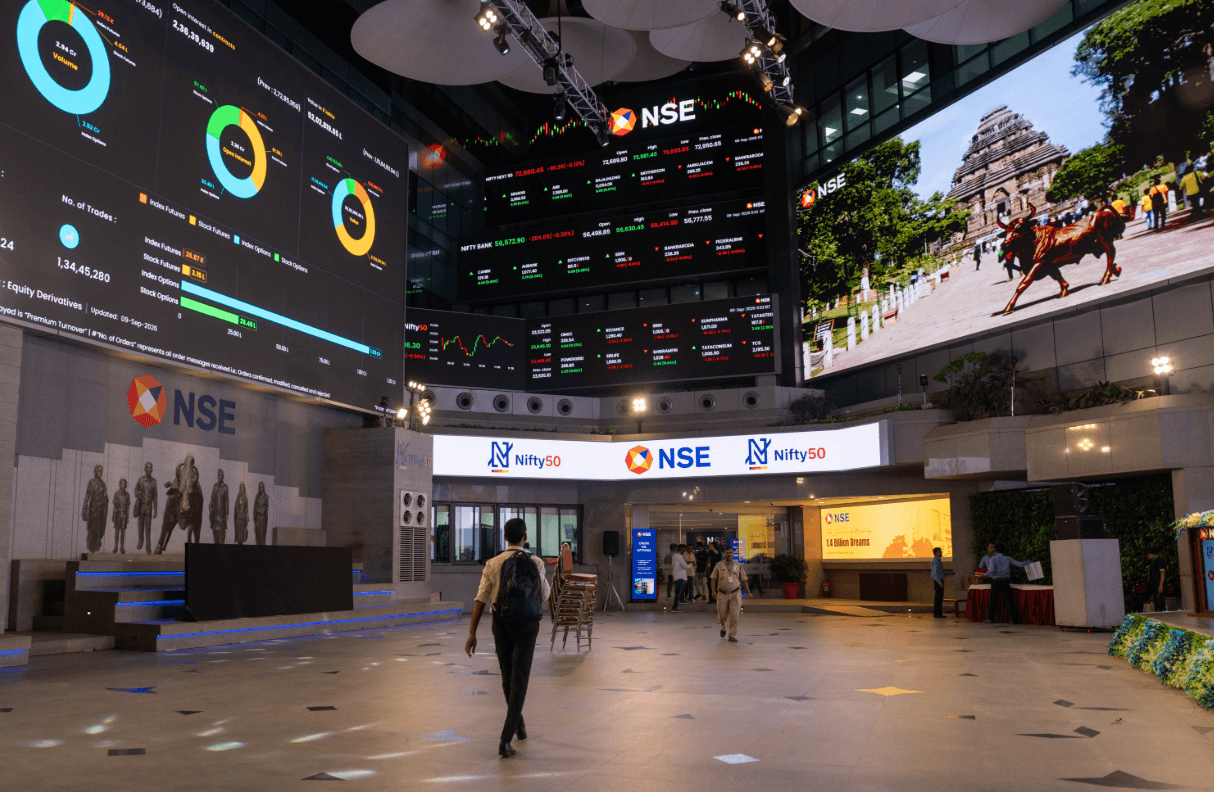
NSE stock price began trading on the BSE today, September 24, marking the end of a nearly decade long wait for India's largest stock exchange to go public.
NSE stock price opened at ₹1,800, a modest 0.84% premium over its ₹1,785 issue price, before climbing further to touch ₹1,869 during the session, a gain of 3.83% from the listing price. What makes this debut genuinely notable isn't the opening pop itself, it's that NSE stock price carries a valuation multiple higher than Nasdaq, Intercontinental Exchange, and several other major global exchanges, a gap worth understanding rather than treating as a simple headline curiosity.
What Actually Happened Today
The National Stock Exchange of India's ₹22,569 crore ($2.3 billion) initial public offering became the country's second largest IPO in history, trailing only Hyundai Motor India's ₹27,870 crore offering in 2024. The listing itself took place on the BSE, NSE's own domestic competitor, rather than on NSE's own platform, a structural choice made to avoid an obvious conflict of interest given the company being listed is itself an exchange operator.
Demand for the offering was genuinely intense. The IPO drew bids for 505.81 million shares against 88.64 million shares on offer, an oversubscription rate of 5.7 times, pulling in total bids worth more than $10 billion. A week before the public offering opened, NSE raised ₹6,746 crore (roughly $704 million) from anchor investors including India's state-owned Life Insurance Corporation, Goldman Sachs, and Fidelity, alongside sovereign wealth funds such as GIC Singapore, the Abu Dhabi Investment Authority, and Norges Bank.

Why NSE's Valuation Actually Exceeds Nasdaq's
Here's the specific comparison worth understanding in detail. At the upper end of its IPO price band, NSE sought a price to earnings multiple of roughly 42.9 to 43 times trailing earnings, according to BusinessToday's reporting citing Bloomberg data. That figure sits meaningfully above every major listed global exchange: Nasdaq trades at around 26 times earnings, Intercontinental Exchange around 21 to 23 times, Hong Kong Exchanges around 25.2 times, the London Stock Exchange Group around 29.3 times, and the Singapore Exchange around 34.3 times, the highest among NSE's international peers before this listing.
That's not a small gap. NSE's asking multiple runs roughly 65% above Nasdaq's and nearly double Intercontinental Exchange's, positioning NSE as, by some measures, the world's most expensive listed stock exchange on an earnings basis, even though its actual market capitalization, estimated at around $46 billion at the upper price band, remains smaller than Nasdaq's roughly $54 billion, CME Group's $99 billion, and ICE's $88 billion.
Why Investors Are Paying This Premium Anyway
The specific reasoning analysts give for this gap centers on growth expectations rather than current earnings alone. Shruti Jain, Chief Strategy Officer at Arihant Capital Markets, put the logic directly: "This premium is not because NSE is a larger exchange but because investors are valuing it based on India's long-term capital market opportunity and NSE's dominance." She added a specific framing worth including directly: "In a way, investors are paying for India's growth story, not just NSE."
That distinction matters for understanding why a smaller exchange can command a richer multiple than considerably larger global peers. India's economy has been growing at roughly 6% to 7% annually, compared to the slower growth typical of developed markets where Nasdaq and ICE generate most of their business. Investors aren't simply pricing NSE's current profitability, they're pricing the possibility that India's financial markets, and NSE's dominant position within them, continue expanding at a pace developed-market exchanges can't match.
-- Price
Why NSE's Market Position Also Supports The Premium
Beyond the growth-story argument, NSE's specific competitive position within India adds another layer to the valuation case. NSE operates as part of a duopoly with BSE inside India, a considerably less competitive landscape than the one Nasdaq or NYSE operate in within the more fragmented US exchange market. Businesses holding stronger, more defensible market positions typically command higher valuation multiples than those facing more direct competition, a standard piece of valuation logic that applies here specifically.
NSE also posted a profit of ₹10,302 crore in fiscal year 2026, with earnings per share of ₹41.62. For direct domestic comparison, India's only other listed exchange, BSE, trades at roughly 54 times its own FY26 earnings, meaning NSE's asking multiple, while expensive by global standards, actually looks less rich relative to its single domestic peer than it does against international exchanges.
Analysts have also pointed to NSE's operational efficiency as a specific justification. According to Nirmal Bang Institutional Equities, NSE's non volume linked expenses ran at 22.73% of operating revenue in FY26, compared to 31.71% for CME Group, 33.45% for Nasdaq, and 52.06% for LSEG, a meaningfully leaner cost base than several of the larger global peers NSE is being compared against.
Why This Comparison Still Comes With Real Caveats
It's worth including the more skeptical read directly rather than treating the growth story justification as settled. Some analysis has specifically flagged that NSE's profit compound annual growth rate over the past five years has been "just 8%," with some investor commentary suggesting this year could actually see an earnings decline, a detail that complicates the growth narrative used to justify the premium multiple. In that framing, a valuation in the high 30s to low 40s on a P/E basis starts to look considerably more demanding than the optimistic growth story alone would suggest.
There's also a specific revenue concentration concern worth noting. NSE depends on its options trading segment for around 60% of total revenue, with a majority of that tied specifically to weekly options contracts, a concentration that raises both business risk and regulatory risk questions, since any future regulatory changes targeting derivatives or weekly options specifically could disproportionately affect NSE's revenue base compared to more diversified global exchanges.
What This Debut Actually Represents Beyond The Valuation Question
Separate from whether the multiple itself is justified, today's listing carries real symbolic weight. NSE's IPO had been stalled for nearly a decade amid regulatory hurdles, including issues linked to a co-location controversy that dogged the exchange's public listing ambitions for years. Clearing those obstacles and finally reaching the public market today represents a significant milestone for Indian capital markets regardless of where the stock trades in the weeks ahead.
A successful listing at this scale would also position NSE among the world's most valuable exchanges by market capitalization, even without matching the largest global players dollar for dollar, reflecting both the scale NSE has already reached as the world's largest derivatives exchange by contract volume and the broader growth story investors are betting on by accepting its premium valuation.
Conclusion
NSE stock price's debut today caps a listing process nearly a decade in the making, opening at a modest premium before extending gains to nearly 4% above its issue price. The valuation questions surrounding this listing are genuinely worth taking seriously in both directions: NSE's roughly 43 times earnings multiple exceeds every major global exchange including Nasdaq, ICE, and Hong Kong Exchanges, a premium analysts attribute to India's growth trajectory and NSE's dominant domestic market position rather than current earnings alone. Whether that premium proves justified depends on whether NSE's profit growth accelerates meaningfully beyond its recent 8% five year trajectory, and whether its heavy reliance on weekly options revenue holds up against future regulatory scrutiny, questions today's listing itself doesn't resolve.
FAQ
1. Why did NSE stock list on the BSE instead of its own exchange?
As an exchange operator itself, NSE listing on its own platform would create an obvious conflict of interest, so the IPO took place on rival exchange BSE instead.
2. How does NSE's valuation actually compare to Nasdaq?
NSE sought a price to earnings multiple of roughly 42.9 to 43 times trailing earnings, compared to Nasdaq's approximately 26 times, meaning NSE's earnings multiple runs about 65% higher despite NSE's smaller overall market capitalization.
3. Why are investors willing to pay a premium above global exchange peers?
Analysts attribute the premium primarily to India's faster economic growth trajectory and NSE's dominant duopoly position with BSE domestically, framing the valuation as a bet on India's broader capital markets growth rather than NSE's current earnings alone.
4. What risks could challenge NSE's premium valuation?
NSE's profit growth has averaged only around 8% annually over the past five years, and the company depends on options trading, particularly weekly options, for roughly 60% of its revenue, creating concentration and regulatory risk concerns.
5. How large was NSE's IPO compared to other Indian listings?
At ₹22,569 crore (roughly $2.3 billion), it ranks as India's second largest IPO ever, behind only Hyundai Motor India's ₹27,870 crore offering in 2024.
This content is provided for general informational purposes only and doesn't constitute financial, investment, legal, or tax advice. Any events, rewards, online promotions, or related information mentioned herein should not be considered a recommendation, solicitation, or invitation to purchase, sell, trade, or otherwise deal in any crypto assets. Crypto assets are highly volatile and may result in loss. The availability of WEEX services, products, and related events may vary by region. You are responsible for ensuring that your participation is in accordance with applicable local laws and regulations.
You may also like

Stablecoins: Mastercard and BVNK Launch Fiat and Crypto Account, Stripe Targets 100 Countries with Its Cards

Memecoins: 17 Days to Reach the Peak, One Year to Lose 95%!

LayerZero Launches Post-Quantum Signature Aggregation System Aerie, Aggregating Over 32,000 Signatures in 0.65 Seconds

Bitcoin Directly or via an ETP in a Securities Account: What to Choose?

New Exchanges in Russia, Spy Chips in Ledger, and Cryptocurrency Market Events

September Web3 Security Monthly Report: 48 Major Security Incidents, Over $760 Million in Stolen Funds

Papertrade Revenue Surpasses Circle? It's Just a 'Liquidation Harvesting Machine'

Pearl's Strategic Power: Not Eliminating Useless Miners, But Naturally Phasing Them Out Through Economic Principles

G7, AI and Stablecoins: The 3 Stablecoin Issues Ignored by Finance Ministers

Is a Bitcoin record closer than you think? This one indicator reveals everything

WEEX TradFi Weekly Review: Semiconductor Contracts Lag While Apple and Coinbase Rise
WEEX TradFi weekly review: chip contracts lag SPY as Apple and Coinbase rise. Compare returns, buying activity, and leveraged ETF product risks.

A Project Aiming to Live for 100 Years Hands Over Its Exam to the Community

The Kobeissi Letter: Today's 'Invisible' Bear Market is 'One of the Most Significant Opportunities'

The Past and Present of Currency in the Age of Exploration

Bank Terminated Account of Crypto Company. Court Threatened 10,000 PLN for Each Day of Delay

Who Will Take Over the U.S. Crypto Agenda After the Departure of Crypto Policy Advocate from the White House?

Rising Energy Costs Push Up Prices, Fed Faces Tougher Rate Decisions

Budget 2027: Where do the crypto amendments stand in the assembly?

Ledger Scams: A Fraudster Loses 60 Bitcoins

a16z: The Endgame of AI Business Models Is Not Selling 'Seats' but Taking 'Cuts'

What is being said at the tables: the BCRA turns on the dollar vacuum and the city counts the bullets in Javier Milei's bazooka
New Developments in the Blue Sky Ge Rui Case: Bitcoin Rises 200 Times, Can Victims Only Be Compensated at Original Price?

Chainlink Integrates Oracles on Stellar for DeFi Markets
Bitget CEO Warns of New Decline in Cryptocurrency Market
Google Says AI Isn't Building Itself Yet—Even Though It Writes 75% of the Code

iGaming Tokens Need Real Revenue, Not Just Hype

Ledger launches a phone and payment system for AI amid community criticism

AI 'Challenges' Cryptography? Web3 Must Prepare in Advance, But Should Not Rush to Migrate

American inflation is 'blazing hot': experts warn

Zcash Q3 Report: Zakura Launched, Privacy Pool Supply Returns to 29%
Stablecoins: Mastercard and BVNK Launch Fiat and Crypto Account, Stripe Targets 100 Countries with Its Cards
Memecoins: 17 Days to Reach the Peak, One Year to Lose 95%!
LayerZero Launches Post-Quantum Signature Aggregation System Aerie, Aggregating Over 32,000 Signatures in 0.65 Seconds
Bitcoin Directly or via an ETP in a Securities Account: What to Choose?
New Exchanges in Russia, Spy Chips in Ledger, and Cryptocurrency Market Events
September Web3 Security Monthly Report: 48 Major Security Incidents, Over $760 Million in Stolen Funds


