
The Past of Prince Group: $15 Billion in Bitcoin Frozen on the Chain

 Prefer us on Google


The coins are frozen, and no one can access the money.
Written by: Cathy
On October 22, the Cambodian Anti-Fraud Committee announced the freezing of nearly $1 billion in assets belonging to the Prince Group, uncovering 198 affiliated companies and issuing arrest warrants for 32 individuals. In the same month, the UK froze the London mansion of the Prince Group's financial officer. The recovery of assets is still accelerating, but that batch of Bitcoin remains untouched.
Approximately 127,000 coins, breaking the three-year seizure record held by the Bitfinex case. Based on the price of Bitcoin at the time of the U.S. Department of Justice's indictment in October 2025, this amounts to about $15 billion. After being transferred to the U.S. government's cold wallet in June to July 2024, the chain has been completely silent.
01 Ten Parks, Tens of Thousands of Slave Laborers
Chen Zhi, born in 1987 in Fujian, China, holds the title of Neak Oknha in Cambodia (often translated as 'Duke') and was a senior advisor to former Prime Minister Hun Sen. His Prince Holding Group claims to control over 100 entities, with operations in more than 30 countries.
The indictment from the U.S. Eastern District of New York reveals another side: the Prince Group has built and operated at least ten closed scam parks across Cambodia, surrounded by high walls, barbed wire, and armed guards.
This is not a prison; it is an 'industrial park' of a commercial group that claims to be in real estate.
The parks run industrialized fraudulent investment schemes, known in the industry as 'pig butchering'. Just two locations seized 1,250 mobile phones, controlling over 76,000 fictitious social media accounts.
Operators impersonate high-end financial professionals, spending months building trust with targets before leading them to fake trading platforms. Once victims invest their savings, they disappear completely.
At the core of the scam is human trafficking. A 2023 report from the UN Office of the High Commissioner for Human Rights estimates that at the peak of the Cambodian scam parks, at least 100,000 forced laborers were detained. The indictment cites communication records alleging that Chen Zhi personally approved violent punishments for the laborers.
A duke's title and a charitable facade hide a camp of enslaved workers surrounded by barbed wire. The Prince Group is not just a scam gang; it is a complete chain from human trafficking to crypto money laundering.
Chen Zhi was arrested in Cambodia in January 2026. At least seven jurisdictions worldwide subsequently initiated freezes or confiscations of Prince Group assets. The U.S. applied to confiscate approximately 127,000 Bitcoins, Cambodia froze nearly $1 billion in assets and uncovered 198 affiliated companies, Hong Kong restricted about 8.9 billion HKD, and the UK froze the London mansion and luxury watches of affiliated individuals.
02 Where Did the Private Keys Come From?
The 127,000 Bitcoins are the core target of the entire case, but their origin is itself a mystery.
Blockchain intelligence firm Elliptic released a tracking report in October 2025, determining that this batch of Bitcoin was not a summary of transfers from victims but rather assets that were transferred in one go from the mining pool LuBian in December 2020.
However, the U.S. Department of Justice still claims that this batch of Bitcoin is the proceeds of fraud converted through money laundering and is subject to confiscation.
LuBian was once among the top mining pools globally. However, the technical team made a fatal error when generating the cold wallet private keys: the random algorithm used only a 32-bit seed, resulting in about 4.3 billion possible combinations. It sounds like a lot, but for modern computers, trying them all is just a matter of time.
In December 2020, approximately 127,000 Bitcoins were drained in one go, valued at about $3.5 billion at the time.
The mining pool operator spent tens of thousands of dollars in on-chain fees, sending hundreds of requests to the target address, stating, 'Please return our funds; we are willing to pay a ransom.' No one responded. LuBian ceased operations in early 2021, and the incident was initially viewed as an internal embezzlement.
Until August 2025, on-chain analysis firm Arkham Intelligence disclosed part of the address files, bringing this dormant asset back into the public eye.
The U.S. Department of Justice keeps the process of obtaining the private keys highly confidential. The public indictment only states that this batch of Bitcoin is now held by the U.S. government, without explaining how control was obtained.
But one key question remains unanswered: if Chen Zhi's people stole the coins from the mining pool, how did the U.S. government obtain the private keys from him? The indictment does not explain.
The origin of the private keys is unclear, yet they are precisely the legal basis for the entire confiscation case. The defense team has pointed out in court motions that the lack of transparency in obtaining the keys could undermine the legality of the confiscation.
03 Seven Countries Pursuing Asset Recovery, Winners Undetermined
The assets of the Prince Group are scattered across at least seven jurisdictions, with each asset recovery process advancing independently.
The U.S. Eastern District Federal Court is currently hearing the civil forfeiture case for Bitcoin, and as of October 2026, both parties are still exchanging legal documents, with a final judgment far from being reached.
In January 2026, the Central Bank of Cambodia officially ordered Prince Bank to liquidate and arrange for depositors to withdraw their funds.
On October 22, the Anti-Fraud Committee further announced the results of its investigation: freezing buildings, casinos, and thousands of properties, valued at nearly $1 billion, uncovering 198 affiliated companies and issuing arrest warrants for 32 individuals.
In May 2026, the Hong Kong High Court issued property restriction orders against Chen Zhi and others, totaling about 8.9 billion HKD, of which over 6 billion HKD is under Chen Zhi's name.
In October, the UK froze the London mansion and luxury watches of Prince Group's financial officer Li Tian, Singapore froze hundreds of millions of dollars, Taiwan seized luxury cars and other assets, and South Korea froze about $64 million.
Freezing does not equal confiscation, and confiscation does not equal distribution. Each country's legal basis and disposal priorities are entirely different.
The U.S. tends to reclaim the Bitcoin for the federal treasury, while Cambodia wants to assign real estate to the state. There is no binding transnational distribution mechanism among the parties. Whoever actually controls the asset carriers holds the initiative in disposal.
Victims are facing not one lawsuit, but seven disconnected lawsuits.
-- Price
04 Why Victims Cannot Get Money
The sharpest contradictions are concentrated in the U.S.
Several law firms representing hundreds of victims submitted civil claims to the U.S. Eastern District Federal Court, demanding proportional compensation from the 127,000 Bitcoins. The U.S. Department of Justice quickly requested a complete dismissal.
The core reason for the dismissal is: there is no corresponding relationship on-chain between the victims' money and the seized Bitcoins.
The money that victims were scammed out of was mostly fiat currency or USDT (a stablecoin pegged to the dollar), which flowed into the money laundering network and became operational funds for the mining pool. The seized Bitcoins are accumulated stock from the mining pool, which, after multiple layers of cleaning, cannot be directly matched with any of the scammed funds on-chain.
In other words, the money that was scammed and the seized coins are not legally the same asset. Victims cannot participate in distribution as property rights holders and can only wait for an indefinite administrative remedy.
The International Consortium of Investigative Journalists (ICIJ) criticized in its Coin Laundry series that the Department of Justice has never publicly disclosed the technical details of obtaining the private keys but used the strictest evidentiary standards to dismiss victims' claims. Rights protection lawyers call this 'secondary harm'.
Victim advocacy organization 'Clover Action' calls on Congress to establish a special compensation fund to bypass the on-chain tracing threshold and compensate based on verified loss ratios.
But another force is also vying for this asset. Wyoming Senator Lummis and other lawmakers advocate for the 127,000 Bitcoins to be included in the proposed 'U.S. National Strategic Bitcoin Reserve' as a permanent anti-inflation asset.
Victim organizations publicly condemn: reclaiming plundered assets for national reserves is a dual failure of law and morality.
The breakdown of on-chain tracing, the rigidity of the confiscation system, and the competition of national sovereignty create three overlapping barriers. Victims face the same reality: the money is on the chain, visible but unrecoverable.
This money belongs to everyone, yet belongs to no one.
This content is provided for general informational purposes only and doesn't constitute financial, investment, legal, or tax advice. Any events, rewards, online promotions, or related information mentioned herein should not be considered a recommendation, solicitation, or invitation to purchase, sell, trade, or otherwise deal in any crypto assets. Crypto assets are highly volatile and may result in loss. The availability of WEEX services, products, and related events may vary by region. You are responsible for ensuring that your participation is in accordance with applicable local laws and regulations.
You may also like

Tether Releases Voice Recognition Model for Local Use on Mobile and PC

Waller Faces a Tough Battle Next Week: Pausing Rate Hikes is Easy, But How to Stabilize Inflation Expectations?

HTX Research's Latest Report Interprets Midterm Elections and the Crypto Market: Elections Change Policy Expectations, Macro and Capital Determine Market Limits

Anthropic Set to IPO, Crypto Market Prices in $1.9 Trillion Valuation?

RedStone Launches New FIL Price Feed on Filecoin for Apps

Total Inflows in XRP ETFs Reach $1.8 Billion

A Midnight privacy-vault demo needs outside signers to release Ethereum tokens

How Should Heirs Legally Withdraw Cryptocurrency Left by Deceased Relatives?

Ripple teams up with $10B payments firm Arf to expand RLUSD use on XRPL

DFINITY Founder Accuses NEAR Intents of Misappropriating Proprietary Technology

U.S. Blockchain Association Calls for Advancement of Digital Asset Tax Legislation

Are Meme Stock Tokens a Passing Fad or a New Gateway to Traditional Securities Markets?

One billion dollars in three days is not enough. Bitcoin faces a significant challenge

Lido’s proposed exits would pay lenders with borrower collateral

Countdown to the U.S. Midterm Elections: How Will Changes in Congressional Control Affect Cryptocurrency Market Pricing?

From Ledger to Bitget: What Are the Overlooked 'Trust Blind Spots' in Crypto Security?

France Proposes Accountability for Crypto Platforms in DeFi Events
SpaceX’s $194 billion share unlock exposes a major risk in Aave’s tokenized stock ambitions

The Global Illusion of 'Zero Tax' on Crypto: No Capital Gains Tax Does Not Mean Tax-Free Profits

Decibel launches Aptos Encrypted Mempool to protect traders from MEV

DekaBank launches Bitcoin trading for Sparkassen customers
Solana Surpasses Robinhood Chain with 1.5 Million Tokenized Shareholders

Elon Musk Discusses National Debt, Reflections on DOGE, and the Robot Economy, Revealing the Truth About Superintelligence Going Out of Control

Kraken’s $80 stablecoin fee gap exposes hidden costs

Money Here: What the New Cryptocurrency Regulations Change
Cardano Leios targets 3–5x capacity through staged Dijkstra rollout
Pump.fun’s 79% first-day dropout rate fuels memecoin trader fatigue

Dragonfly Executive Haseeb Qureshi: AI Agents Don't Need Cryptocurrency, What They Need is Us Humans
After Disassembling a Genuine Ledger, TBC Discusses the True Boundaries of Self-Custody
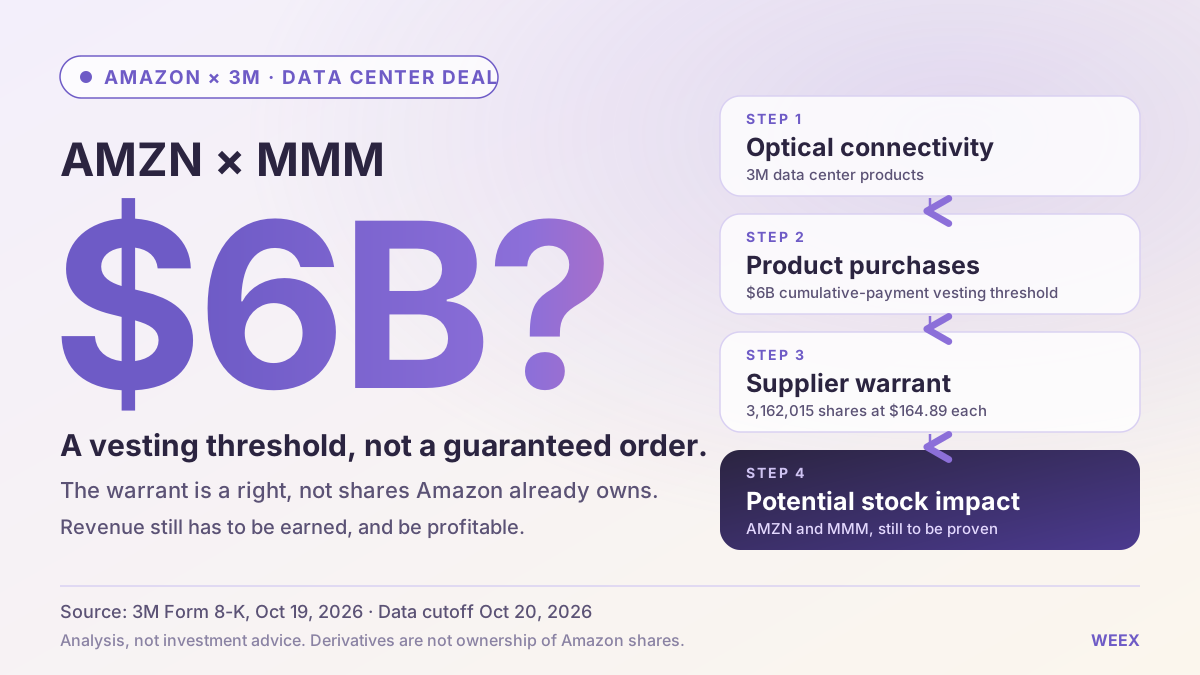
Amazon’s 3M Data Center Deal: What It Means for Amazon (AMZN) and 3M (MMM) Stock
Assess Amazon’s 3M data center deal, the $6 billion warrant threshold, potential dilution, and what the agreement could mean for AMZN and MMM stock.
Tether Releases Voice Recognition Model for Local Use on Mobile and PC
Waller Faces a Tough Battle Next Week: Pausing Rate Hikes is Easy, But How to Stabilize Inflation Expectations?
HTX Research's Latest Report Interprets Midterm Elections and the Crypto Market: Elections Change Policy Expectations, Macro and Capital Determine Market Limits
Anthropic Set to IPO, Crypto Market Prices in $1.9 Trillion Valuation?
RedStone Launches New FIL Price Feed on Filecoin for Apps
Total Inflows in XRP ETFs Reach $1.8 Billion



