
PONS Robinhood Chain Token: What the Buyback Rally Rests On

 Prefer us on Google


PONS is not Robinhood's token. It is the native asset of Pons, a third-party launchpad that anyone could deploy on Robinhood Chain because the chain is permissionless — Robinhood Markets does not issue it, endorse it, or stand behind it. That distinction matters more than usual right now, because the PONS Robinhood Chain token has been one of the loudest movers in the market: CoinGecko had it at $0.4238 on 2 September 2026, up 280% in seven days and roughly 1,298% in thirty, with a $302.7M market cap and 287.9 million tokens already burned. This piece covers what the launchpad actually does, where the money comes from, why a single competitor launch cut the token in half in August, and how to trade it without walking into the liquidity trap underneath the volume figure.
Is PONS Robinhood's own token? No — here's the difference
Robinhood Chain went live on 1 July 2026 as an Arbitrum-built Ethereum Layer 2 aimed at tokenized equities and real-world assets. Permissionless is the operative word: any developer can deploy to it, and the presence of the Robinhood name on the chain confers nothing on the contracts running there.
Four separate assets get mixed up under the "pons robinhood" heading:
- HOOD — the Robinhood Markets equity, and separately its tokenized-stock representation trading on-chain. Company exposure. Nothing to do with PONS.
- ETH — the gas token of Robinhood Chain. PONS is not the chain's gas.
- PONS — the launchpad token at contract
0x39dBED3a2bd333467115dE45665cC57F813C4571on Robinhood Chain, built by a developer who goes by Ozzy and posts as MEADGod. WEEX's listing page notes the deployer transferred ownership and fee rights to Ozzy, with fees directed to buybacks and burns. - A same-ticker PONS on Solana — a different asset entirely. Ticker collisions are how people buy the wrong thing.
Verify the contract address before you touch anything. Any token marketing itself as the "official Robinhood coin" is a scam, and the permissionless chain guarantees there will be more of them. If you want the architecture underneath all of this, WEEX's breakdown of how Robinhood Chain works and how stock tokens are bought covers the L2 design and the RWA side.
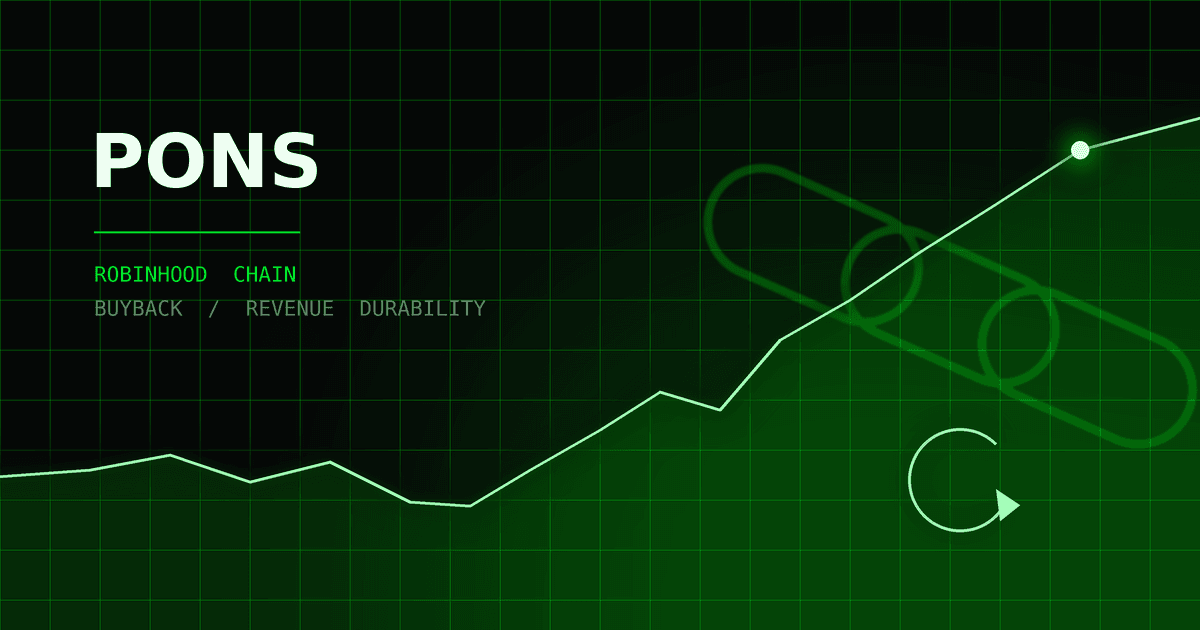
How the Pons launchpad turns 1% fees into PONS burns
Pons opened on Robinhood Chain on 13 July 2026 as a no-code token deployer — pick a name, pay a small fee, get a token and a liquidity pool in one transaction. The economics are the whole investment case:
- Launch fee: 0.0005 ETH plus gas per deployment.
- Pool fee: 1% on trades in Pons-launched pools.
- Split: 70% of that 1% to the token's creator, 30% to the protocol.
- Buyback: 80% of the protocol's share funds automated TWAP purchases of PONS, which are then burned.
Version two, whose factory first ran on 3 August 2026, replaced V1's fixed 1-billion-supply-against-WETH design with an ETH bonding curve that graduates at a 4.2 ETH threshold into a permanently locked Uniswap v4 pool via a shared Pons hook. It also opened pairs beyond ETH — the USDG stablecoin and tokenized equities including NVDA, AAPL and HOOD — and switched creator payouts to ETH by default rather than the launched token.
Read plainly: PONS is a claim on launchpad market share. Every token deployed and every trade in a Pons pool feeds the burn. Nothing else does.
What the Uniswap pools.trade shock revealed about PONS revenue
This is the part the explainers skip, and it is the most useful thing on the record.
On 5 August 2026, Uniswap Labs launched pools.trade on the same chain — charging no launchpad fee at all, with each token opening a Uniswap v4 pool at a 0.25% LP fee that autocompounds into liquidity the creator cannot withdraw, plus an optional 0.05% creator cut. Uniswap's own framing called that "a fraction of the standard ~1% on other launchpads." Hayden Adams argued directly that the 1% pool fee is where launchpad extraction happens and that a 2% effective spread degrades a token's liquidity as it grows.
Pons launched on Uniswap's infrastructure. It was named in Uniswap's own launchpad aggregator six days before pools.trade opened. Then it was competed with.
The result was immediate: pools.trade created 10,506 tokens on 5 August against Pons' 7,210, per on-chain counts. PONS traded at $0.0213 on 6 August, down 49.1% on the week, with a $15.92M market cap — about 68% below its 27 July record. Pons' daily launches that day were roughly a third of its 21,689 peak.
PONS has since recovered violently — new highs on ten consecutive sessions from 23 August, a record 22,600 token creations and $187M of volume on 30 August, roughly $950K of daily revenue at the end of the month, and a reported $4.73M fee day on 1 September that exceeded Hyperliquid, Polymarket and Fomo combined. Cumulative platform volume passed $4.54 billion on 2 September, with more than 500,000 tokens created.
The recovery is real. So is the lesson: the buyback is downstream of market share, market share is contestable by anyone willing to charge less, and the 1% fee that funds the burn is exactly the surface a competitor attacks. Treat the August drawdown as the base rate for what a credible challenger does to this token, not as an anomaly that has been permanently resolved.
One housekeeping note on sourcing — at least one outlet reported Pons generating "over $500 million in daily revenue" during the rally. That figure is off by roughly three orders of magnitude against the $950K daily revenue and $4.73M fee-day numbers reported elsewhere. In a fast-moving launchpad narrative, sanity-check revenue claims against the protocol's own analytics before sizing anything on them.
-- Price
PONS price, supply and burn: where the numbers stand
As of 2 September 2026, CoinGecko had PONS at $0.4238 with $101.6M of 24-hour volume and a $302.73M market cap, ranked around #134. The all-time high of $0.4933 was set on 1 September; the all-time low of $0.003317 was 17 July — a seven-week range that should tell you what kind of instrument this is.
The burn is the headline tokenomics fact. Of a 1 billion maximum supply, 287,895,237 PONS had been sent to the burn address as of 2 September — roughly 28.8% of the total, leaving 712.1M circulating on CoinGecko's read. Market cap and fully diluted valuation now sit almost on top of each other, so there is no unlock overhang to price in.
Here is a detail worth noticing: WEEX's PONS perpetual futures page showed 706.679M circulating — 70.66% of max supply — on 3 September, alongside a $336.16M market cap and a $0.4826 quote. That is about 5.4 million tokens below CoinGecko's figure from the day before. The gap is not an error; it is the burn running in real time. Any PONS supply number you read is a snapshot with a timestamp, and a chart drawn from stale supply data will misstate market cap.
How to trade PONS on WEEX spot and perpetual futures
PONS is available in two forms on WEEX, and the choice between them is the main risk decision:
- Check the contract first. Confirm
0x39dBED3a2bd333467115dE45665cC57F813C4571on Robinhood Chain. The Solana ticker collision is a real way to buy the wrong asset. - Spot for directional exposure. PONS/USDT spot on WEEX gives you the token outright, with no funding cost and no liquidation.
- Perpetuals for leverage — carefully. WEEX offers PONS/USDT perpetual futures with up to 20× leverage. On an asset that moved 280% in a week and previously fell 49% in a week, 20× is a liquidation in either direction on a normal day. Size the position off the token's realized volatility, not off the maximum leverage the venue permits.
- Set the exit before the entry. Momentum tokens with reflexive buybacks unwind faster than they build.
What traders usually miss: the volume figure flatters the depth. Around $100M traded in 24 hours on 2 September, but the deepest single pool — PONS/USDG on Uniswap V4 — carried roughly $112K of liquidity within 2% of mid, and the largest centralized books showed $20K–$50K in the same band. That is a market where a mid-six-figure exit moves the price against you. Fee-driven buybacks also work both ways: they bid the token when launchpad activity is high and vanish when it isn't, which amplifies drawdowns rather than cushioning them.
For context on how the rest of this ecosystem trades, Cash Cat (CASHCAT) — the memecoin that PONS overtook as the chain's largest token by market cap — is the closest comparable on Robinhood Chain.
What to watch next on PONS and Robinhood Chain
If you track one number on the PONS Robinhood Chain token, track daily launchpad market share, not price. Fees follow share, buybacks follow fees, and the burn follows buybacks. Price is the last link in that chain, and in August it was also the first to break.
The second thing to watch is whether V2's tokenized-stock and USDG pairs pull in flow that a zero-fee memecoin launchpad cannot serve. That is the only structural argument for why Pons keeps a fee premium in a market where a credible competitor already charges nothing. If it works, the 1% is defensible. If it doesn't, the August episode was a preview.
You can trade both sides of that view on WEEX — spot for a position you intend to hold through the volatility, perpetuals for a shorter-horizon expression of it.
FAQ
1. Is PONS issued by Robinhood?
No. PONS is a third-party token deployed permissionlessly on Robinhood Chain by an independent developer. Robinhood Markets does not issue, endorse, audit, or back it, and any token claiming to be an "official Robinhood coin" should be treated as a scam.
2. What does the Pons launchpad actually do?
It lets anyone deploy a token and its liquidity pool in a single transaction without writing code, for a 0.0005 ETH launch fee. Trades in the resulting pools carry a 1% fee, split 70/30 between the token creator and the protocol.
3. Why is PONS deflationary?
80% of the protocol's share of pool fees funds automated buybacks of PONS, which are then burned. As of 2 September 2026, 287,895,237 tokens — about 28.8% of the 1 billion maximum supply — had been permanently removed.
4. What happened to PONS in August 2026?
Uniswap Labs launched a zero-fee competing launchpad on Robinhood Chain on 5 August and out-launched Pons on its first day, 10,506 tokens to 7,210. PONS fell 49.1% over that week to $0.0213 before recovering to new highs from 23 August.
5. Where can I buy and trade PONS?
PONS trades on centralized venues including WEEX, Gate, MEXC and Bybit, and on Robinhood Chain DEXs led by Uniswap V4. WEEX offers both PONS/USDT spot and PONS/USDT perpetual futures with up to 20× leverage.
6. Is PONS a good long-term hold?
That depends entirely on whether Pons keeps its launchpad market share, since fees, buybacks and burns all derive from it. The 1% pool fee that funds the burn is also the point a zero-fee competitor attacks, which August demonstrated. This is not investment advice.
Risk Warning
Crypto assets are highly volatile and you may lose part or all of the capital you commit. PONS carries risks specific to a launchpad token on a two-month-old chain. Its revenue, buybacks and burns depend entirely on Pons retaining launchpad market share against zero-fee competitors, and the token fell 49% in a single week in August 2026 when that share was contested. Liquidity is thin relative to headline volume — roughly $112K within 2% of mid on the deepest pool against about $100M of daily turnover on 2 September 2026 — so realized slippage on a sizeable exit can far exceed quoted spreads. Perpetual futures at up to 20× leverage will liquidate on moves this asset makes routinely. There is smart-contract risk in the launchpad, the bonding-curve mechanism and the Uniswap v4 hook; the burn address is irreversible; and a same-ticker PONS on another chain creates a genuine risk of buying the wrong asset. Neither Robinhood Markets nor any exchange listing PONS provides a backstop for it. Verify the contract address, size positions against realized volatility rather than maximum available leverage, and never commit capital you cannot afford to lose.
This content is provided for general informational purposes only and doesn't constitute financial, investment, legal, or tax advice. Any events, rewards, online promotions, or related information mentioned herein should not be considered a recommendation, solicitation, or invitation to purchase, sell, trade, or otherwise deal in any crypto assets. Crypto assets are highly volatile and may result in loss. The availability of WEEX services, products, and related events may vary by region. You are responsible for ensuring that your participation is in accordance with applicable local laws and regulations.
You may also like

AIINU After LongX: What the NVDA 3x Fee Loop Actually Pays
What Is PONS? Inside the "100x Coin" Taking Over Robinhood Chain
NVIDIA Stock: What the $108B Q3 Guide Means for NVDA Next
Cathie Wood Nvidia Stock Purchase: What ARK's August Buys Show

PEP Stock Analysis: Why PEPon Trades Above PepsiCo Shares
Micron (MU) Earnings Date: When Q4 FY2026 Reports and What to Watch
Oracle (ORCL) Earnings Date: When Q1 FY2027 Reports and What to Watch

NVIDIA (NVDA) Earnings Date: When Q2 FY2027 Reports and What to Watch
BitMEX Is Closing September 23, 2026: Timeline and How to Withdraw Before the Deadline

Micron Stock (MU): Price, Outlook and How to Buy

How to Log In to MetaMask: Unlock, Troubleshooting and Recovery (2026)

SanDisk Stock (SNDK): Price, Outlook and How to Buy
Bybit Japan Service Termination: The Complete Timeline and What Happens on July 22, 2026
Bitcoin Price Over 10 Years: Historical Recap and Long-Horizon Outlook
BitMart Is Closing: Shutdown Timeline and How to Withdraw Before August 26, 2026
SOXSB Explained: Why the 3x Chip Bear ETF Resets Without You
CLARITY Act: What Happens in the Senate's September Window
Crypto Exchange API: Permissions, Signing and Rate Limits
How to Call a Crypto Exchange API Without Getting Blocked
How to Trade Unitree Stock When You Can't Buy 688836
QQQB and the Fed: What the FOMC Minutes Mean for Nasdaq-100
ETH to USDT: What the Converter Rate Leaves Out
Your Crypto Exchange Is Shutting Down: How to Move Your Funds and Choose the Next Exchange
Meta Stock at $548: The Free Cash Flow Number Behind the Drop
Kioxia Stock Before the Oct 1 Split: The 24/7 Perp Problem
MU Stock Is Down 24% While Micron's Profits Hit Records
Recordati Stock (REC): The Respighi BidCo Tender Offer, the Timetable and What Happens If You Do Nothing
Eiffage Stock (FGR): The Two Engines, the Motorway Concession End Dates and the 26 August 2026 Half-Year Results
Deutz Stock (DEZ): The 24 August 2026 Extraordinary General Meeting, the FFG Share Issue and What the Resolution Says
Logista Stock (LOG): The August 2026 Interim Dividend, the Four Dates That Decide Who Is Paid and What the Company Is
AIINU After LongX: What the NVDA 3x Fee Loop Actually Pays
What Is PONS? Inside the "100x Coin" Taking Over Robinhood Chain
NVIDIA Stock: What the $108B Q3 Guide Means for NVDA Next
Cathie Wood Nvidia Stock Purchase: What ARK's August Buys Show
PEP Stock Analysis: Why PEPon Trades Above PepsiCo Shares
Micron (MU) Earnings Date: When Q4 FY2026 Reports and What to Watch
Contents
Popular coins
Latest articles


