
Stablecoins Have Solved On-Chain Settlement, But How Do They Enter Merchant Checkout?

 Prefer us on Google



For stablecoins to enter offline checkout, they must rely on the consumer layer.
Written by: Sebby Davies, Partner at Primal Capital
Compiled by: Chopper, Foresight News
Stablecoins have fundamentally resolved the settlement issues in crypto-native scenarios. However, getting merchants to accept them at checkout is a separate challenge, and the most feasible solution at this stage is to leverage payment card networks.
Imagine you deposit 2,000 USDC into your Base chain wallet and walk into a restaurant. This balance exists in reality, but the restaurant's checkout terminal is completely unaware of this asset.
Over the past five years, stablecoins have become a reliable settlement infrastructure for various transaction scenarios. In trading, DeFi liquidity, corporate treasury management, and cross-border remittance scenarios, stablecoins have consistently handled large transaction volumes, operating 24/7, completing settlements in seconds, and costing less than a cent per transaction. In crypto-native and cross-border capital flow scenarios, settlement capabilities have nearly been fully realized.
However, making payments to merchants is much more complex. A checkout transaction requires payment credentials, authorization engines, compliance checks, fraud prevention, chargeback rules, and foreign exchange conversions, all while going through card networks for settlement. Transfers between wallet addresses do not require any of these steps.
The most noteworthy innovation in the digital asset space currently lies between these two aspects—what we call the spend layer. It is responsible for converting on-chain asset balances into compliant, authorized card transactions, allowing merchants to accept payments directly using existing terminals, software, and banking processes.
Settlement and Consumption Are Two Completely Different Things
Industry narratives often conflate these two. Smart contracts can transfer tokens from Alice to Bob in two seconds, leading people to easily assume that checkout payments have also become simple.
Settlement answers one question: Has value been successfully transferred? Consumption, on the other hand, deals with more complex issues: Can the merchant approve the sale through existing systems, deliver goods, handle fraud and disputes, reconcile daily revenue, and complete the collection?
Merchant checkout systems are based on the ISO 8583 standard (the communication message protocol between card terminals and payment processors), checkout software, acquiring institution partnerships, and network rule manuals. When users swipe their cards or tap their phones to pay, the merchant's system needs to receive authorization results in a very short time. No one at the checkout wants to understand gas fees, block confirmations, or chain reorganizations; most merchants do not even need to know what a chain reorganization is. Cardholders also do not want the payment experience to be filled with the complexities of cryptocurrency. The core value of Apple Pay and Google Pay is to package card credentials into a familiar, fast, and seamless payment method.
Settlement is backend fund clearing. Consumption involves trust, transaction rules, authorization, message communication, and commercial guarantees, allowing merchants to be willing to deliver goods even before fund clearing is completed.
Merchant Acceptance Is the Biggest Bottleneck
Blockchain can enable global fund transfers without permission, but it cannot force merchants to accept cryptocurrency.
Merchants are willing to accept Visa and Mastercard because these card networks have already been embedded in checkout hardware, e-commerce checkout software, acquiring partnerships, accounting processes, and user habits. Retailers evaluate a payment method based on the comprehensive costs of the entire business chain, with transaction fees being just one part. Changing payment methods involves modifying checkout equipment, training staff, end-of-day reconciliation scripts, tax software, and acquiring institution liability agreements. This creates a strong path dependency in the payment system: unless a new payment channel offers significant advantages to merchants, they will maintain the status quo.
Directly using stablecoins for payments faces three major challenges:
- Retailers are unwilling to install separate QR code scanning devices next to existing terminals;
- Finance teams prefer funds to be deposited into bank accounts on a fixed schedule via ACH or wire transfer;
- Merchants rely on card organizations' chargeback mechanisms to handle fraud and payment errors, while on-chain transfers, once initiated, cannot be reversed and lack this capability.
Thus, a contradiction arises: the USDC in users' hands is liquid but cannot be directly used for offline consumption. We need to shift our thinking—rather than persuading millions of merchants to overhaul their software and hardware at once, can we enable on-chain assets to directly reuse the existing payment systems of merchants?
Credit Cards Remain the Gateway
Early views in the crypto industry suggested that stablecoins could bypass all card networks, avoiding transaction fees and intermediaries to enable direct peer-to-peer transfers from users to merchants.
This perspective treats card networks merely as expensive information transmission channels. However, card networks also serve as merchant acceptance networks, rule engines, dispute resolution systems, and coordination layers for issuing and acquiring, which is why they are difficult to bypass.
At this stage, credit cards are becoming the primary channel for stablecoins to enter the real economy. Stablecoins provide the funding channel, while credit cards carry the merchant payment channel, and the spend layer is where the two intersect. This does not mean that card networks will permanently dominate the payment market. During the current phase of stablecoin adoption, the ability of merchants to accept them is far more important than completely replacing traditional payments.
The ultimate form is not a simple replacement of old and new payment channels: stablecoins provide transaction funds, credit cards convert these transactions into a form that merchants can accept, and the spend layer is responsible for completing the entire transfer process.
-- Price
Stablecoin Consumption Tech Stack
Converting token balances into a complete card payment requires the collaboration of eight modules, and the entire process must be completed in a very short time:
- Wallet and Asset Balance: The vehicle for users to store assets, which can be a self-custodied mobile wallet, a browser plugin, or an account at a licensed exchange.
- Stablecoin Funding Layer: APIs, protocols, or smart contracts that lock, reserve, or deduct tokens upon receiving a payment authorization request.
- Program Infrastructure (Spend Layer): The core engine that receives card authorization messages, verifies balances in real-time, assesses risk control strategies, and provides risk decisions.
- Payment Processor: Handles ISO 8583 messages, PIN code verification, and routes authorization information between card organizations and project management systems.
- Issuer and Network Access: Licensed issuing banks or primary member institutions that have the legal qualifications and card organization permissions to issue payment credentials.
- Card Network: For example, Mastercard, which routes authorization and settlement messages between issuers and acquirers.
- Acquiring Institutions and Merchant Processors: Partner institutions on the merchant side that handle transactions, manage terminals, and settle fiat funds with merchants.
- Merchant Checkout: Terminals, card readers, or online checkout pages where users present payment credentials to complete payment.
This article focuses on the third layer, responsible for bridging wallet balances and payment network standards. Without the spend layer, on-chain dollars cannot be integrated into everyday commercial scenarios.
Case Study: Immersve
Immersve is a great example that sits within this conversion layer. The company has built a B2B card infrastructure based on Mastercard's issuing capabilities. Wallets, exchanges, and fintech companies can use it to launch card credentials funded by crypto asset balances without needing to independently build the entire system for issuing, authorizing, compliance, and clearing.
The complexity of the entire tech stack is high. Developing a card project in-house requires membership qualifications with card organizations, integration with issuers and processors, transaction monitoring, dispute processes, and multi-currency fund management. For most wallet and exchange teams, investing manpower to build this system is not cost-effective, while platforms like Immersve fill this gap. End users continue to operate within their existing apps, while Immersve manages the entire card project in the background. Wallets or fintech companies can launch their branded cards, generating ongoing transaction flows without having to build the entire card system themselves.
Whether in the custodial or self-custodial space, this logic can be seen in action. The MetaMask Card brings the spend layer into mainstream self-custodial wallets, allowing users to operate entirely within the wallet while the underlying infrastructure converts on-chain asset balances into card network transactions. Platforms like Binance, Bitget, and KuCoin also have similar needs on the custodial exchange account side. In these platforms, user balances are stored in the platform's ledger rather than in self-custodied wallets, but the core payment challenge remains the same: how to ensure that this balance can be recognized for consumption by merchants already accepting credit cards?
The differences in custodial models will lead to different technical implementations. Self-custodial wallets need to address permissions and balance reservations, and during checkout authorization, they cannot wait for real-time on-chain transaction confirmations; block times, network delays, and gas fluctuations cannot meet payment timeliness requirements. Therefore, projects must ensure that card transactions are approved before the on-chain fund transfer is completed. This requires configuring corresponding mechanisms in advance, such as smart contract authorizations, fund reserves, delegated spending permissions, or liquidity arrangements where the project party pays upfront and later completes on-chain settlements. Different projects have varying implementation solutions.
Supporting both modes simultaneously within the same authorization layer allows cardholders to enjoy a consistent payment experience, regardless of where their assets are stored.
The Underlying Capabilities That Seem Mundane Are the Real Moat
Stablecoin payment promotions often emphasize transfer speed and low gas fees. However, the real challenges lie elsewhere, confirming that settlement and consumption are two distinct matters:
- Compliance and Sanction Screening: KYC, anti-money laundering, sanction list management, transaction monitoring, and wallet risk screening cover the entire process from account opening to ongoing monitoring and transaction authorization.
- Fraud Risk Control: Real-time scoring for card-not-present transaction risks, unusual transactions from different locations, high-frequency transactions, and credential theft.
- Disputes and Chargebacks: Card networks allow consumers to revoke unauthorized transactions or unfulfilled orders. The spend layer must reconcile non-reversible on-chain funds with a dispute system that supports rollbacks.
- Foreign Exchange and Fund Management: Using USD stablecoins in Paris or Tokyo requires real-time conversion to euros or yen. Projects must reserve foreign exchange buffers for each authorization, managing price differences, liquidity, and slippage; otherwise, they will incur losses.
- Three Ledger Reconciliations: On-chain records, processor transaction flows, and card organization settlement documents must be reconciled daily.
- Issuer and Project Responsibilities: Issuing banks and project managers must be accountable to card organizations and regulators for each card issued under the project, and this responsibility does not diminish because funds come from on-chain.
- Card Organization Rules: Authorization, disputes, and project access are all governed by card organization manuals, which will continue to evolve.
"Using stablecoins for payment" can be a simple phrase on a PowerPoint slide. Completing reconciliations for three ledgers every night is the real challenging work. This is also the root of the difficulties in payment business. Under the premise that merchants and users are unaware, the core work is to ensure that authorization, compliance, disputes, foreign exchange, and reconciliations are all seamlessly integrated, which constitutes the majority of the workload.
Unresolved Issues Awaiting Verification
Leveraging card distribution channels, stablecoins can quickly gain widespread merchant support, but this also brings some unresolved issues:
- Dependence on Card Networks: Projects relying on card channels must comply with card organization rules and face potential adjustments in fees and policy changes. If card organizations restrict certain digital asset architectures, service providers need to adjust quickly.
- Regulatory Uncertainty: Regulations related to issuing, stablecoin reserves, user disclosures, and cross-border transfers vary by region.
- User Consumption Habits: It remains unclear whether users will treat stablecoins as everyday spending accounts or only for specific scenarios, such as travel, transaction repayments, freelancer remittances, or inflation-resistant savings.
- Technical Risks: Self-custodied funds depend on smart contract security, network availability, and stable gas costs. Network congestion or contract vulnerabilities can disrupt payments.
- Direct Competition: Large merchants or acquiring institutions may build cardless stablecoin checkout systems for large B2B or e-commerce payments in the future.
Using credit cards to enable stablecoin consumption does not eliminate the costs inherent in the card system; transaction transfer fees, card organization fees, processing fees, project operational costs, compliance costs, and dispute liabilities will all remain. Pure on-chain stablecoin checkout has lower underlying channel costs, but the premise is that merchants are willing to bear the integration of new systems, reconciliations, refund logic, accounting determinations, and operational risks. For many merchants, a lower channel price does not equate to a lower overall cost; forcing businesses to overhaul their processes will increase comprehensive costs.
Credit cards have solved the merchant acceptance issue. By relying on the credit card system, it also inherits its rules and constraints.
Making Stablecoins a Common Payment Tool
Wallets control the user-side entry, merchants control the checkout scene, card organizations hold payment acceptance capabilities and brand trust, and issuers and project managers possess licenses, BIN number permissions, and card organization partnership resources. To achieve tap-to-pay functionality, these four parties must collaborate.
Expecting merchants to completely abandon existing terminals, acquiring processes, and accounting systems to directly accept on-chain transfers is currently unrealistic. Stablecoins have solved the settlement issue, but the consumption aspect needs to address a series of challenges, including authorization, compliance, merchant onboarding, and checkout experience.
If stablecoins are to become common payment tools, the winning architecture will not require all parties to overhaul at once. Users hold dollar tokens, wallets provide interaction interfaces, card networks retain merchant payment capabilities, and merchants continue to accept conventional fiat settlements. The spend layer is responsible for bridging the conversion between these two systems.
Settlement gives stablecoins their utility, while consumption will determine whether stablecoins can enter daily life.
This content is provided for general informational purposes only and doesn't constitute financial, investment, legal, or tax advice. Any events, rewards, online promotions, or related information mentioned herein should not be considered a recommendation, solicitation, or invitation to purchase, sell, trade, or otherwise deal in any crypto assets. Crypto assets are highly volatile and may result in loss. The availability of WEEX services, products, and related events may vary by region. You are responsible for ensuring that your participation is in accordance with applicable local laws and regulations.
You may also like
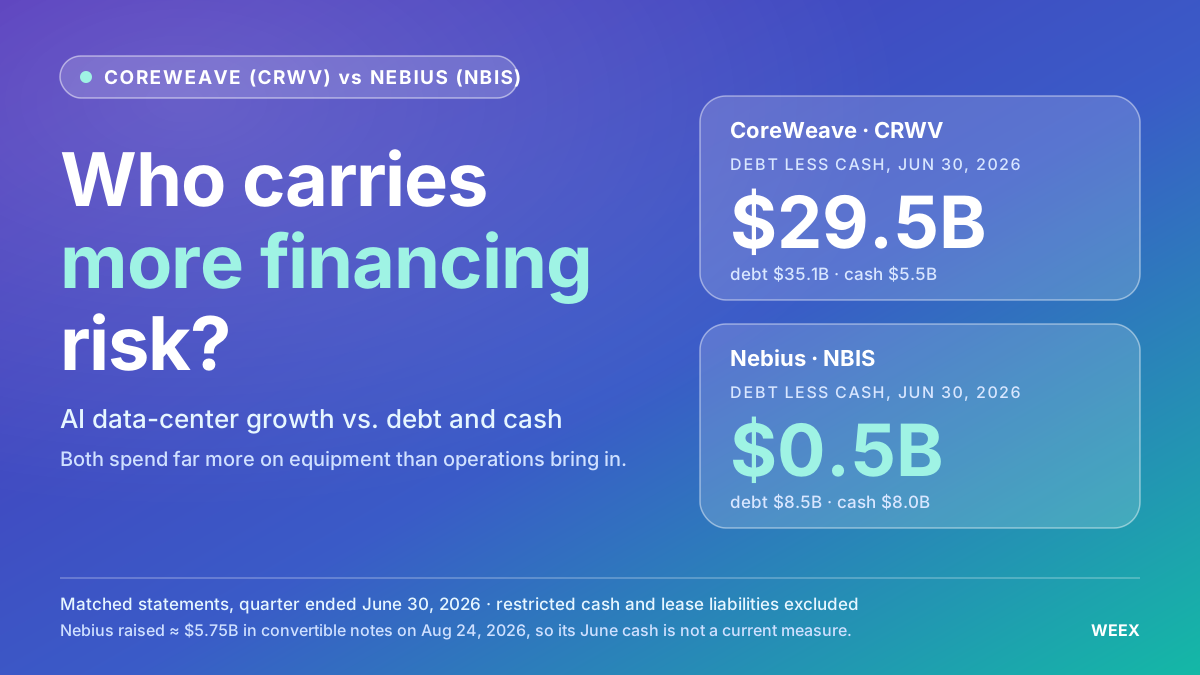
CoreWeave vs. Nebius Stock: Which AI Cloud Business Faces Greater Financing Risk?
Compare CoreWeave and Nebius stock through debt, cash flow, customer prepayments and dilution to assess which AI cloud business faces greater financing risk.

Solana Becomes the Most Profitable Blockchain Network, SOL Price Drops 15%
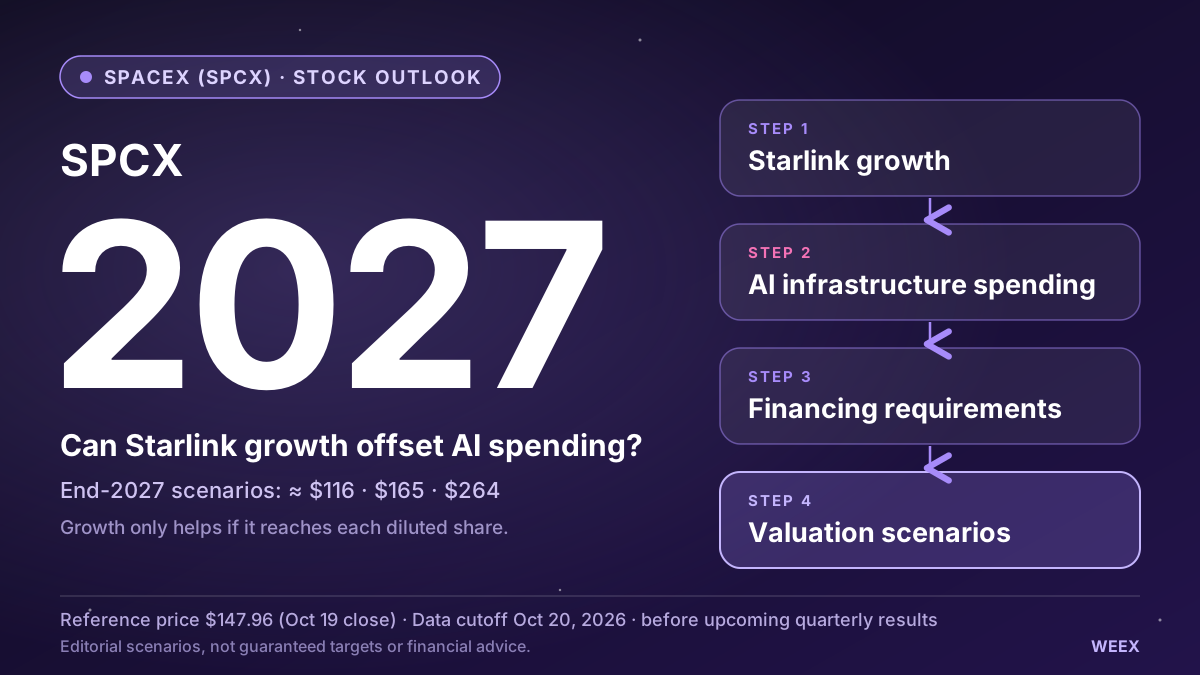
SpaceX Stock(SPCX) Price Prediction 2027: Can Starlink Growth Offset AI Spending?
SpaceX stock price prediction for 2027: assess Starlink growth, AI spending, valuation compression and dilution through transparent price scenarios.

Bitcoin (BTC) Mining Profitability: Will Higher Difficulty Trigger Miner Selling?

What Makes Spending on AI Agents Difficult?

Conditional Return of Companies to the Bitcoin Market; The Era of Reckless Capital Raising is Over!

WEEX Exclusive:Tech Rebounds; Bitcoin Holds $81,000–$82,000 Support| WEEX TradFi Daily (October 20, 2026)

Tech Rebounds; Bitcoin Holds $81,000–$82,000 Support| WEEX TradFi Daily (October 20, 2026)
On October 19, tech rebounded. The three major indexes were mixed, with the Nasdaq relatively stronger. Intel rose after a JPMorgan upgrade, and SpaceX closed up more than 2%. Bitcoin traded near $81,000–$82,000, a zone traders viewed as strong support and a local bottom. Worldcoin (WLD) rose more than 10% in 24 hours, leading majors. October 20 focus includes earnings from SPCX and other listed names.

Banking Coalition Gathers: Stablecoin Market Faces Structural Shock

S&P Warns of Potential Increase in AI Debt for Tech Companies

Brooklyn's 'Crypto Hunters': A Cross-National Scam Chase Across Three Time Zones

Citigroup Research Positions Aave as a Decentralized Collateral Liquidity Protocol

Sam Price Points Out Ethereum ETF Sees Outflows for Three Consecutive Weeks

The Architecture Of Money: Mapping Financial Power In The Age Of Bitcoin

BBVA and Santander of Spain lend 150 million euros through decentralized network
Number of Tokenized Stock Wallets on Solana Reaches 1.4 Million

Jito Labs Co-founder Claims Increase in Front-running and Sandwich Attacks on Solana

XRP holders can now earn fees from Kraken’s DeFi customers, but there is a catch

Variant Investment Partner: In the Second Half of the Bull Market, Which Two Camps Are Marginal Dollars Flowing To?
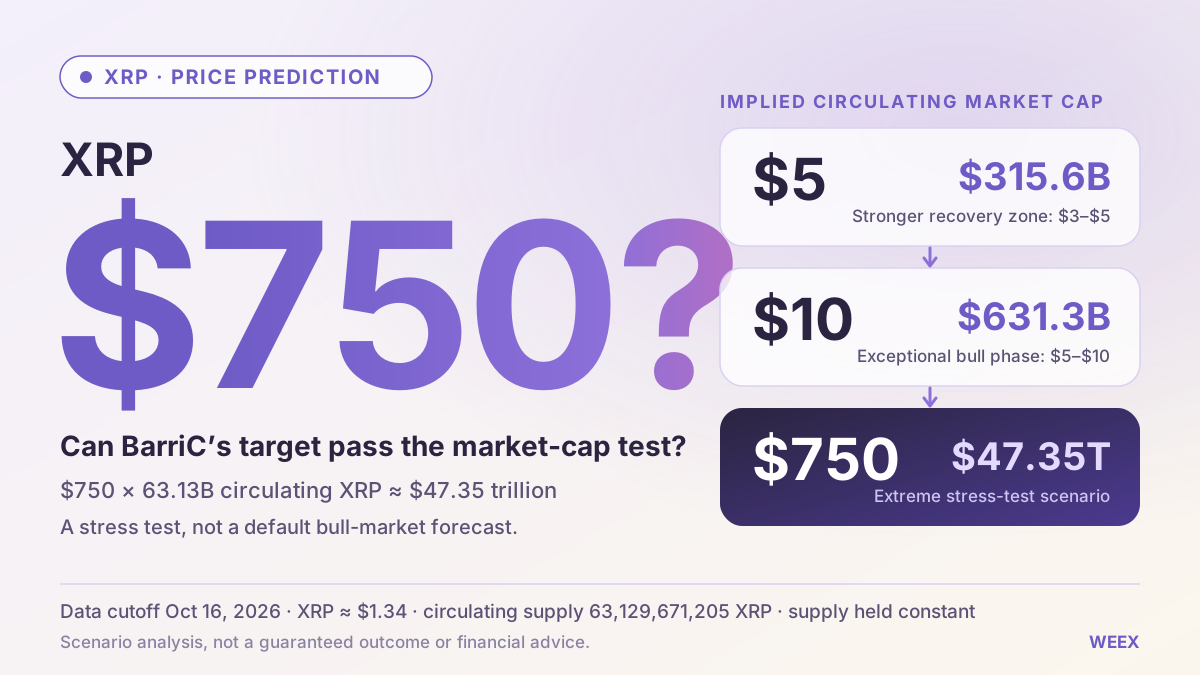
XRP (XRP) Price Prediction: Can BarriC’s $750 Target Pass the Market-Cap Test?
XRP price prediction: examine BarriC’s $750 target, market-cap math, next-bull-run scenarios, token demand and what could support a recovery to $5.

CITIC Securities: Market Overestimation of CoreWeave Concerns, New Cloud Providers' Short-Term Funding Gap 'Still Manageable'

Financing Weekly Report | Fission Completes $10 Million Series A Financing Led by Pantera Capital; DeepSeek Plans to Raise Approximately 100 Billion Yuan in New Financing

The Six-Year Tug of War Between Privacy and Regulation
Goldman Sachs Throws Out 'Chilling Chart': Either the Bond Market is 'Overly Pessimistic' or the Stock Market is 'Too Optimistic'

Ethereum Staking Outflows May Exceed New Inflows
Bitcoin or Dollar Returns: Same Strategy, Opposite Results

BitTorrent Ushers in Next-Gen Web3 Infrastructure with Strategic Rebrand and Inaugural BTT Burn

Cysic Cross-Chain Bridge Attacked, Hacker Minted 10 Million CYS

Bank of America’s Hartnett: Sell Signal Ends, Tech Stocks Return to Focus on Semiconductor Prices

Kraken's New Leader, After Acquiring European Bank, Aims to Disrupt the Crypto Market?
CoreWeave vs. Nebius Stock: Which AI Cloud Business Faces Greater Financing Risk?
Compare CoreWeave and Nebius stock through debt, cash flow, customer prepayments and dilution to assess which AI cloud business faces greater financing risk.
Solana Becomes the Most Profitable Blockchain Network, SOL Price Drops 15%
SpaceX Stock(SPCX) Price Prediction 2027: Can Starlink Growth Offset AI Spending?
SpaceX stock price prediction for 2027: assess Starlink growth, AI spending, valuation compression and dilution through transparent price scenarios.
Bitcoin (BTC) Mining Profitability: Will Higher Difficulty Trigger Miner Selling?
What Makes Spending on AI Agents Difficult?
Conditional Return of Companies to the Bitcoin Market; The Era of Reckless Capital Raising is Over!


